If you’re reading the headlines, you’d think 2026 is shaping up to be a softer year for travel demand.
The data says something much more interesting.
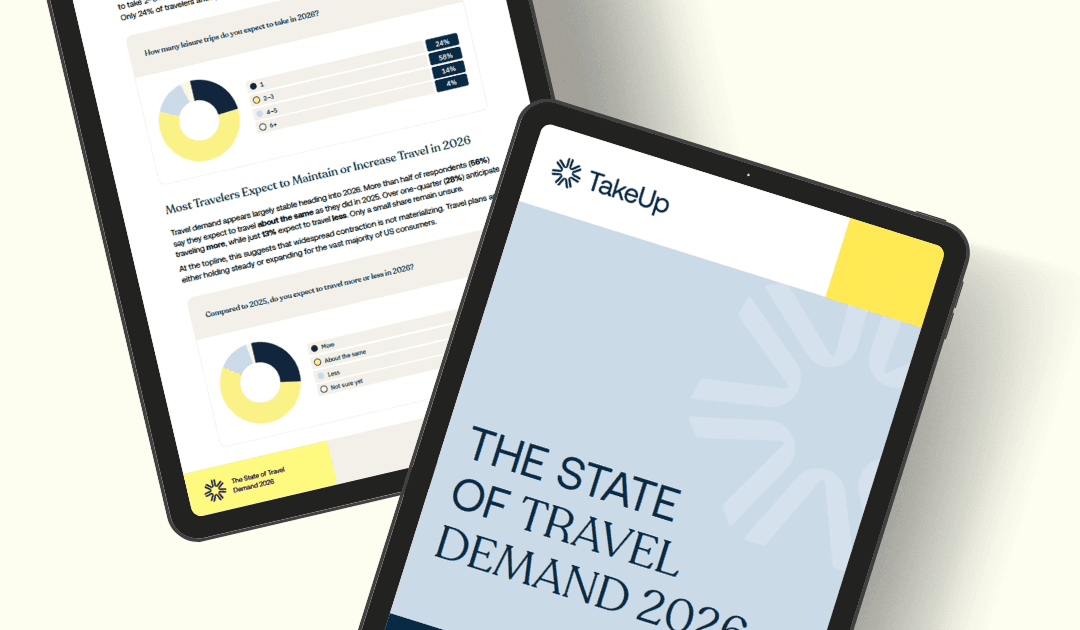
According to TakeUp’s latest research, The State of Travel Demand 2026, a majority of travelers plan to maintain or increase their trip volume this year. Travel is still a priority, even with economic pressure in the background.
What’s actually happening is not a drop in demand. It’s a shift in how that demand behaves.
And that shift is where operators either win or fall behind.
Demand Is Holding. But It’s Splitting.
At the broadest level, leisure travel demand remains steady, with 56% of travelers expecting to take about the same number of trips in 2026 and another 28% planning to travel more.
But underneath, the market is fragmenting in a very real way:
-
Budget-conscious travelers are showing clear signs of financial pressure
-
Mid-market travelers remain steady, but are more deliberate in how they spend
-
Luxury travelers are accelerating, with nearly 80% planning to increase spending
That is not one demand curve. That is three different ones moving at different speeds.
If you are pricing like it is a single market, you are already misaligned.
Price Sensitivity Is Up. But It Has Clear Boundaries.
More than 40% of travelers report increased sensitivity to accommodation pricing compared to last year.
But here is the nuance. They are not opting out of travel. They are scrutinizing it.
And the data gives us a very clear threshold:
-
When prices exceed expectations by roughly 10 to 20%, travelers begin to reconsider
-
Beyond that range, resistance increases sharply and conversion drops
This is where most operators get it wrong. They assume pricing is about direction. Up or down. In reality, it is about precision. Small misses now have outsized consequences.
Demand Is Not Disappearing. It Is Moving.
When travelers encounter higher prices, they are not canceling trips.
Fewer than 10% of travelers say they would delay or cancel travel entirely due to pricing.
Instead, they adjust:
-
Switching to a different accommodation type
-
Shortening the length of stay
-
Choosing a different destination or travel date
Demand is still active. It is just more fluid. Which means the risk is not losing demand. It is losing where that demand lands.
Length of Stay Is the First Lever to Break
The most common cost-control behavior is not canceling. It is compressing the trip.
-
56% of travelers planning to spend less say they will shorten their stays
That has real implications. You may still see bookings. But fewer nights per reservation quietly erodes revenue.
If you are only watching occupancy, you are missing the actual performance signal.
Behavior Is Shifting, Not Expectations
Travelers are also changing how they move:
-
A growing share expect to drive more often in 2026 instead of fly (28%)
-
More are choosing closer-to-home destinations or lower-cost destinations (37%)
-
Value perception is playing a bigger role in decision-making
But here’s the important counterpoint: aspirational demand is still very much intact. Coastal and beach destinations continue to lead planned growth, with 36% of travelers saying they expect to visit them more in 2026, while 26% say they plan to travel to major cities more. Travelers are not lowering their expectations. They are being more intentional about how they meet them.
The 2026 Traveler Is Intentional
This is the defining trait. Travelers are making active decisions about:
-
When to spend more
-
Where to pull back
-
How to structure each trip
Nothing is passive anymore. And that creates a clear divide in the market.
Operators who rely on static pricing or broad assumptions will struggle to keep up.
Operators who understand segmentation, respect pricing thresholds, and adjust dynamically will capture demand.
Let’s Be Clear About What 2026 Actually Is
This is not a demand problem. The data shows demand is holding. Spending is active. Travel is still a priority. It is a precision problem. And precision doesn’t come from automation alone.
A lot of revenue management systems will tell you they are “dynamic.” What they really mean is they automate rules. They move prices up and down based on pace, comps, or seasonality.
That is not enough anymore. Because the market is no longer reacting in predictable ways.
When 42% of travelers are more price sensitive, when behavior shifts at a 10–20% pricing threshold, when fewer than 10% cancel but most adjust, your pricing system cannot just react to demand. It has to understand it.
Specifically, it has to understand how your guests respond to price.
-
At what point does demand slow down?
-
Where is willingness to pay stronger than you expected?
-
Which segments will convert at higher rates, and which will walk?
If your RMS is not learning that in real time, you are not optimizing. You are guessing faster.
This is the line that is being drawn in 2026.
Want the Full Picture?
The data behind these shifts goes much deeper, including segmentation trends, pricing thresholds, and how traveler behavior is evolving across markets.
Download the full State of Travel Demand 2026 report to see exactly what is changing and how to act on it.