
Quiet compassion doesn’t announce itself. It just shows up in the smallest moments, between the people we love most, and breaks through every darkness words never could. These stories will remind your heart what kindness, healing, and light were always meant to look like.
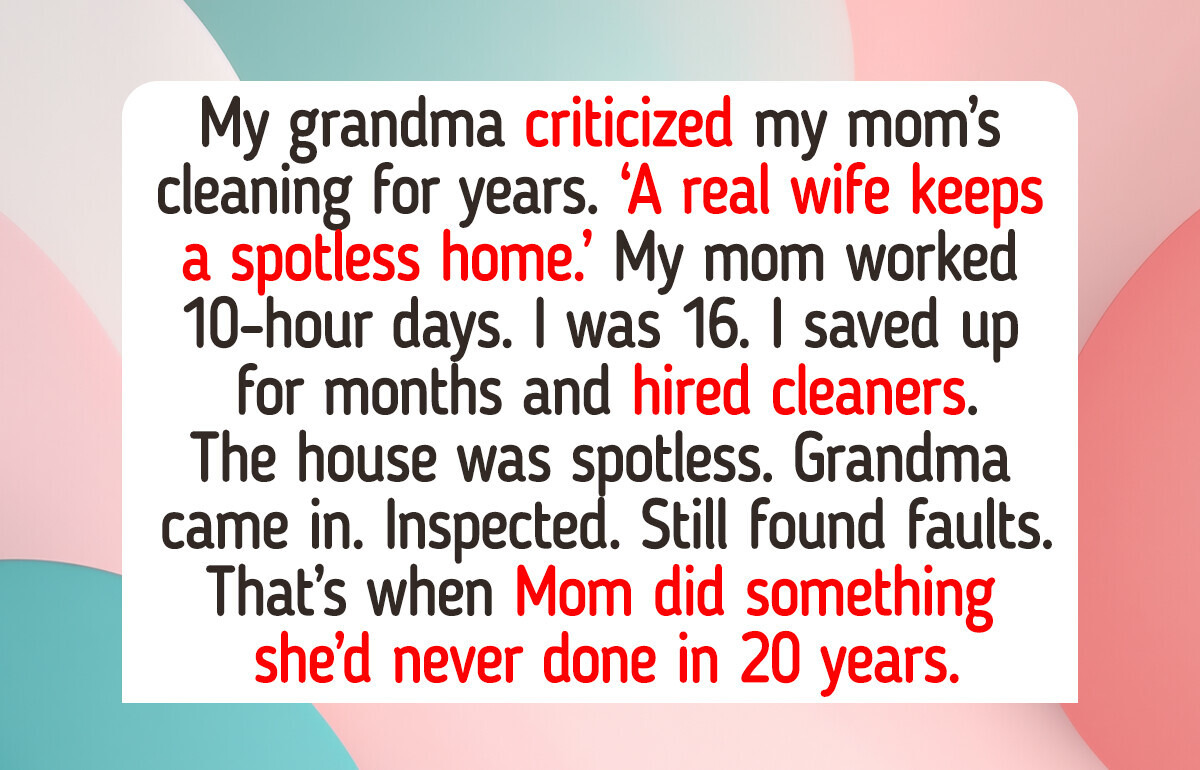
My grandma criticized my mom’s cleaning for years. “A real wife keeps a spotless home.” My mom worked 10-hour days.
I was 16. I saved up for months and hired cleaners. The house was spotless. Grandma walked in, inspected, and still found faults. I went still when my mom finally spoke up.
“My daughter just showed me something you never could.” Grandma froze. “For years I’ve worked 10-hour days. Cooked. Cleaned. Raised two kids. And every time you visited, you found something wrong.”
Mom’s voice was steady. “Today, professional cleaners did this. And you still found faults. So it was never about the house.” She looked at me.
“My 16-year-old saved up for months to hire cleaners. Not because I asked. Not because she had to. But because she saw me struggling and wanted to help.” Her eyes were wet. “That’s what family is supposed to do. Notice. Care. Show up.”
She turned back to Grandma. “When did you ever do that for me?” Grandma went silent. For the first time, she had no response.
That night, after Grandma left, Mom sat beside me. “You didn’t have to do that.” “I know. I wanted to.” She hugged me.
“I spent years thinking I wasn’t enough. Believing her. Today you showed me that the people who love me see me differently.” She wiped her face. “You showed me more kindness in one afternoon than she did in 30 years.”
A week later, Grandma called. She didn’t apologize for everything. But she said something she’d never said before, “You’re a good mother. I should’ve told you sooner.” It wasn’t perfect. But it was a start.
And it started because a 16-year-old noticed what no one else did, and did something about it. Some lessons aren’t taught. They’re shown. By the ones who love us enough to pay attention.


My son came home from school every day and went straight to his room. No snack, no TV, nothing. I assumed he was tired.
Three weeks later, his teacher called. He’d been giving his lunch away every day to a boy in his class whose family had stopped packing one. He came home hungry every single day and never said a word.
I asked him why he didn’t tell me. He shrugged. “Because then you’d worry and you already worry about everything.” He was eight.
I packed two lunches the next morning. He smiled like it was the most obvious solution in the world. It was.
My husband left when our kids were three and five. I held everything together on the outside and fell apart every night after bedtime. Our neighbor Mr. Hassan was a quiet man. Widower, kept to himself.
One morning I found groceries on my porch. Then again the following week. And the week after. I never saw him do it.
One day I caught him and asked why. He looked at the ground and said, “My wife was alone with small children once too. Nobody helped her. I’ve thought about that my whole life.”
He brought groceries every week for two years until I got back on my feet.
My wife passed away after a long illness. The grief was the kind that made ordinary things unbearable: the second coffee cup, the quiet side of the bed, her chair at the dinner table. My kids were grown and scattered. I didn’t tell anyone how bad it was.
One Sunday, all three of them showed up unannounced. No occasion, no explanation. They just came, filled the house with noise, cooked her recipe badly, laughed too loud.
Before they left, my eldest said, “We’re coming every Sunday. Don’t argue.” They have. Every single one. Nobody sits in her chair. But somehow the room feels less empty now.

My mom forgot my birthday for the first time the year she was diagnosed. I told myself it was fine. It wasn’t. I spent the day alone, quietly devastated in a way I couldn’t explain even to myself.
That evening my younger brother showed up at my door with a cake. Candles and everything. I told him he didn’t have to do that. He said, “Mom called me this morning crying because she forgot. She couldn’t get out of bed but she made sure I didn’t forget.”
She couldn’t give me what she always had. So she made sure someone else did.
I was new at my job and drowning. I made a mistake that cost the team a client. My manager called a meeting. I sat there waiting to be made an example of. Instead, my colleague David spoke first. “That was partly my fault. I should have walked her through the process more carefully.” It wasn’t true. Everyone in that room knew it wasn’t true. The meeting ended quietly. Afterward, I found David at his desk and asked him why. He didn’t look up from his screen. “Because three years ago someone did it for me and I’ve been waiting for a chance to pass it on.” I’ve done it twice since then. I don’t plan on stopping.

My son was born with a condition that made walking painful. He never complained, but I watched him watch other kids run, and I felt it in my chest every single day.
When he was ten, his school announced a sports day. He said he didn’t want to go. I didn’t push. His older brother went. An hour later, he called me. “Mom, you need to come.”
When I arrived, every single child in my son’s class was doing the relay race in a seated position. On the ground, in chairs, however they could. His teacher had quietly suggested it that morning without telling anyone why.
My son was in the middle of the track, laughing harder than I’d ever seen. He won his heat. His brother was filming and crying at the same time. So was I.
My husband was diagnosed with early-onset Parkinson’s at forty-four. We told no one for months — too proud, too scared, too unsure of what to say.
When we finally told our neighbors at a block dinner, the table went quiet. I hated that quiet. Then one by one, without discussion, without anyone organizing it, things started appearing.
A meal on Monday. A ride offer on Wednesday. The guy across the street who started mowing our lawn without asking. The woman next door who learned everything she could about Parkinson’s and left printouts in our mailbox with little notes attached.
Nobody made a big deal. Nobody expected thanks. They just quietly rearranged their lives to make space for ours.
We’d lived on that street for six years and never knew our neighbors like that. It took the worst news of our lives to show us we’d been surrounded by good people the whole time.

My little brother has autism. Growing up meant a lot of hard days, meltdowns in public, stares from strangers, and constantly changing plans. I won’t pretend I was always patient. I was a teenager, and sometimes I was embarrassed, and I’ve carried that guilt for years.
When he turned twenty-one, he gave me a card. Inside, he’d written a list of his ten favorite memories. I was in every single one. The movie nights. The drives. The time I sat with him for two hours during a thunderstorm, saying nothing, was peaceful.
He remembered everything. Every moment I showed up and every moment I almost didn’t but did anyway. I called my mom after and told her I didn’t deserve it. She said, “That’s exactly why he gave it to you.”
My brother stopped coming home three years ago. He left his keys on the counter, his wallet in the drawer, and his phone charging by the bed. Police said voluntary. I never bought it.
Last week, an envelope showed up at my door. No return address. Postmarked from a small town in rural Kentucky I’d never heard of. Inside was a photo of a lake and a single line in his handwriting. “I’m okay. Come alone.”
I drove six hours without telling anyone. It took me twenty minutes to find him. Small town. One diner. He was sitting at the counter drinking coffee like it was any ordinary morning. He looked up and didn’t seem surprised.
I sat down next to him and ordered coffee too. The waitress filled both cups without a word, like she’d seen this before. We sat in silence for a while. Then he said, “I had to disappear before I did something permanent. I didn’t know how to say that to anyone.”
I didn’t ask anything else. He’s been getting help for eight months. Has a job, a small place, and a routine that keeps him steady. He wasn’t ready for us to know until now.
He came home for the first time last Sunday. My mom opened the door and didn’t say a single word. Just pulled him in. We didn’t either. Some things don’t need one.

I drive a taxi at night. Last Tuesday, around 1 AM, I got a ping outside Northwestern. A woman came out wearing a patient bracelet and no coat in February. She got in and said, “Please don’t look at me in the mirror.” I flipped it up and drove.
Ten minutes of silence. Then: “I just walked out. I needed one hour outside of that building.” I didn’t respond. Kept driving.
When we pulled up, she checked her pockets. Nothing. She looked at me. I ended the trip before she could apologize. She got out without a word. I figured that was it.
Three days later, I got a message through the app. “I went back that same night. Finished the treatment. Got discharged this morning. You were the only person who didn’t look at me like I needed fixing. I don’t know why that helped, but it did.”
Kindness still exists. You just have to know where to look. Read this next.
Comments
Lucky you! This thread is empty,
which means you’ve got dibs on the first comment.
Go for it!