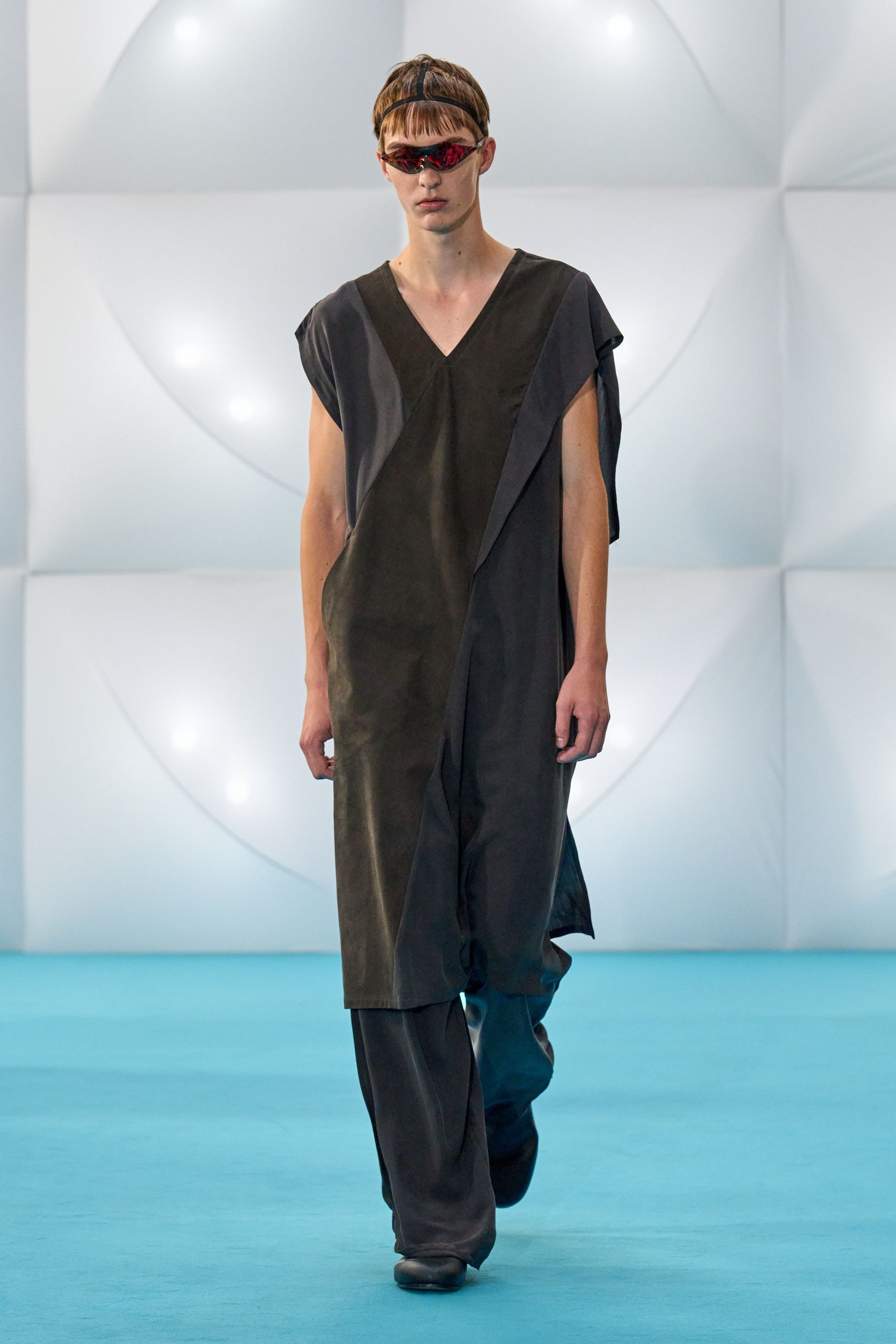
“How can we keep pushing?” This was the question Kiko Kostadinov said he set himself and his team following last season’s rejection of storytelling superfluity—no characters, no narrative—and his effort to reduce garments into geometric form. The answer came through Agostino Bonalumi, an Italian artist whose canvases were shaped by structures hidden beneath their surfaces. Kostadinov described the practice as “almost like reverse Fontana”: not the cutting-open of a plane, but the exertion of pressure from within it. “He constructed the canvas more like sculpture,” Kostadinov said. “So I was like, oh, we can maybe try and use some sort of structure like boning.”
That became the basis of a collection in which visual emphasis was generated by construction rather than surface decoration. There was no print, almost no topstitching, no visible zippers and few exposed fastenings. “Everything is concealed,” Kostadinov said, “so the only thing you focus on is the lines and the proportion of the body.”
Bonalumi’s convention-testing act of pushing form outward satisfyingly mirrored Kostadinov’s own purist pursuit of new templates for clothing. He is working towards that objective by stripping away the conventional and rebuilding from scratch, using pattern-making as his fundamental instrument.
The binary of human symmetry typically reflected in conventional shirting was strikingly altered by inserting a round-necked panel of fabric between placket and buttonholes. Wrap tunics fastened at the right collarbone fell serenely around the body. Jersey tops contained layers that either cut away down across the body or were knotted to lie clear of it. Long shirts, tabards, and T-shirt gowns were similarly treated as minimal planes whose folding, cutting, and fastening generated their shape.
It seems a betrayal of Kostadinov’s no-narrative stance to use similes, but post-show it was the designer who used “medical green” to describe the institutional pistachio of a long shirt with ribbed and perforated short sleeves. The shade carried through into the carpet of the showspace as well as the painted feet of three models: they were merged through color with the surface of the space in order to push through from it.
Pants were cut with radiating hems that opened around the foot, extending the garment downwards with the same impulse that sent Bonalumi’s canvases outward. Others carried asymmetric fastenings, rhombus-shaped sections, or sash-like panels that crossed around the back of the leg. These were sometimes vaguely classical, sometimes vaguely surgical, and often oddly sexy: clothes whose refusal of an easy reference made you look harder at the way they were built.
That rhombus form repeated across the collection: in the neck guards of wool coats and blousons, the lapels of jackets, and the indentations of low-profile slip-on shoes. It was further echoed in hardware, brooches, and belt buckles, and emphasized in the lens shape of some Oakley eyewear. The returned Crocs collaboration freshly serviced Kostadinov’s ongoing appetite for functionally efficient, anti-elegant footwear.
The rigor and dryness of both show and collection amounted to an act of boldness: Kostadinov is attempting to create a new register of clothing without resorting to familiar codes. “To achieve something in fashion, you need to propose a silhouette,” Kostadinov said. “Otherwise you’re just making nice clothes.”