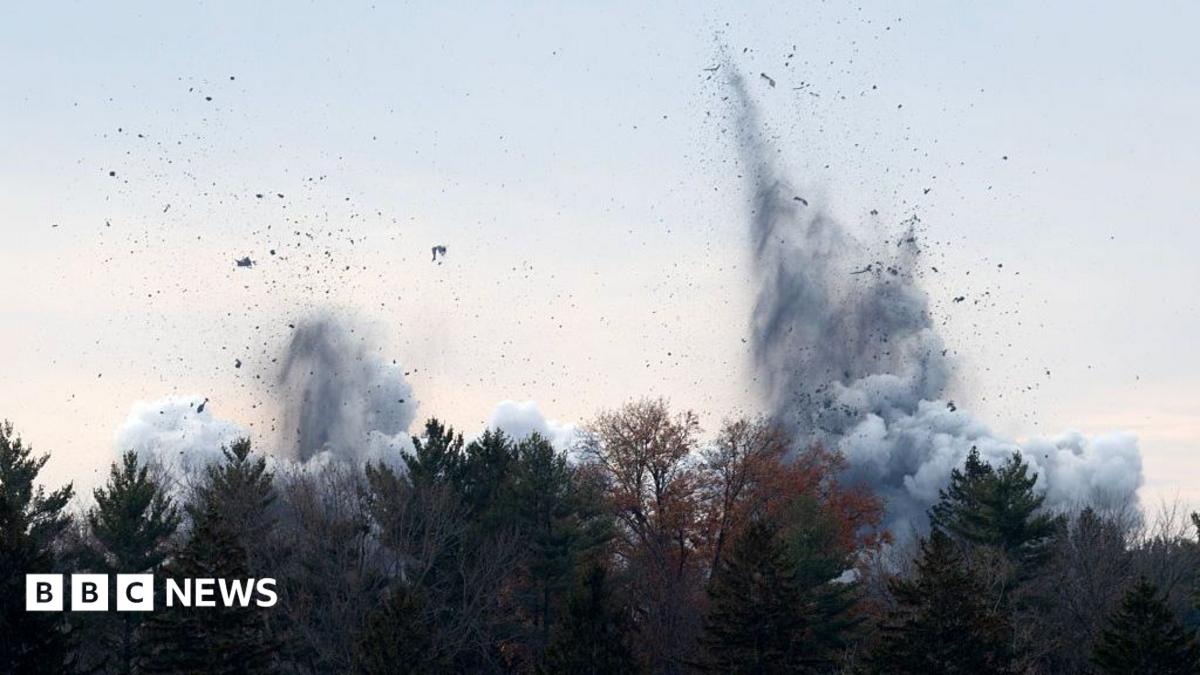
The U.S. Army has called a controlled explosion of lead azide explosives in Iowa a ‘huge success’. The blast occurred at 09:00 local time on Wednesday near Middletown. No airborne lead was detected in the area after the detonation. Source: bbc.co.uk.
What Happened
Over time, they degraded through recrystallisation, making them more sensitive to friction or movement. This increased the risk of accidental detonation.
The Army conducted a controlled detonation to eliminate that risk. Smoke rose shortly after the blast. Officials said the chance of an uncontrolled spread was ‘as close to zero as is absolutely humanly possible’.
The Federal Emergency Management Agency (Fema) issued an ‘all clear’ around the site. The EPA confirmed all air monitors reported a ‘ZERO DETECT’ of airborne lead. This suggests no immediate health or environmental threat.
Key Facts
- Lead azide is a volatile compound that can detonate on its own under certain conditions.
- The explosives degraded over 20 years through recrystallisation, increasing sensitivity.
- Post-detonation soil and surface sampling is ongoing. Results will be released once complete.
- The Army paused the blast several times due to public concern and legal challenges.
- An appeals court ruled the risk of an unplanned explosion outweighed health risks from a controlled detonation.
Public Response
Middletown Mayor Rodney Johnson watched the blast from a manufacturing plant eight miles away. He monitored a live feed from his home, just one mile from the site. ‘We did not feel anything. We did not see anything,’ he said.
Sandy Mabeus, eight miles from the site, closed her windows and brought her cat inside. She watched live streams on her devices and confirmed the explosion. ‘We did not feel or hear a thing,’ she said. ‘The waiting has been stressful. Hopefully, it was a good result.’
Farmer David Vandenberg, 20 miles away, said he first heard about the blast two weeks prior. 'I didn’t see or smell anything,' he said. 'I think the effects will be minimal.'
Illinois Governor JB Pritzker said his state saw ‘little to no impact’. He asked agencies to stay on standby for any unanticipated effects. The Iowa site is just 10 miles from the Illinois border.
Concerns and Limitations
Some officials remain cautious. Rob Sand, Iowa’s incoming governor-elect, said more testing is needed. He called for immediate transparency about the lead-up to the blast. He said any impacted residents must be supported right away.
Fema Administrator Cameron Hamilton said additional environmental testing will continue. This includes soil and water samples in residential and farmland areas. Results are expected in weeks.
Residents were warned of possible lead dust exposure. The Army issued an optional evacuation zone and a shelter-in-place advisory. These were not widely used. The warnings were meant to prepare vulnerable groups, like children and pregnant women.
Lead exposure is not safe at any level. Long-term effects include developmental issues in children and neurological damage in adults. While air quality appears safe now, long-term impacts are still being studied.
Why It Matters
The detonation was rescheduled due to colder winter temperatures. Cold can increase sensitivity of stored volatile materials. This shows the balance between safety and operational needs.
Storing volatile materials for decades without regular safety checks poses risks. This incident highlights the need for better oversight and public communication.
Officials say the operation met all safety standards. But trust remains low after delays and legal challenges. Residents are still waiting for full results. No comprehensive public report on long-term effects has been released yet.
The situation is under active monitoring. No further actions have been taken. Still, it serves as a key example of how rural communities and government agencies manage hazardous material risks.
Sources & further reading
Featured image: Debris is seen overtop trees. Via original publisher. Image source