Moon cycles are a visible monthly rhythm many people use for planning, reflection and self-care. The moon phases are astronomically real—they happen because the Moon orbits Earth and we see changing portions of its sunlit half.
At the same time, claims about the Moon controlling health or behaviour are often exaggerated. A realistic approach is to use moon phases as a wellness framework (sleep, routine, planning), while knowing the strongest proven lunar effect on Earth is gravity-driven tides—not guaranteed mood shifts.
The Lunar Cycle, Simply Explained (Science)
- The lunar phase cycle repeats about every 29.5 days (new moon to new moon).
- The 8 phases are: New Moon → Waxing Crescent → First Quarter → Waxing Gibbous → Full Moon → Waning Gibbous → Third Quarter → Waning Crescent.
Do Moon Phases Affect Health, Emotions, and Mentality?
What is plausible
- Sleep can be sensitive to light and routine. Full Moon nights are brighter, and some people sleep more lightly if their room is not fully dark. NHS guidance consistently recommends sleep routines, wind-down time, and reducing stimulation in the evening.
What research suggests (carefully)
- Some controlled studies report modest changes in sleep around lunar phases (for example, slightly less deep sleep or shorter total sleep near full moon), but results are not universal and individual sensitivity varies.
Practical takeaway: if you notice mood swings, anxiety, or irritability during certain phases, the most actionable lever is usually sleep quality + stress load, not the Moon itself.
The Best “Diet Rule” for Every Moon Phase (Foundation)
Before phase-by-phase tips, keep the basics consistent. The UK Eatwell guidance emphasises:
- 5+ portions of fruit and vegetables daily
- Base meals on higher-fibre starchy foods
- Include protein sources (beans/pulses/fish/eggs/meat alternatives)
- Choose unsaturated oils in small amounts
- Drink plenty of fluids (about 6–8 glasses/day)
Moon-phase “diet hacks” should sit on top of this foundation, not replace it.
What to Do and Avoid in Each Moon Phase (Health, Emotions, Mindset + Diet)
1) New Moon — Reset and Intention
Theme: quiet beginning, planning, mental clarity.
Do: plan, journal, set 3–10 intentions, prioritise sleep routine.
Avoid: impulsive commitments; late-night scrolling.
Diet focus: lighter, cleaner meals for a “reset” feel—vegetable soups, fibre-rich meals, steady protein; hydrate well (6–8 glasses).
2) Waxing Crescent — Small Steps
Theme: momentum, habit-building.
Do: start the habit in its smallest form; schedule 1–2 actions.
Avoid: perfectionism; starting 10 new routines at once.
Diet focus: stabilise energy—breakfast with protein + fibre; limit high-sugar spikes.
3) First Quarter — Decisions and Discipline
Theme: friction, problem-solving, boundaries.
Do: decide, adjust, say no to distractions.
Avoid: arguments from stress; over-caffeinating to “push through.”
Diet focus: balanced plates (Eatwell style) to support focus; include slow-release carbs + protein.
4) Waxing Gibbous — Refinement and Preparation
Theme: improve quality, practise, edit.
Do: review progress; refine your plan; prepare for delivery.
Avoid: last-minute chaos; adding new goals.
Diet focus: performance nutrition—regular meals, hydration, and earlier dinners to protect sleep.
5) Full Moon — Peak Awareness and Release
Theme: heightened awareness, emotions feel louder for some people.
Do: reflect, celebrate wins, release one draining habit; keep evenings calm.
Avoid: big emotional decisions at night; alcohol-heavy evenings if sleep is sensitive.
Diet focus: sleep-protective choices—lighter evening meal, reduce caffeine later in the day, avoid very spicy/heavy foods if they disturb sleep. NHS notes diet and routine can support better sleep.
6) Waning Gibbous — Integration and Gratitude
Theme: process lessons, share, teach, tidy systems.
Do: document what worked; simplify commitments.
Avoid: forcing intensity when your body wants steadier pacing.
Diet focus: digestion and recovery—more vegetables, fermented foods if tolerated, adequate protein.
7) Third Quarter — Recalibration and Decluttering
Theme: course-correction, endings, clearing.
Do: declutter space, budget, habits; close open loops.
Avoid: starting major new launches without need.
Diet focus: practical structure—meal planning, batch cooking, reducing ultra-processed snacking.
8) Waning Crescent — Rest and Closure
Theme: restoration, sleep, emotional reset.
Do: rest more; gentle movement; prepare next cycle.
Avoid: late nights and overload.
Diet focus: calming routines—regular meal times, warm foods, reduce stimulants; protect hydration.
“Other Important Things” to Add (High Impact)
1) Sleep hygiene is the multiplier
If you do only one thing across all phases: protect sleep. The NHS recommends consistent sleep/wake times, winding down, and a supportive sleep environment.
2) Training and movement (simple rule)
- Waxing phases: build (strength, longer walks, progressive goals).
- Waning phases: restore (mobility, yoga, light cardio, deload).
3) Emotional regulation toolkit (use any phase)
- 5 slow breaths before difficult conversations
- Journaling: “What is true? What is assumption?”
- Reduce evening light exposure, especially around Full Moon nights
4) Supplements and “detox” caution
Be careful with aggressive detox plans, fat burners, or restrictive diets tied to moon phases. If you have medical conditions, take medication, or are managing mental health symptoms, speak with a professional before changing diet or supplements.
FAQ (Ideal for WordPress FAQ blocks / Yoast)
Are moon phases scientifically real?
Yes—phases come from the Moon’s orbit and how we see its sunlit half.
Does the Moon reliably control mood or mental health?
Evidence is mixed. Some studies show modest sleep variation around phases, but effects are not consistent for everyone.
What is the most realistic way to “use” moon phases?
As a monthly planning rhythm: reset (New Moon), act (waxing), review (Full Moon), declutter/rest (waning).
Safety note
This article is for wellness and lifestyle guidance, not medical advice. If you have persistent sleep issues, anxiety, depression, significant mood changes, or health symptoms, consult your GP or a qualified medical professional.
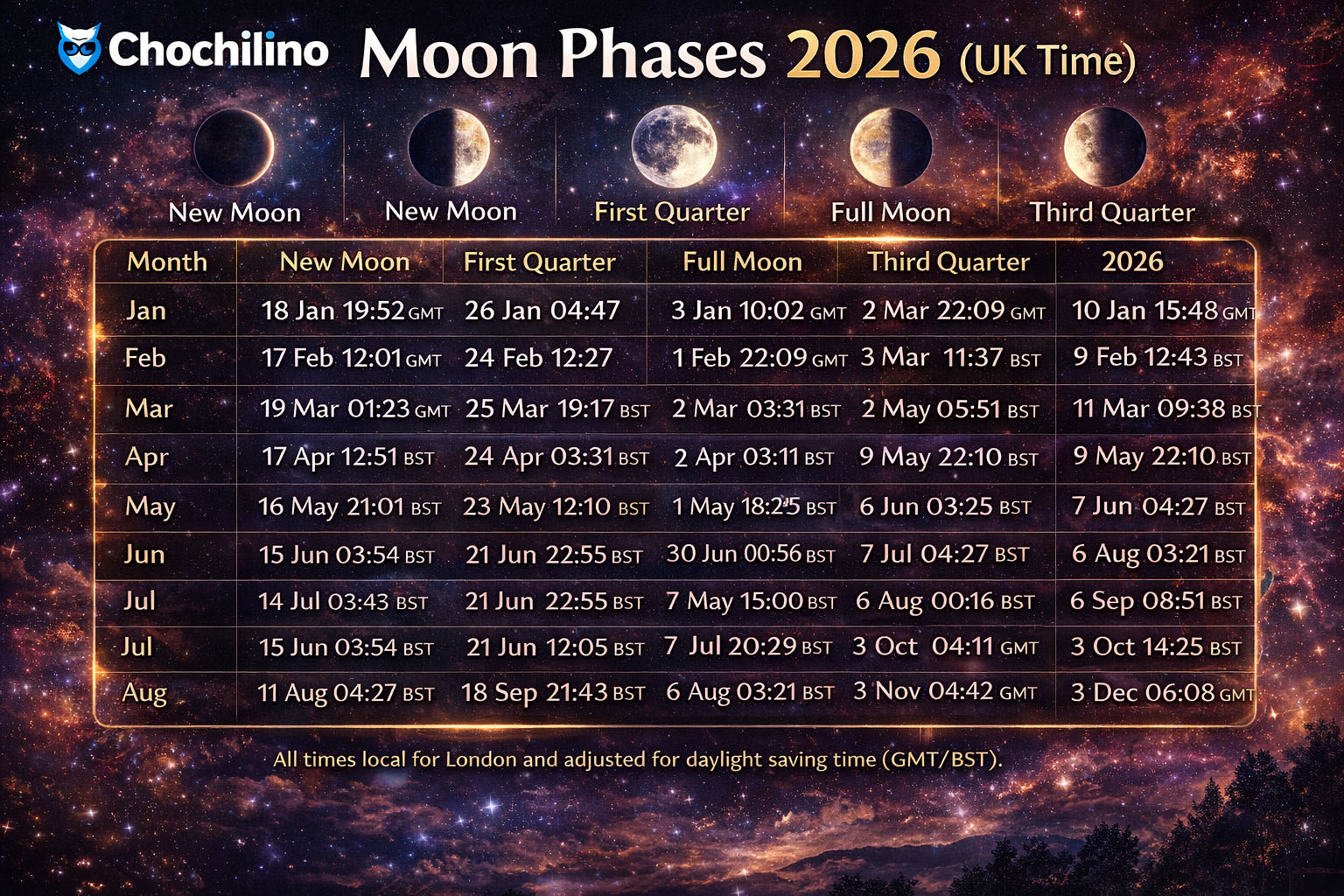
full 2026 Moon Phases calendar for the UK (London local time, GMT/BST adjusted), plus downloadable files.
Downloads
- Moon Phases 2026 (UK/London) — Printable PDF
- Moon Phases 2026 (UK/London) — CSV
- Moon Phases 2026 (UK/London) — iCalendar (.ics) for Google/Apple Calendar
Moon phases 2026 — UK time (London)
| Month | New Moon | First Quarter | Full Moon | Third Quarter |
|---|---|---|---|---|
| Jan | 18 Jan 19:52 GMT | 26 Jan 04:47 GMT | 3 Jan 10:02 GMT | 10 Jan 15:48 GMT |
| Feb | 17 Feb 12:01 GMT | 24 Feb 12:27 GMT | 1 Feb 22:09 GMT | 9 Feb 12:43 GMT |
| Mar | 19 Mar 01:23 GMT | 25 Mar 19:17 GMT | 3 Mar 11:37 GMT | 11 Mar 09:38 GMT |
| Apr | 17 Apr 12:51 BST | 24 Apr 03:31 BST | 2 Apr 03:11 BST | 10 Apr 05:51 BST |
| May | 16 May 21:01 BST | 23 May 12:10 BST | 1 May 18:23 BST; 31 May 09:45 BST (Blue Moon) | 9 May 22:10 BST |
| Jun | 15 Jun 03:54 BST | 21 Jun 22:55 BST | 30 Jun 00:56 BST | 8 Jun 11:00 BST |
| Jul | 14 Jul 10:43 BST | 21 Jul 12:05 BST | 29 Jul 15:35 BST | 7 Jul 20:29 BST |
| Aug | 12 Aug 18:36 BST | 20 Aug 03:46 BST | 28 Aug 05:18 BST | 6 Aug 03:21 BST |
| Sep | 11 Sep 04:27 BST | 18 Sep 21:43 BST | 26 Sep 17:49 BST | 4 Sep 08:51 BST |
| Oct | 10 Oct 16:50 BST | 18 Oct 17:12 BST | 26 Oct 04:11 GMT | 3 Oct 14:25 BST |
| Nov | 9 Nov 07:02 GMT | 17 Nov 11:47 GMT | 24 Nov 14:53 GMT | 1 Nov 20:28 GMT |
| Dec | 9 Dec 00:51 GMT | 17 Dec 05:42 GMT | 24 Dec 01:28 GMT | 1 Dec 06:08 GMT; 30 Dec 18:59 GMT |
All times are local time for London and adjusted for daylight saving time where applicable.