Artificial intelligence is rapidly reshaping how marketing work gets done, from analyzing audiences and segmenting consumers to generating images, copy and video. But a deeper question is beginning to surface inside creative industries: Can AI truly be creative, or is it fundamentally limited to recombining what already exists?
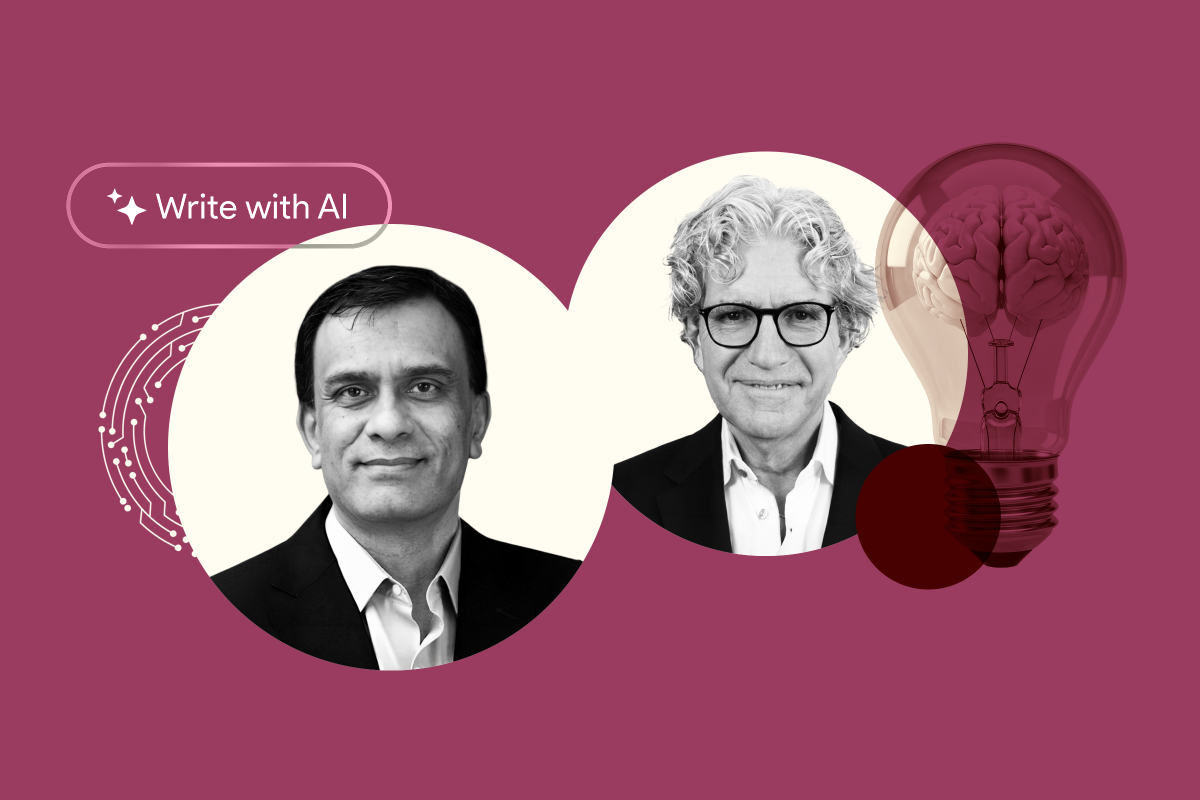
That question anchored a conversation on March 10 during Newsweek’s “AI Agenda” webinar, “AI and the Future of Marketing: Does Creativity’s Definition Change?,” in which Suraj Srinivasan, professor at Harvard Business School, spoke with David Sable, vice chairman of marketing company Stagwell. The two discussed how artificial intelligence is transforming marketing—and what it may never be able to replicate. The talk touched upon art history, technology and the future of creative work, but at its core was a deceptively simple problem: defining creativity itself.
“First of all, we have to define creative,” Srinivasan said. “What does creativity really mean?”
For Sable, the distinction between creativity and replication is central to understanding both the promise and the limits of artificial intelligence.
“I think that AI can make us creative, can help us be creative,” he said. “I don’t think that in and of itself, it is creative.”
Tools and media have evolved throughout history—from cave paintings and papyrus to film and the internet, but Sable argued that technological change has never replaced the human spark behind original ideas.
“The canvas has changed, the tools have changed, but they always do,” he said. “The thing that hasn’t changed is the human leap.”

To illustrate the point, Sable pointed to a well-known moment in art history involving Claude Monet. In one exhibition recreating a historical gallery display, Monet’s painting appeared beside a more traditional work that represented the height of academic painting in Paris at the time.
“The other painting was the absolute culmination of the best in Paris at the time,” Sable said. “And then here’s this Monet, which has nothing to do with anything that anyone had ever seen before.”
The contrast highlights what Sable described as a “synapse leap”—a creative breakthrough that departs from established patterns rather than refining them.
“There was a synapse leap that happened there with Monet that took him beyond what was,” Sable said. “Creativity is about changing the status quo.”
Sable extends that idea through what he calls the “da Vinci factor.”
“If AI had trained on everything up to the da Vinci era, it would have given another Giovanni, not a Last Supper,” Srinivasan said, summarizing the concept.
Sable recalled visiting the monastery in Milan where Leonardo da Vinci’s The Last Supper appears alongside a more conventional fresco painted by Giovanni Donato da Montorfano, one of the leading artists of the period.
“When you walk into the monastery, you look to the left and there’s Giovanni,” Sable said. “And there is this huge fresco, very typical for the time.”
But da Vinci’s work stands apart.
“You look to the right and you see the da Vinci, and you realize that it’s impossible,” he said. “Like how is it possible that somebody could have painted that? It had zero reference to anything anyone had done.”
For Sable, these examples underscore a broader point: AI systems trained on existing data are extraordinarily powerful at recognizing patterns and producing variations, but genuine creative breakthroughs often emerge by departing from those patterns entirely.
At the same time, neither Sable nor Srinivasan dismissed the transformative impact AI is already having on marketing and advertising.
In many areas of the business, AI is proving especially powerful at accelerating research and analysis—tasks that once required weeks or months of manual work.
“I think that creating insight—getting great insight—there’s nothing like it,” Sable said. “It allows you to go through reams of data that ordinarily would take you years to do.”
That capability can dramatically shorten the path from data to strategy, allowing marketers to identify patterns, motivations and emerging opportunities more quickly than before.
The technology is also reshaping how creative assets are produced and distributed. AI tools can generate multiple versions of advertisements, videos or images tailored to different audiences, reducing both cost and production time. But Sable is skeptical that AI can replicate the emotional resonance of human creative work.
“You can get some of it from AI,” he said. “But you’ve all seen it. The AI is pretty soulless.”
Instead, he sees AI less as a replacement for creative work and more as the latest tool in a long lineage of technologies that have changed how ideas are produced.
“So think about the tools and the canvas,” he said. “Where is your canvas with AI? It’s basically your screen.”
The method of interacting with creative tools may be evolving as well.
“Once we painted, once we chiseled rock,” Sable said. “Now we prompt.”
Learning how to guide AI systems through thoughtful prompts—combining imagination, context and insight—may become one of the defining skills for marketers and creators in the years ahead.
“Anybody can prompt,” he said. “But you need to understand how to prompt to get anything good out of it.”
For leaders navigating the shift, Srinivasan said the challenge is not simply adopting AI tools but understanding how they reshape the nature of creative work itself.
Drawing on an idea attributed to Socrates, Sable suggested that curiosity and imagination may become even more important in an AI-driven world.
“Wonder is the beginning of wisdom,” he said. “Bring back wonder. Make wonder and imagination a KPI in your organizations.”
In an era when machines can generate images, headlines and campaigns in seconds, Sable argued that imagination itself may become the most valuable asset creative leaders can cultivate.
“Whatever you can imagine,” he said, “you can do.”