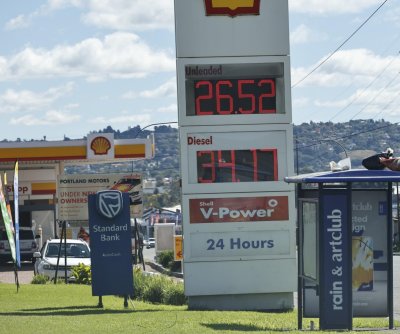
A gas station in South Africa displays the latest prices for petrol and diesel after they hit a record high on Wednesday despite global oil prices plunging back below $100 a barrel on hopes of a deal to end the war in Iran. Photo by Kim Ludbrook/EPA
May 6 (UPI) — Global oil prices fell sharply and financial markets rallied Wednesday after U.S. President Donald Trump paused a military operation to reopen the Hormuz Strait to commercial shipping to give advanced peace talks with Iran a chance to deliver “a complete and final deal.”
Falls in Brent crude of more than $10 a barrel to $99, American crude by $13 to $92 a barrel and rallies in Asian stock markets overnight that fed into Europe when bourses opened there failed to feed through to U.S. gas prices, which jumped 5 cents a gallon to their highest level of the war.
AAA motor club figures showed a national average of $4.54 for a gallon of petrol and $5.67 for diesel, meaning drivers were paying 53% and 51% more than before the war started on Feb. 28, with the caveat that fuel price adjustments normally lag crude oil price movements by several days.
The White House believes a draft one-page, 14-point memorandum of understanding to end the war and create a structure for more in-depth nuclear talks could succeed in breaking the deadlock, two U.S. officials and two other sources said.
An Iranian foreign ministry spokesman confirmed to CNBC that Iran was in receipt of the U.S. proposal and was “evaluating it.”
The Trump administration anticipates Iran will give its response with regard to the most critical elements of the plan in the next two days and although nothing has been finalized it was being seen as significant because it was the closest the sides had been to a deal since the beginning of the war.
However, Trump also appeared ambivalent, saying Wednesday it was “perhaps” too big of a stretch to believe Iran would take the deal and threatening to order the U.S. military to restart its airborne offensive against the country if it didn’t.
Analysts said investor confidence was boosted mainly by the fact the cease-fire was holding and signs that the economy was nowhere near as badly affected by the war as feared.
“This helped oil prices to come back down again and ease fears about a renewed escalation, with investors a bit more hopeful that an extended stagflationary shock would be avoided,” Deutsche Bank wrote in a note.
It added that investor confidence was also bolstered by new U.S. economic data showing among other positive indicators, that job vacancies declined less than anticipated in March, saying the numbers “cemented the case that the conflict’s wider economic impact was still fairly muted.”
Hopes were also riding on the possibility China would prevail on visiting Iranian foreign minister Abbas Araghchi to persuade Iran to uphold the current truce with the United States, so as not to throw a wrench into Trump’s visit to Beijing on May 14, the first by any U.S. president in almost a decade.
China is one of Iran’s largest customers for its oil exports.

President Donald Trump speaks before signing a proclamation inside the Oval Office at The White House on Tuesday. The memorandum is set to restore the Presidential Fitness Test Award, a competitive school-based fitness program last seen under the Obama administration. Photo by Tom Brenner/UPI | License Photo