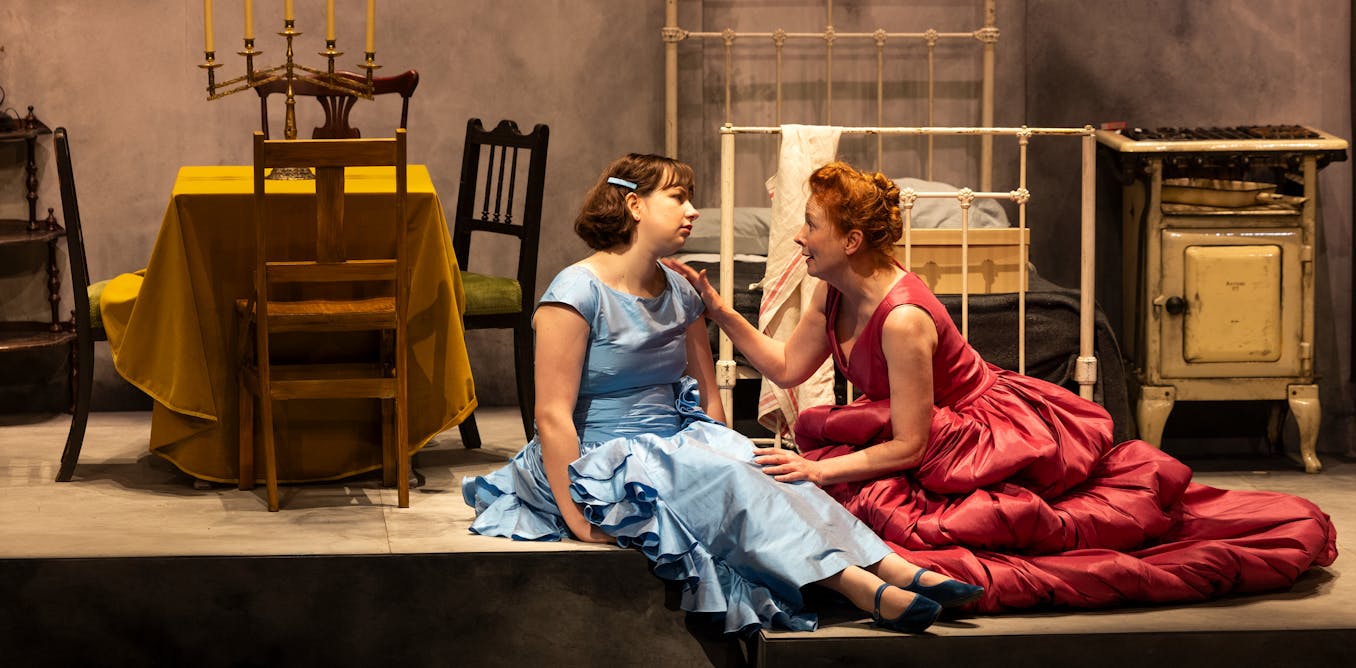
Mark Wilson’s novel version of Tennessee William’s The Glass Menagerie at the Melbourne Theatre Company doesn’t cooperate with historical readings of the play – but is exactly the kind of theatre we should be championing.
Wilson takes a much-loved classic that recollects family anxieties and subverts it, pushing into its dreamlike strangeness and nudging its audience to interrogate how memories are constructed.
This new version of Menagerie might well mark a defining shift for Melbourne theatre aesthetics, inviting real experimentation back into the main stage conversation.
An agonising subtext
The Glass Menagerie (1944) explores a haunted family in mid-depression era St Louis. It is Williams’ most autobiographical work.
A mother and her adult son and daughter – whose husband and father has deserted them – share a claustrophobic apartment and emotionally suffocating relationships, inhabiting the stifling space within their own distinct dreams about what their lives should be.
Tom (Tim Draxl in this production), the son, yearns for freedom, adventure, poetry. He disappears every night into dancehalls.
His mother, Amanda (Alison Whyte), is emotionally neglected, holds Tom responsible for their futures, and is desperate for control in a life in which she has almost none.
The daughter, Laura (Millie Donaldson), is disabled, displayed as a deficit; she is habituated to low self-esteem. But Laura’s second act encounter with gentleman caller Jim (Harry McGee) is a revelation – she is finally seen in a different light.
This play is a dream play. Tom tells us at its beginning we are about to see his memory; we understand this memory tortures him. Tom has been running from his family, like his father before him, but will never escape.

Pia Johnson/MTC
To echo a dream, Wilson has played with the theatrical form. The tone keeps subtly shifting. Sometimes we identify with the realism of Amanda and Tom’s visceral arguments; sometimes gestures are heightened in bizarre ways that ask us to intellectualise interiority.
He employs a heightened and surreal physical vocabulary, making manifest the characters’ internal tensions. We see Tom’s hand shape a gun while arguing with his mother. When the actors eat a meal or smoke cigarettes, they mime – as in a dream, they ingest no actual food and inhale no real smoke.
Within this dream-vortex, Tom’s memory distorts. This is what memories do – they garble and highlight unevenly; they are strange and unsolvable.
A distant cackle of laughter arising from a moment of tenderness helps make this production awkward and uncooperative, but isn’t that the truth of our lives? We are not resolved, and our familial relationships are often not straightforward.
Critics of Wilson’s production have questioned Wilson’s use of
“buffoonery”, but this vastly misses the point. Wilson’s production inserts heightened, ridiculous moments we least expect precisely because it aims to subvert.
The play has been synonymous with melancholy when melancholy is but a tiny fraction of its possibilities. Wilson’s bold experiment holds value in asking audiences to consider Williams’ ideas anew: relationships are complicated, people are inconsistent, lives are strange.
This production gets the discomfort right in a way I haven’t seen before.
A house of the oppressive
Kat Chan’s set is appropriately oppressive. The apartment is drab and far too small for the players, filled with too much furniture – and, at one point, Amanda’s ridiculous pink dress (Matilda Woodroofe’s canny costumes) – in a way that forces the characters to inelegantly navigate each other’s bodies.
The enormous tenement fire escape is used mostly to compose stunning shadows in collaboration with Paul Lim’s remarkable lighting. Marco Cher’s composition and sound design evocatively underscore haunted inner lives.
These theatrical experiments make for a confronting production, which in turn gives audiences much to debate – and debate is critical if we want to continue to flex Melbourne’s cultural muscle.

Pia Johnson/MTC
Unlike productions that focus on melancholic realism, the production takes an intellectual approach to emotional truth, which makes it less emotionally absorbing.
But by disrupting our expectations of a single emotional tone, Wilson offers its contemporary audience an opportunity to think critically about how contradictory and strange we all are, and about theatre’s powerful ability to provoke these ideas.
A changing theatre landscape
Melbourne’s main stages are undergoing a curious shift in identity.
Melbourne Theatre Company’s artistic director Anne-Louise Sarks came up through experimentation. Mark Wilson had a long and lauded career on the experimental theatre scene before hitting the main stages.
Bringing him into the MTC fold speaks to a respect for pushing audiences gently forward.
Meanwhile over at Malthouse Theatre, Dean Bryant is new to the helm. Malthouse has a history of being the more formally inventive of Melbourne’s two main stage companies and while we are yet to see Bryant’s first season fully roll out, he comes from a decidedly more commercial and traditional background, at the forefront of Australian music theatre.
Will we see a shift in aesthetics between these two companies? And is experimentation being ushered back into the zeitgeist?
Wilson’s provocative, peculiar and beautiful Menagerie allows its audience to grapple with complex ideas about what theatre can do. It might not cooperate with our previous expectations of the play – but this is what is important.
The Glass Menagerie is at Melbourne Theatre Company until June 5.