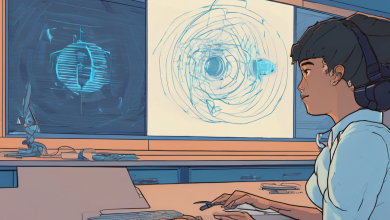

Featured image: A woman with curly dark hair is sitting at a wooden table. AI-generated image; not a photograph of the reported event.
A recent job interview experience has raised serious concerns about the use of artificial intelligence in hiring. Source: theguardian.com.
What Happened
Over 15 years of experience in diverse roles—from call centre operator, social media manager, bookseller, copywriter, library worker—led a writer to apply for a preschool teaching position.
The organisation responded with an AI interview. The process began with a disembodied voice greeting the applicant by name.
The interview was conducted via video, with the applicant seeing only themselves in the window. No human presence was visible.
When the AI asked a question requiring time to think, the applicant paused—something accepted in traditional interviews. Instead, the system ended the session abruptly.
At the end, the AI offered no real answers to follow-up questions. It repeated content from the job ad and suggested contacting a manager for clarification—an ironic and dismissive response.
The applicant was told their video would be reviewed, but no human contact followed. No response came in over a month.
Key Facts
- The interview was conducted entirely by an AI assistant, with no human presence.
- The applicant was booted from the interview after pausing to think.
- Follow-up questions were answered with regurgitated job ad content.
- The organisation has not responded to a withdrawal request or follow-up email.
- The role is in early childhood education—a profession deeply rooted in human connection.
Why It Matters
Preschool education is one of the most human and emotionally demanding professions.
Children rely on warm, attentive, and empathetic interactions to learn and grow. Using AI to assess such a role undermines the very foundation of care and connection.
Discrimination risks are already known—AI tools can reflect biases in training data.
When job seekers are treated as data points, the human element of work is eroded. This is especially troubling in a sector facing a childcare crisis.
Limitations and Open Questions
The source does not confirm whether the AI was used in other roles or across the organisation.
It does not explain how the AI was trained or what criteria it used to evaluate candidates.
There is no evidence of a broader trend in Australia or globally, though AI hiring is growing.
It remains unclear whether such practices are being tested or scaled in other education or care roles.
What to Watch Next
As AI tools become more common in hiring, scrutiny must grow—especially in roles requiring emotional intelligence and human interaction.
Job seekers should be informed of AI interviews and given the right to request human interviews.
Organisations must ensure that AI tools do not replace human judgment in recruitment.
For more on how hiring manager practices shape your job search, see how hiring manager practices shape your job search.
And for a broader look at AI in hiring, explore AI robot interviews and personality tests.
Ultimately, the experience reflects a deeper issue: the erosion of human dignity in the hiring process.
The writer ultimately withdrew their application, not out of failure, but out of a sense of being degraded by a machine that offered no empathy or response.