In a white-cube gallery in Sydney, an installation by French artist Philippe Parreno pulses with life — not from electricity, but from a desert 17,000km away. Source: theguardian.com.
The Art That Listens
At the Museum of Contemporary Art, the exhibition 5 Moons unfolds across three levels. It is Parreno’s first major show in Australia, and it challenges visitors to slow down and observe.
The gallery features floating fish-shaped balloons, a grand piano playing an unknown score, and a screen showing a cuttlefish that gently undulates. These pieces feel haunted — as if powered by unseen forces.
But the real magic lies in the data. Real-time environmental readings — wind speed, humidity, temperature — are collected from an abandoned almond farm in the Tabernas Desert, Spain.
These readings are processed through an algorithm and transmitted to Sydney. They then influence the sound, lighting, and airflow in the gallery. The desert is not just a backdrop. It is an active participant.
How the Data Travels
The farm in Spain is located in a region famous for spaghetti westerns. It is a dry, sun-baked landscape, once used for almond cultivation. The site was abandoned decades ago, but its remote location and stable climate make it ideal for long-term sensor monitoring.
Sensors embedded in the soil and structures capture environmental data at regular intervals. This data is transmitted via satellite to a server in Spain, where it is processed by a custom algorithm. The algorithm translates raw environmental variables into a series of digital signals — a kind of abstract score — which are then sent to the Museum of Contemporary Art in Sydney.
At the museum, these signals trigger real-time changes in the installation. A silvery light slides up and down a pole, mimicking the movement of a celestial body. The bulbs on the power adapters flicker in rhythm with the wind speed. A large industrial fan begins to rotate slowly, creating a gentle air current. The ambient sound system plays a layered mix: insect chirps from the Spanish desert, the distant barking of a dog, and the toot of an ocean liner docked in Sydney Harbour.
The result is an environment that feels alive — not through human design, but through real-world conditions. The installation does not simply react to data; it interprets it, transforming it into a sensory experience that evolves over time.
Parreno’s Philosophy of Art
Parreno’s work is not about beauty or narrative. It is about systems — how objects respond to each other, and how perception shapes reality.
He says his goal is to create spaces where visitors are not constantly responding to signals. Instead, they float — they move at their own pace.
‘In the system we live in, you are always obliged to respond to a signal,’ he says. ‘Here you are not. You just float with your own attention, and you spend the time you want.’
His earlier work, such as the 2016 Tate Modern takeover, used a jar of yeast in a hidden lab. The yeast’s data — including its metabolic activity — was fed into the exhibition’s systems, influencing the lighting, sound, and movement of objects. That work was controversial — some found it confusing, others found it mesmerizing.
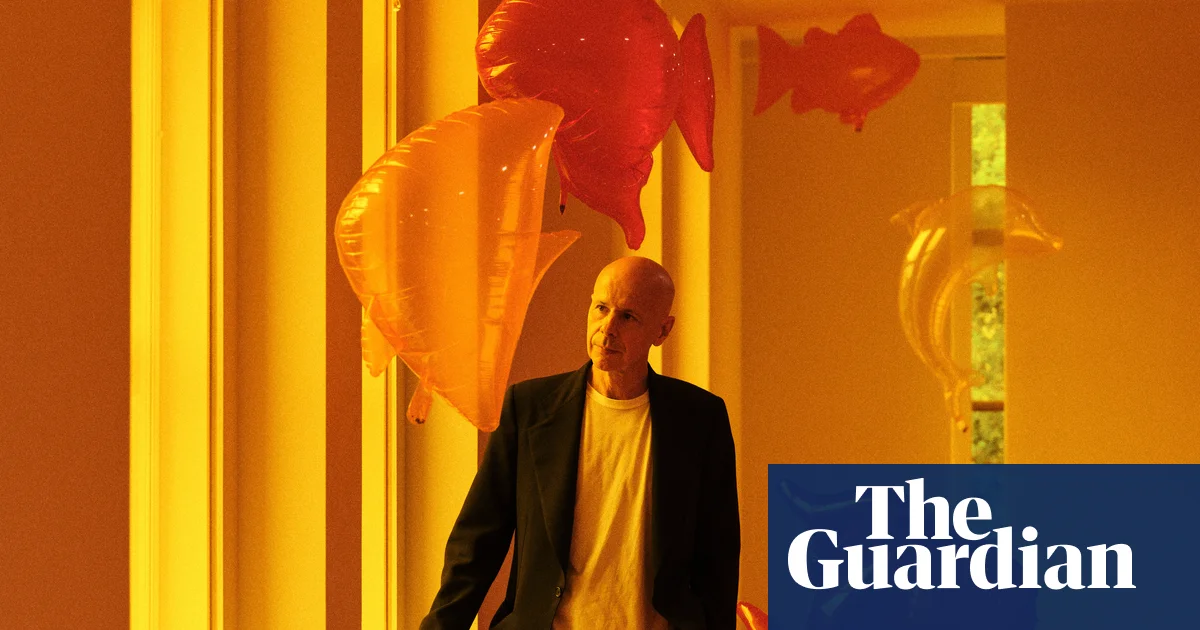
Parreno has long been interested in fiction. ‘Lots of the things I do require people to endorse a fiction,’ he says. ‘It’s not just a gimmick. It’s deeply philosophical.’
He believes that imagining a place changes it. When he showed an earlier version of 5 Moons in Munich in 2024, he said the work was designed to feel as if the land was ‘speaking to you’.
‘With the ways climate change is changing the world,’ he said, ‘how do we address the landscape? Are we going to keep transforming it? Or is it maybe the other way around — that the land is looking at us?’
Backstory as Meaning
Parreno’s family migrated from Spain to Algeria, where he was born. This history informs his work. The connection to his ancestral homeland is not just personal — it is central to the emotional resonance of the exhibition.
Some installations in the exhibition stand alone — without clear stories. A ceiling covered in helium-filled speech-bubble balloons flashes with coloured lights. The pattern is a morse code translation of a French writer René Daumal’s mystical adventure, Le Voyage en Terre d’Ailleurs. Without that backstory, the piece might seem arbitrary. With it, it becomes meaningful — a bridge between fiction and reality.
Why This Matters
This exhibition is not just about art. It is about how we relate to the world — especially in an age of rapid digital change.
Parreno’s work suggests that art can be a form of listening — to land, to climate, to time. It invites visitors to consider how their actions affect environments, and how environments, in turn, shape human experience.
It also raises questions about the role of technology in art. Is data from a desert in Spain really ‘influencing’ a gallery in Sydney? Or is it just a signal — a performance?
Yet Parreno insists that the data is not merely a technical transmission. It is part of a living system. The installation does not simulate a desert — it connects to one. The gallery becomes a conduit, a shared space where two distant places interact through data and perception.
The exhibition runs until 26 April 2027. Visitors can watch an 11-hour film of a night in the Spanish desert, as it passes under the moon. The film captures the same environmental conditions that feed the installation — a quiet, meditative experience that resists the usual demands of modern art: spectacle, speed, engagement.
Parreno’s vision is not to entertain. It is to create a space where attention can breathe. For those who visit, the experience may feel simple. But it is rooted in a profound idea: that perception is not passive. It is active. And it can change the world.
For more on how art shapes cultural debates, see our coverage of art commission debates and legal issues in museums.
Sources & further reading
Featured image: original publisher image. Via original publisher. Image source