Coming off a banner year in which she was named Emerging Designer of the Year at the CFDA Awards, and became the 2025 CFDA/Vogue Fashion Fund winner, Ashlynn Park closed her studio, stopped answering calls and went back to what she knows and loved best, practicing her craft. Though deeply embedded in her work, Park is not someone who craves the spotlight and, reading between the lines, she seems to have felt a kind of disconnect between her self-perception as a self-described “ordinary” person and a headline maker. This sense of doubling is present in other aspects of Park’s life, for example, as an immigrant to America from Korea, and as an artist reconciling Eastern and Western approaches to design.
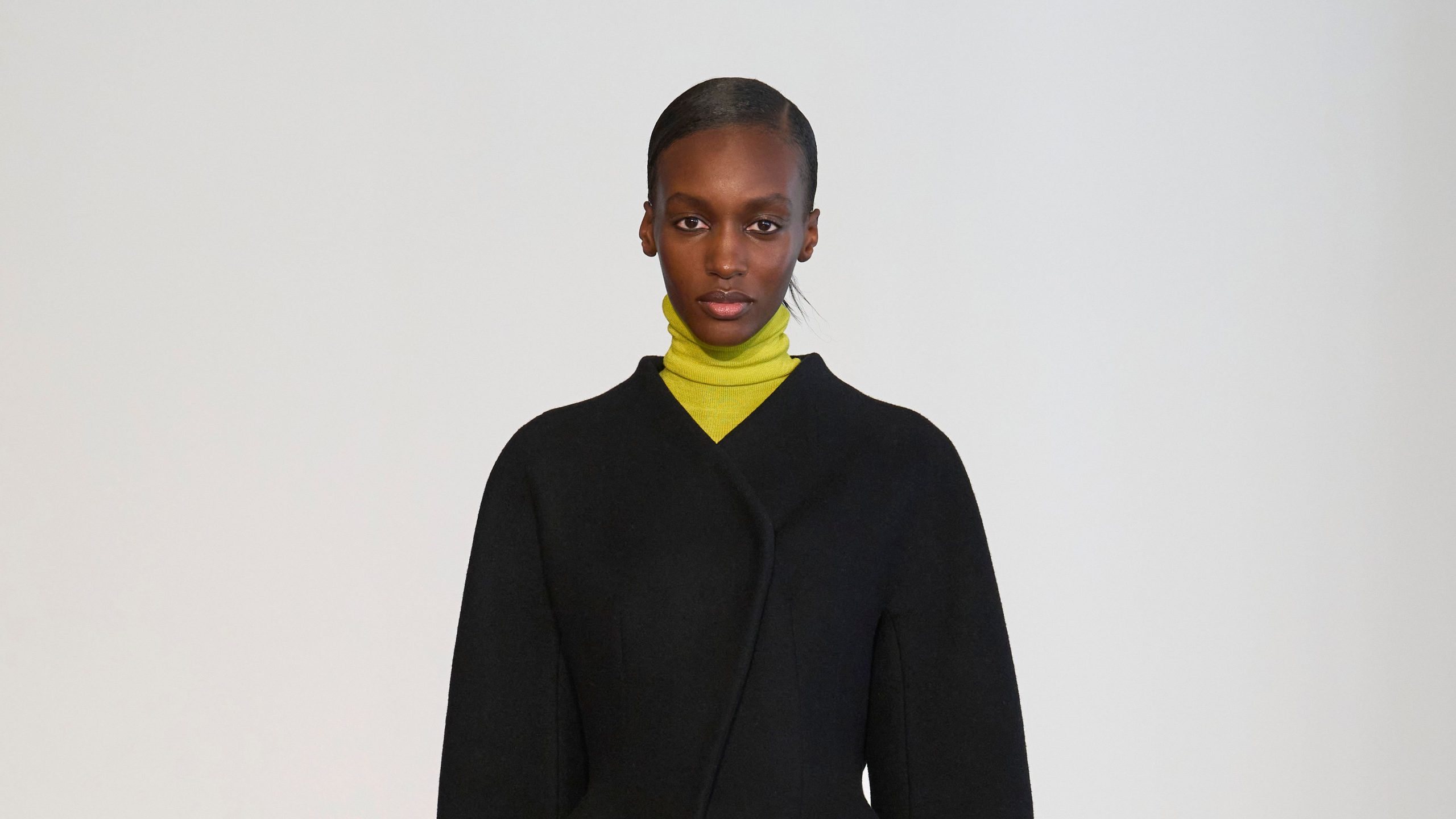
For fall, the designer settled on the idea of the vernacular—“what is shared, what is common, what belongs to the people,” as she wrote—as the starting point for a spectacular collection in which she took previous themes to their ultimate expression at the same time that she advanced her practice. When the first model appeared in a black-and-white ensemble over a tart citron top, you could almost taste the change. As the bold color excited the eyes, gathered jersey swayed softly over draped pants. Providing a grounding sense of structure to the whole was a double-cashmere jacket with a basque back that wrapped around the body like a calla lily. That same acidic color reappeared in a textural tweed that framed the waist as a peplum and extended down the sides of the legs.
Park perfected her deconstructed suits, rendering them so airy that the exposed stitches seemed to float on the fabric. The designer committed to the frisson between the masculine/feminine this season by seeming to cut a boyish slouch into curvy pants, a luxe wrapped shearling jacket and a butter-soft zip-front calfskin jacket. The designer also reimagined the white button down, by adding seams that brought it in at the waist before pepluming out over the hips and creating slouchy batwing sleeves.
“Clothing is a common object,” Park wrote. “We are not artists apart from life, we are makers within it.” Still, there is nothing quotidian about what Park does. Part of her magic is that she has been able to combine her flat pattern making skills with three-dimensional, body enhancing draping. So curves and lines can move with a Cubist-like dexterity as was the case with the not-so-flat silk-taffeta piece that closed the show and which was monastic at front, and sensual at its open back.
This was the most densely textural of Park’s collections. The design worked both with deeply piled wool fringe, which, in monochrome, added an untamed element to the whole. When a black-and-white fringed skirt was paired with a “snowy” melange bouclé the effect was kinetic. While visually adjacent to a Jackson Pollock splatter painting, Park’s practice depends on the balance between intuition and precision.