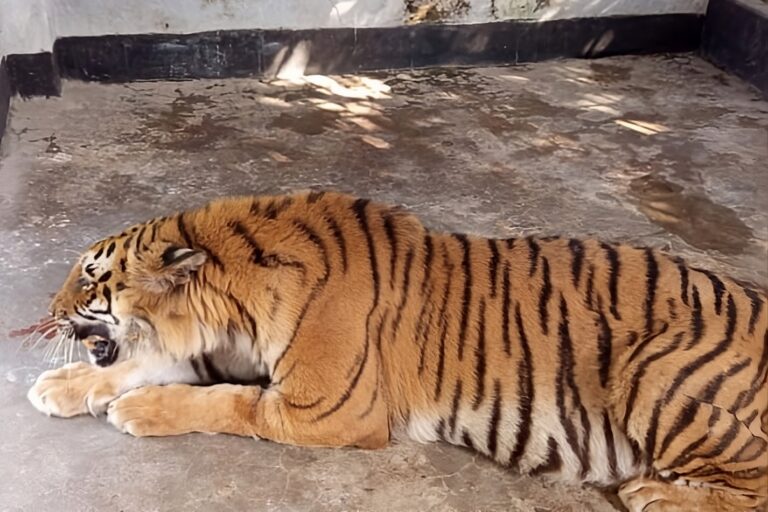
- In early 2026, the Bangladesh Forest Department rescued an adult female Bengal tiger from the Sundarbans from a poachers’ trap set for deer.
- The critically injured tiger was taken to the Khulna Wildlife Rescue and Rehabilitation Center. After receiving the treatment, she is now ready to be released back into the mangrove forest.
- Since this is the first release of its kind in the country, the authority is struggling to decide on the best process, including whether the tiger should be fitted with a satellite collar or monitored with camera traps after release.
- Since last year, the Forest Department has taken strict action against deer poachers by conducting raids and seizing large amounts of netting and other traps. The tiger’s rescue from a snare and the increased deer population are results of these efforts.
In a first, Bangladesh is preparing to release a tiger back into the wild after it was rescued from a poacher’s trap and provided with medical treatment.
On Jan. 4 this year, the Forest Department rescued the female tiger (Panthera tigris), estimated to be around 10 years old, from the Chandpai and Sarankhola forest range in the Sundarbans East division.
The critically injured tiger was taken to the Khulna Wildlife Rescue and Rehabilitation Center, a facility of the Bangladesh Forest Department, for treatment.
“We rescued the tiger from a snare set for deer poaching. After receiving adequate care, the tiger is now ready to return to the wild. We are planning to release her in a few days,” said Md Rezaul Karim Chowdhury, divisional forest officer, Sundarbans East division.
According to the latest tiger census, conducted in 2024, Bangladesh is home to 125 globally endangered Bengal tigers living in the Sundarbans mangrove forest.

Covering 6,017 square kilometers (2,323 square miles), the mangrove forest is administratively divided into Sundarbans East and Sundarbans West. It is also divided into three blocks — Chandpai-Sarankhola, Khulna and Satkhira.
As per the census, the highest number of Bengal tigers is found in the Chandpai-Sarankhola block.
“This indicates that the density of other wildlife, including deer and wild boars, is also higher in this block because the forest’s top predators are more concentrated here,” Chowdhury said, adding that illegal activities, including poaching, are therefore common in the area.

Debate over the release process
Since this will be the first release of its kind in the country involving a Bengal tiger, experts are divided over the procedure. Some say they believe the tiger should be fitted with a satellite collar so they can monitor her condition in the wild, while others say she has only recently recovered from severe stress and may not be able to withstand the added burden of carrying equipment or being tranquilized again.
Using a GPS-based collar is a common global practice when releasing such a “problem tiger.” Neighboring countries such as India and Nepal often use this method. “Following global practice, we decided to release the tiger with a GPS tracker,” said Mohammad Abdul Aziz, a zoology professor at Jahangirnagar University, Dhaka.
“Since the tiger has been out of her territory for the past six months, she may have lost [the territory] during that time. There is a strong chance she could return to a nearby [human settlement] in search of food,” said Aziz, who is also a member of the expert committee formed to oversee the tiger’s release. “If she is fitted with a GPS tag, we can monitor her movements and alert local residents if she tries to return to the area. Considering these factors, collaring would be the best option.”
However, Hatem Sazzat Md Julkarnine, a veterinary surgeon at Gazipur Safari Park who cared for the wounded tiger, said, “Releasing the tiger with extra equipment, such as a collar, could put her life at risk.”
“We rescued the tiger in critical condition. Her left foreleg was severely injured by the metal snare. Although she has recovered, she has already lost strength and reflexes,” he told Mongabay. “In this condition, she will struggle to reclaim her territory and hunt for food. If we send her back with extra weight, it will be difficult for her to survive.”

The alternative is to use camera traps.
“We decided to use a radio collar, but the issue remains pending because of technical problems in securing the equipment on time,” Aziz said.
“If we are unable to obtain the collar within the next couple of days, we will use camera traps instead. In that case, the Forest Department will set up cameras across a 20-km2 [7.7-mi2] area where the tiger was rescued to monitor her condition,” he said.
However, if she moves beyond the cameras’ range, they may lose track of her, he added.

Strict action against deer poaching
Among other illegal activities, deer poaching remains common in the Bangladeshi part of the Sundarbans. Some locals living on the forest’s periphery and depending on mangrove resources for their livelihoods are involved in such illegal activities.
According to a note released by the Forest Department, officials identified and removed traps made of rope and metal spanning about 35 kilometers (22 miles) from the eastern part of the forest over the past year. In addition, at least 70 poachers were detained and penalized.
The tiger’s rescue from a poacher’s trap reflects the Forest Department’s recent exhaustive action against poachers through increased patrolling and arrests.

“As a result of these actions, the number of deer in the forest has also visibly increased,” said Mohammed Mostafa Feeroz, a zoology professor at Jahangirnagar University who recently visited the forest.
“I even found several female deer with triplets, which had been rare in the mangrove forest for a long time,” he added.
Banner image: The rescued tiger at Khulna Wildlife Rescue and Rehabilitation Center. Image courtesy of the Bangladesh Forest Department.
Illegal trade is pushing Bangladesh’s freshwater turtles to the brink
Feedback: Use this form to send a message to the author of this post. If you want to post a public comment, you can do that at the bottom of the page.
Cite this article
Abu Siddique (2026). Bangladesh gets ready for its first release of tiger rescued from poachers’ trap. Mongabay Conservation news. DOI: https://doi.org/10.66709/news-323027