- In an interview with Mongabay, the former Gabon environment minister Lee White makes the case that the Congo Basin should be treated as “critical national infrastructure” to be protected for Africa’s future water and climate security.
- He also defends nuclear energy as a “necessary evil” to generate the energy that Africa needs while avoiding catastrophic climate and water crises across the continent.
- White says weak governance, not mining itself, is the main driver of environmental destruction linked to mineral extraction.
- He criticizes the current carbon finance system, saying developed countries failed to honor their pledges to pay developing ones like Gabon for protecting their forests.
On May 11 and 12, 2026, the Africa Forward Summit took place in Nairobi, with several heads of state from across the continent and beyond attending. Thousands of political, economic and civil society actors also gathered in the Kenyan capital to discuss potential investments, particularly in the fields of energy transition and international financial assistance.
Lee White, Gabon’s former minister of water, forests, marine and environment, was in Nairobi on the sidelines of the summit to discuss carbon markets and Africa’s development. Originally from the United Kingdom, White is a naturalized Gabonese citizen. A scientist and zoology Ph.D., he took over the reins of Gabon’s National Parks Agency (ANPN) in 2009, and 10 years later was appointed environment minister under the controversial presidency of Ali Bongo Ondimba. Following the 2023 coup d’état that ousted Bongo from power, White left Gabon and his ministerial position, but did not leave Central Africa behind. During the COP30 U.N. climate summit in Belém, Brazil, he served as a special envoy for the Congo Basin.
Mongabay spoke to White over video call about the challenges facing the Congo Basin and the paths African countries should take to address them. The following interview has been lightly edited for length and clarity.
Mongabay: During the Africa Forward Summit, France announced that it would sign agreements with several African countries generating up to 23 billion euros ($26.7 billion) in investments. These investments will target climate and energy transition sectors, among others. What do you think about this?


Lee White: I’ve not read what President Macron announced but I am very cynical about the advantages of using donor money to fund conservation or development in Africa. There are so many promises. For instance, [$1.5 billion] were promised for the Congo Basin in Glasgow [at COP26 in 2021]. Probably less than 10% of that has hit the ground. You get false promises of money. And the problem with false promises is once somebody’s promised you money, you don’t look for it elsewhere because you think you’ve found it. And then when it doesn’t come, then you have a real problem.
And even when donors give you money, often it’s really difficult to spend it. They have such difficult rules. If you look at EU projects across Africa, when they announce how much money they’re giving, it’s always these big announcements, but they never say how much is actually spent on the ground.
If we are going to manage our countries in Africa properly, we have to think of parks and ecosystems as critical national infrastructure. If you lose the forest, you lose the rainfall in Africa. If you lose the Congo rainforest, you’ll lose part of the rainfall in the Sahel and in Ethiopia and you lose the Blue Nile and [rainfall] in Angola and in Zambia. The rainforest is the pumping heart of Africa.
Mongabay: During the summit’s joint press conference, Kenyan President William Ruto, after highlighting planned French investments in transport and logistics, said that Kenya is seeking to leverage France’s experience in the nuclear energy sector. Kenya itself currently has plans to incorporate nuclear power into its national energy mix. What do you think about this energy shift?
Lee White: Shifting towards renewable energy in Africa makes absolute sense. There are many people that don’t even have energy yet. If we can start with renewable energy, obviously — solar as an off-grid solution for many rural communities or micro hydro systems — but if we are establishing energy in this world, we should be establishing renewable energy. I’m a conservationist and environmentalist. There’s a certain risk with nuclear, but if you deal with those risks and you avoid the Chernobyls of this world, it is kind of free of carbon dioxide emissions. It creates other problems.
I kind of have a crystal ball and I know how bad things could get in Africa quite quickly. Over the next 20 to 50 years, we might be talking about hundreds of millions of climate or water refugees. Water [crises] might come first actually before the climate. And it’s a matter of life and death in the Horn of Africa and in the Sahel and a few other parts of Africa. If the choice is between climate change running out of control or the calculated risk of nuclear to reduce carbon emissions quickly whilst providing the energy that we need to develop Africa, I go for nuclear energy. Because we need to create jobs for young people and to create growth.
And to do that, we need energy. And so we have to find solutions that will provide enough cost-effective energy quickly enough without destroying the planet. I think [with] nuclear [we] have to kind of ensure, as much as we can, the governance. You don’t want nuclear power stations in war zones; it’s a very, very good example of that in Ukraine right now. I would say it may well be a necessary evil if we’re going to deal with climate change.
Mongabay: The energy transition is presented as a solution to climate change. But this transition requires critical minerals such as cobalt, coltan, copper and nickel. Africa is rich in these minerals, yet their extraction has so far generated pollution and forest degradation. Do you think Africa should continue down this path?
Lee White: There are a few examples of good practice, but there are many more examples of mining going on illegally or with very weak governance, with no consideration at all for the environmental cost. The principal responsibility for that falls on the African governments. You have to have good governance and you have to have norms and environment laws and impact [mitigation] systems and so on. And then the secondary responsibility falls upon the companies, except where it’s illegal exploitation. It’s governments that choose the companies, and so I think most of the responsibility for that has to be on our governments across the Congo Basin or across Africa, making sure that the mineral exploitation does not result in devastating environmental degradation.
If you manage mining professionally, if you have good governance, if you avoid sort of a free-for-all and instead of having thousands of people digging anywhere in the forest, you create systems whereby those people can be employed and have proper livelihoods in the mining industry and you apply environmental norms — mineral resources are usually quite localized — you can extract mineral resources without destroying forests. It’s absolutely possible. I was a co-author on a paper for the Science Panel for the Congo Basin [under the U.N. Sustainable Development Solutions Network] on the impacts of mining and how you manage it. There’s a good example in Rwanda, where sort of illegal, extensive, artisanal tin mining was formalized and so the people got better jobs in a more formal mine and giving them better working conditions and so on. If we’re going to do that, it requires investment.


Mongabay: If Rwanda is, according to you, a good example of mining extraction management, its neighbor, the Democratic Republic of Congo, which possesses some of the world’s richest mineral reserves, does not seem to be faring as well. Why do you think that is?
Lee White: In eastern DRC, a lot of those minerals are being stolen. So, there’s zero benefit for the country. There’s only negative[s] because the environmental damage is bad. Over the last 10 years, a lot of the minerals going out have been literally stolen across borders. [There’s] been illegal exploitation, and hopefully the DRC government will have negotiated [deals] whereby I would say hopefully a significant part of those minerals are going to be transformed in DRC on the African continent.
If the model is the same old what you could call the colonial model of extracting cheap raw materials and sending them away for development, then that will be a very bad deal for the people of DRC. Even with legal mining, if you’re sending those resources off the continent, you’re losing 95% of the value and 95% of the jobs. [Around] 60% of Africans are under 25. If we don’t create jobs for those people in the coming years, then we’re going to create huge social problems all across Africa. And so, we have to start transforming those minerals in the country. That will create better economies, that will create more jobs, and that will give us the resources to do it well, to respect the environmental norms, to restore, where we have to destroy, to mine. You do a little bit of damage to improve the economy. If you make sure that you control that and then you restore afterwards and you invest some of the money in better management of ecosystems around, then that can be a win-win.
Mongabay: The DRC is also home to 60% of the Congo Basin forests, the world’s second-largest tropical rainforest. Why not use green finance as a source of development?
Lee White: There are a lot of carbon cowboys, like I would call them, who are promising the world to both governments and to local communities but who rarely deliver. And even though there are some really good projects, there are also some really bad projects. And so the voluntary REDD+ has been to a certain extent discredited through a whole series of articles in The Guardian newspaper two or three years ago that claims that a lot of the credits were actually hot air and not real.
It’s a real tragedy, because reducing emission from deforestation is the most efficient, most cost-effective way of dealing with about a quarter to a third of the climate change issue. And we’ve known that since 2005. It should be easy. We know how to count carbon molecules and measure trees and deforestation. It’s the same molecule all around the world, but carbon [credits from] Europe seems to be worth 100 euros [on the carbon market] and carbon [credits from] Africa seems only to be worth 5 euros. And even though there are international agreements on paying for reduced emissions, the developed countries never honored those agreements. We are a little bit headless. There are no really good examples of where it has worked. There’s just a lot of examples of where it hasn’t worked, unfortunately.
Mongabay: What could be done to improve the situation?
Lee White: I think integrity is one of the key issues, whether integrity of the measurements of the carbon, and then the integrity of where the money flows to. The voluntary system has to work through a national system; there have to be national systems for monitoring carbon. We can’t have small projects existing in an isolated fashion. You have some projects in a country but they’re not part of the national accounting. Voluntary projects have to be nested underneath national carbon [accounting] so that there’s a check on the integrity and there’s a check on double counting and there’s a check on what they call “leakage” — you’re not saving forest somewhere and destroying it somewhere else. That’s what Gabon is still trying to do, and there are a few other countries trying to do that. Uganda has created REDD+ results, Ghana has some very good systems, and so on.
We need better transparency and governance [about] where the money flows, how you deal with the people living in the forest, and the government and any partners that are working on these things. And it’s actually quite different between anglophone and francophone countries in Africa, because in most francophone countries all the land officially belongs to the government. So, you have people living in the forest, you have villages and so on, but they’re living on government land. And so, you’ve got a kind of a parallel governance on most lands.
In the anglophone countries often there’s much more land ownership. So, communities sometimes own the land. We need to work through all of those governance issues and make sure that all of the actors are benefiting from these. African countries have to take the leadership on that because if we’re not proactive then it never happens.
Mongabay: You mentioned Gabon, where you served as environment minister from 2019 to 2023. What was your record in terms of reducing forest degradation during your tenure?
Lee White: A lot of countries received quite a lot of money for what they called REDD+ readiness, and lots of consultants flooded into Africa to get countries ready for REDD. And actually, in Gabon we refused that money. The president told me not to take REDD+ money, that we needed to do it ourselves. We couldn’t rely on handouts from developed nations.
In the end, Gabon was the first African country to register REDD+ results. We registered 187 million tonnes of REDD+ results [to the U.N.]. We went through all of the audits and the evaluations and the independent experts. It’s slightly ironic that Gabon, the only country that didn’t really take REDD+ readiness funds, was the only country that was ready. And of those 187 million tonnes of REDD+ results, Gabon was paid for 3 million. So, there’s still 184 million tonnes of REDD+ results from Gabon that nobody has paid for. Article 5 of the Paris agreement, which says developing nations will be paid for results, has not been respected by the developed countries. So why would any other country go through all of that work if you’re not going to be paid?


Mongabay: Gabon has experienced significant environmental degradation linked to the oil industry. I am thinking here about Perenco, which recently made headlines over environmental issues. As environment minister, do you believe you did everything you could on the matter?
Lee White: I have started a new life now outside of politics. I don’t think I can be held responsible for everything that’s going on in Gabon today. That was the strategy of the government when I was in it, but I think the strategy of the current government is to work more and more with Perenco to make sure that they manage all of those situations. If you look at the impact of oil in Gabon, the bad impacts are very localized and relatively small compared to the impacts that you see in other parts of the world. I think the government’s taking it very seriously. It would be quite a big decision to throw out the biggest oil producer in Gabon.
The Perenco issue is a little bit complex because Perenco’s specialization is to take over aging oil fields and get oil out kind of at the end of the life of the field. And so a lot of those environmental problems that Perenco have today go back to relatively poor governance at the beginning of oil exploration and exploitation, in the ’60s and ’70s and ’80s. In their contracts, when they take it over, they become responsible for all the previous damage done. Suddenly [there’s] oil seeping out into the lagoon and you realize that that’s because of bad practice 20 years ago. Even if you stopped extracting, often those problems are there anyway. So, I think it’s just too simple to say Perenco are evil because there are problems in their concessions. But if there are new problems that they have created, then that is very bad.
Mongabay: You said you have “started a new life away from politics,” yet you were at COP30 in Belém, you are here today in Nairobi, and according to the French media outlet Afrique Intelligence, you are becoming increasingly active in the Republic of Congo.
Lee White: I’m starting to work with the Congolese government and with a German foundation in Odzala[-Kokoua] National Park. During the colonial period in the Congo and Gabon, the French colonialists forcibly moved every village out of the forest and settled them along roads so they could use the people for forced labor. It wasn’t just in the parks; they possibly moved the entire nations of Gabon and Congo out of the rainforest. There are some examples of abuses during the creation of national parks. In the early post-colonial period, that continued to happen, and in Odzala, the way the Congolese government structured it, with the buffer zone of the park, the people are actually inside the park. So there are 50 villages, 12,000 people, who live inside Odzala national park. They were not moved out.
Mongabay: In 2024, an investigation revealed that eco-guards allegedly beat and raped members of the Indigenous Baka people on their ancestral lands in Odzala-Kokoua National Park. African Parks, the NGO managing the park, confirmed the allegations of violence. What do you think about this?
Lee White: There are still issues. There are issues in America, in the U.K. There are issues in park management all around the world. Well, are they worse in the Congo Basin than elsewhere? Probably not, I would say.
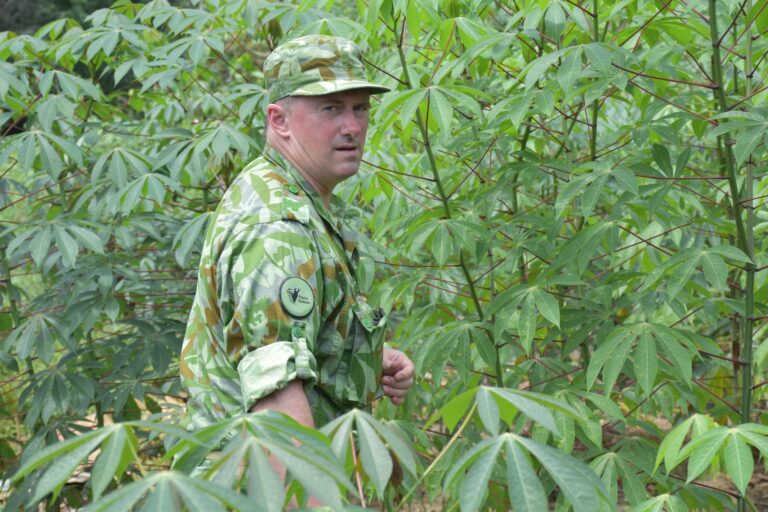
Banner image: Lee White managed Gabon’s national parks for 10 years before becoming environment minister. Image by Lee White via Facebook
Citation:
Mambwe, P., Inogwabini, B., Mohan, K., Ichikowitz, I., & White, L. J. (2026). Mining influence on the future of the Congo basin. Resilience and Sustainability in the Congo Basin, 1-18. doi:10.1007/978-3-032-02023-9_29-1
FEEDBACK: Use this form to send a message to the author of this post. If you want to post a public comment, you can do that at the bottom of the page.