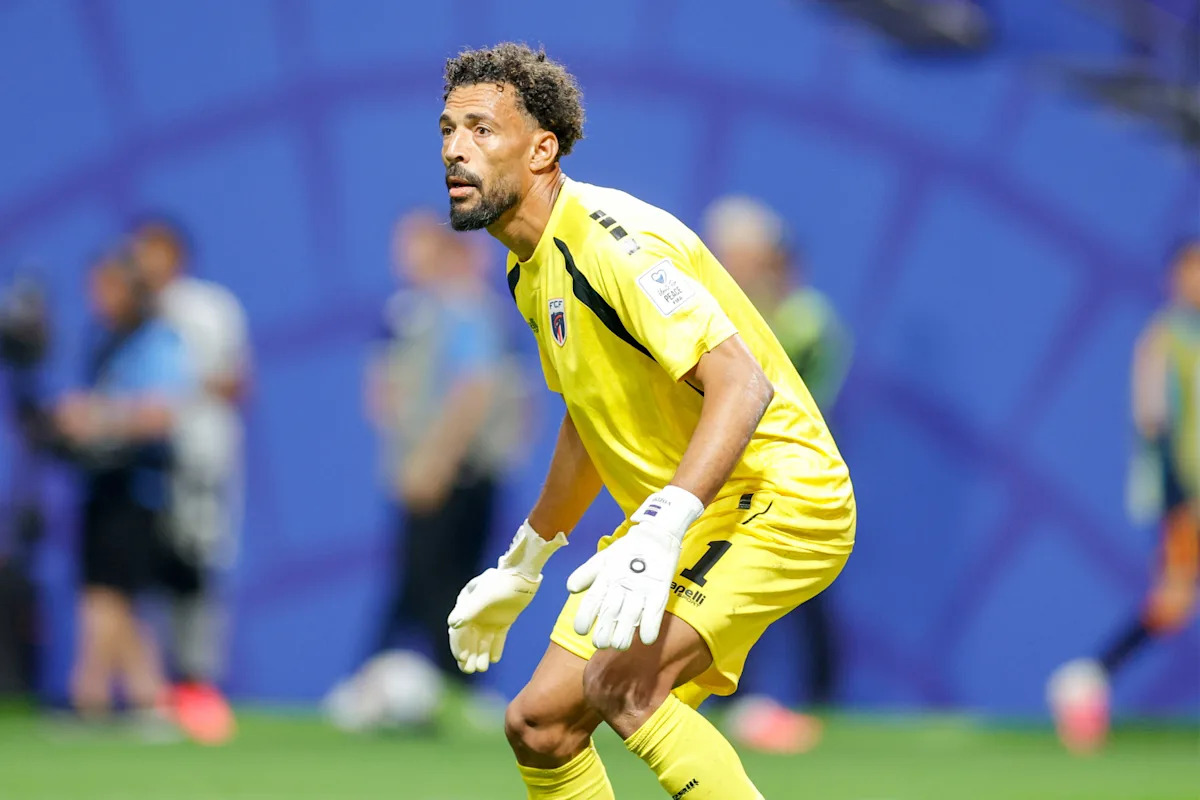
The mother of Cape Verde’s World Cup hero, Josimar “Vozinha” Dias, has been granted a U.S. visa to watch her son play in the tournament this weekend, after House Minority Leader Hakeem Jeffries intervened on her behalf.
Jeffries said he spoke with Secretary of State Marco Rubio directly after Vozinha’s emotional revelation that his mother,Ana Candida Evora, a 59-year-old house cleaner, could not secure the documents needed to attend Cape Verde’s historic 0-0 draw with Spain.
“The Cabo Verde national football team shocked Spain on the strength of a historic performance by goalkeeper Vozinha. His Mom was unable to be there because of visa complications. No mother should miss the chance to see her child make history. I have asked Secretary of State Marco Rubio to do everything in his power to ensure that she can attend Cabo Verde’s next match on Sunday,” Jeffries said, urging the State Department to “do everything in their power” to ensure that Vozinha’s mother could attend the team’s next match.
On Wednesday, Jeffries announced that his efforts had been successful.
“It is a privilege to announce that Vozinha’s mom will be able to secure a visa in time to attend their game this Sunday against Uruguay,” he said in a statement. “All fees have been waived consistent with official policy. Travel arrangements are now being made for mother and son to reunite in Miami.”
“I thank Secretary Rubio, U.S. State Department officials, the government of Cabo Verde and FIFA for working together to make this possible,” he added.
According to the State Department, there was initially “no record” of a visa application from Vozinha’s mother.
“The U.S. Department of State has no record of this individual applying for a visa. All relatives of players are eligible for visa bond waivers, and the Department is actively reaching out to this player’s family to assist with visa services,” a spokesperson told Newsweek earlier on Tuesday.
Cape Verde is among countries previously subject to a U.S. policy requiring visa bonds of up to $15,000 for some travelers—costs that critics say effectively price out fans and families from attending global events. Following the Cape Verde match, a fundraiser was launched to help bring Evora to the next World Cup match and see her son play.
However, the State Department has confirmed that immediate relatives of players are eligible for waivers on the controversial visa bond requirement, which had previously posed a major financial barrier.
Cape Verde’s next match is scheduled for Sunday against Uruguay in Miami, before a final group-stage game against Saudi Arabia in Houston on June 26.
Newsweek reached out to the U.S. State Department via email for comment.
Who Is Vozinha?
Josimar Dias—better known as Vozinha—is a 40-year-old goalkeeper who has emerged as one of the breakout stars of the 2026 World Cup.
At 40, he is also one of the oldest players at the tournament—and among the oldest goalkeepers to deliver a man-of-the-match performance on a World Cup debut.
He currently plays for Portuguese second-tier club GD Chaves and has been a long-time fixture in Cape Verde’s national team, earning caps across more than a decade. His career has taken him through smaller leagues in countries including Angola, Moldova, Cyprus and Slovakia, reflecting a journey far removed from the traditional path to global recognition.
Vozinha only turned professional in his mid-20s and had at times considered stepping away from the game, making his rise on football’s biggest stage particularly striking.
His defining moment came in Cape Verde’s opening match against Spain, where he delivered a player-of-the-match performance with seven saves to secure a shock 0-0 draw.
The performance also triggered a surge in global attention, with his Instagram following jumping from around 50,000 before kickoff to several million within days.
But the milestone was overshadowed by a personal reality. Speaking after the match, the goalkeeper became emotional as he described how close family members—including his mother—were unable to be there in person due to visa challenges and costs.
“My mom could not be here either for a visa issue, and the money we had to pay for it,” he said.
The day before Cape Verde’s opening match against Spain, Vozinha’s mother went on state television to confidently predict that no one would manage to score past her son.
Interest in his story has surged since, with online searches spiking around his club career and salary. While his exact earnings are not publicly disclosed, players in Portugal’s second division typically earn far less than those in Europe’s top leagues, underlining the scale of his rise from relative obscurity to global attention.
Where Is Cape Verde?
Cape Verde—officially Cabo Verde—is an island nation located in the Atlantic Ocean off the west coast of Africa, roughly 350 miles from Senegal.
The country is made up of 10 volcanic islands and has a population of just over 500,000 people, making it one of the smallest nations competing at the 2026 World Cup.
Despite its size, Cape Verde has a strong soccer culture and a large diaspora community, particularly in Europe and the United States.
The official language is Portuguese, reflecting the country’s history as a former Portuguese colony, while Cape Verdean Creole (Kriolu) is widely spoken in everyday life.
The nation gained independence in 1975 and has since developed a reputation for political stability and a vibrant cultural identity—factors that have helped shape its growing presence on the international stage, including in sport.