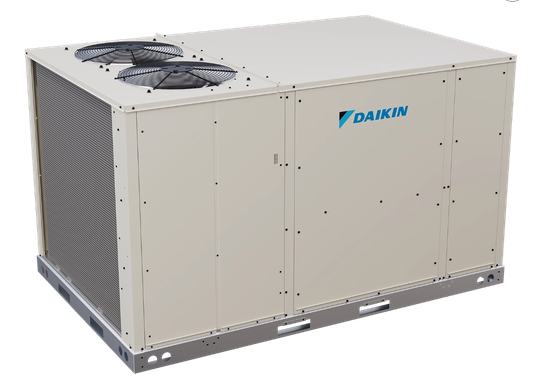
Daikin has unveiled an inverter-driven rooftop heat pump offering 7.5-ton to 10-ton capacities. The system uses difluoromethane refrigerant and reportedly achieves a coefficient of performance of up to 3.85 at 8.3 C
Daikin Comfort Technologies North America, a unit of Japanese heating system manufacturer Daikin, has launched the Nexio Max, an inverter-driven packaged rooftop heat pump designed for light commercial buildings. The new system targets building electrification projects and combines a variable-speed scroll compressor with difluoromethane (R-32) refrigerant.
The heat pump is offered in 7.5-ton (90,000 Btu/h), 8.5-ton (102,000 Btu/h) and 10-ton (114,000 Btu/h) cooling capacities. Depending on the model, it delivers an Integrated Energy Efficiency Ratio (IEER) of 21.0 to 22.0 and Energy Efficiency Ratio (EER) ratings of 12.1 to 12.4.
The heating performance includes a coefficient of performance (COP) of up to 3.85 at 8.3 C, while the units provide between 63,000 Btu/h and 80,000 Btu/h of heating capacity at -8.3 C with a COP of 2.5.
According to Daikin, the unit can operate in ambient temperatures as low as -25 C and maintains 85% of its rated heating capacity at -10 C, enabling operation in cold-climate applications.
The Nexio Max features a single inverter-driven scroll compressor, two variable-speed condenser fan motors, and a direct-drive indoor blower operating between 300 rpm and 1,600 rpm. Standard-airflow models support external static pressure up to 1.4 in. w.c., while high-static versions increase this to 2.0 in. w.c. Indoor airflow ranges from 2,950 cfm for the 7.5-ton unit to 3,600 cfm for the 10-ton model.
All models use a factory refrigerant charge of 335 oz (9.5 kg) of R-32 and are available in either 208/230 V or 460 V, three-phase, 60 Hz electrical configurations. Operating weight is listed at 586 kg), with a shipping weight of 619 kg.
The rooftop unit is intended for both replacement and new construction projects. Daikin said the system matches common rooftop equipment footprints, allowing many retrofit installations to reuse existing curbs and duct connections without requiring curb adapters. Factory-wired electrical connections and an open-access cabinet are designed to simplify installation and servicing, according to the manufacturer.
Standard features include single-zone variable air volume (VAV) operation, native BACnet integration for building automation systems, and compatibility with Daikin’s cloud-based HERO monitoring platform. Optional configurations include multi-zone VAV operation and hot-gas reheat for humidity control.