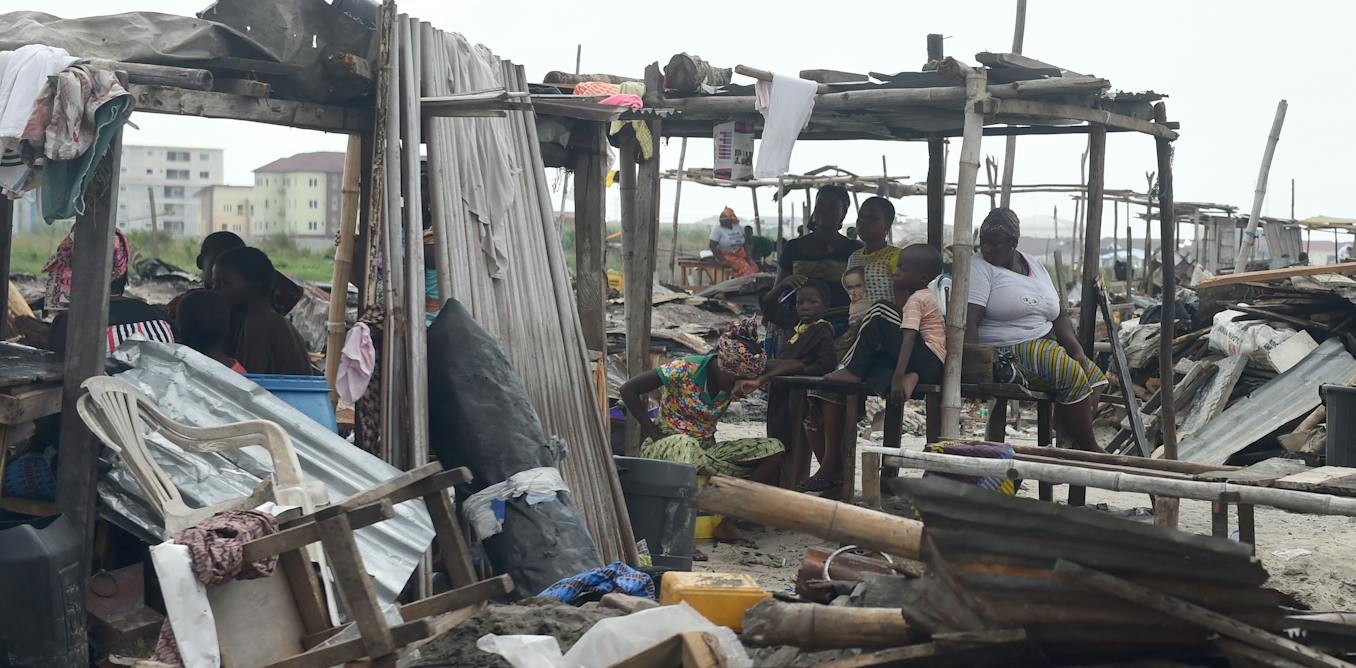
In a waterfront settlement in Lagos, Nigeria, I watched from the shoreline as two men worked a stretch of lagoon from their canoe. One held the boat steady. The other dived underwater a few metres, then surfaced with a bucket full of sand, emptied it into the canoe, and went under again for more. They did this for hours, collecting as much sand as the canoe could hold without sinking before returning to shore.
That sand is sold to households and building sites across Nigeria’s largest city, including neighbourhoods much wealthier than the one the divers live in. It gets packed around foundations and under floors to lift land and structures above water. In a city where more than 40% of the surface is water or wetland and climate change is increasing flooding, sand is a flood defence.
I was observing the activities of the two men during my research into climate change impacts in Lagos. As a climate social scientist who studies adaptation and migration, I set out my findings on adaptation infrastructures in a recent paper about 20 informal settlements in Lagos. I wanted to understand how people living in Lagos’s poorest neighbourhoods built homes and resilient livelihoods, particularly in the face of climate change.
My research found that residents whose homes clustered along waterways, canals and shorelines – where flooding and coastal erosion hit hardest and have the least protection from climate change – had built organised systems for living with it. And those systems supplied the rest of the city as well as themselves. For example, residents dug boreholes to get water and then sold it to households in the settlement and to surrounding residences.
But city authorities ignore these activities. They have demolished at least six settlements since July 2023. When a settlement is cleared, whether in the name of safety, development or climate protection, working infrastructure is destroyed along with the housing.
Residents of Lagos’s informal settlements are not waiting for climate protection to reach them. They are producing it, for themselves and for the formal neighbourhoods that buy their sand and their water. That means adaptation planning can begin with an inventory of what works rather than a demolition.
Read more:
Lagos slum evictions don’t work: 6 ways city planners can actually help the poor
A city growing faster than its services
Lagos has grown from about a million people in 1970 to somewhere between 17 million and 21 million. Nobody can count precisely, partly because so many people move into and out of the city daily. Housing, roads, drainage and water supply never caught up to this growth, and more than 60% of Lagosians live in informal housing – homes built without official permits and plans.
The state government has a different city in mind. A Lagos State commissioner of housing described the goal to me in 2016 as building “the next Dubai”. That ambition is visible in Eko Atlantic, a district rising on land reclaimed from the ocean behind a seawall called the Great Wall of Lagos.
The seawall protects high-end real estate. Downshore, researchers have documented worsened erosion and flooding in the communities left outside it.
Lived realities
I spent four months doing ethnographic fieldwork in Lagos – observing daily life, sitting in community meetings, interviewing officials and developers, and following water sellers, waste collectors and sand divers as they moved between settlements and the rest of the city. I never asked residents to label their own work as climate adaptation. I watched the labour.
My observations can be put into two categories: the strategies people used to make their homes; and how they had adapted to making a living – what I term adaptation livelihoods.
I found that residents had built organised systems, which I call adaptation infrastructures: the routines, knowledge and materials a community assembles to manage flooding while also meeting daily needs like water and transport.
In the Ijora settlement, plank bridges on bamboo supports have grown from temporary rainy-season walkways into a permanent raised network, rebuilt higher each time the water gains on them. The main routes have handrails. The side routes do not, and crossing them is frightening.
The work continues inside houses. Doorway barriers hold back ordinary rain while letting people step over to enter rooms. Plastic waste is bought from vendors, melted, and compacted into raised interior floors, with the height determined by high-water marks of past floods. The point, as one woman explained, is to stay home and keep life ordinary while the water is up.
When it came to livelihoods I found that climate adaptation provides jobs that help both formal and informal neighbourhoods. Sand diving is one. So is collecting and grading plastic waste for land-filling. Another is digging boreholes and carting water to households.
And yet, none of this effort is sufficient.
Land keeps sinking. Water tables rise. Saltwater is reaching boreholes. Within a single settlement, households that can afford to buy and process garbage stay dry while their neighbours move possessions to higher shelves and wait.
These systems are directly responding to climate change and could be scaled and supported through state investment, building on rather than clearing them.
Read more:
Lagos city planning has a history of excluding residents: it’s happening again
What demolition destroys
What clearance does is visible in Otodo Gbame, a waterfront fishing community of tens of thousands on the Lagos lagoon that was demolished in 2016. The bridges went, and the shared wells, and the informal electrical connections. Sand divers and fish smokers lost the shoreline their work required. Water sellers lost their boreholes and their customers in the same week.
Residents scattered across Lagos were cut off from the materials and the neighbours that made their adaptations function. Clearing settlements in the name of protection actually makes people more vulnerable.
Moving forward
In December 2025, bulldozers arrived in Makoko, the largest informal settlement in Nigeria. The United Nations condemned the demolitions, saying more than 40,000 people had been displaced. Lagos State suspended the demolitions and announced a US$10 million plan to build a “water city” in Makoko’s place.
Adaptation planning should start by establishing what a settlement already has.
There is an urgent need for this in Makoko, where most water networks, waste routes and raised walkways are still standing. Recording those systems before the water city design is finalised could be the difference between a project that works and one that destroys flood-management capacity.
-

-

-

-