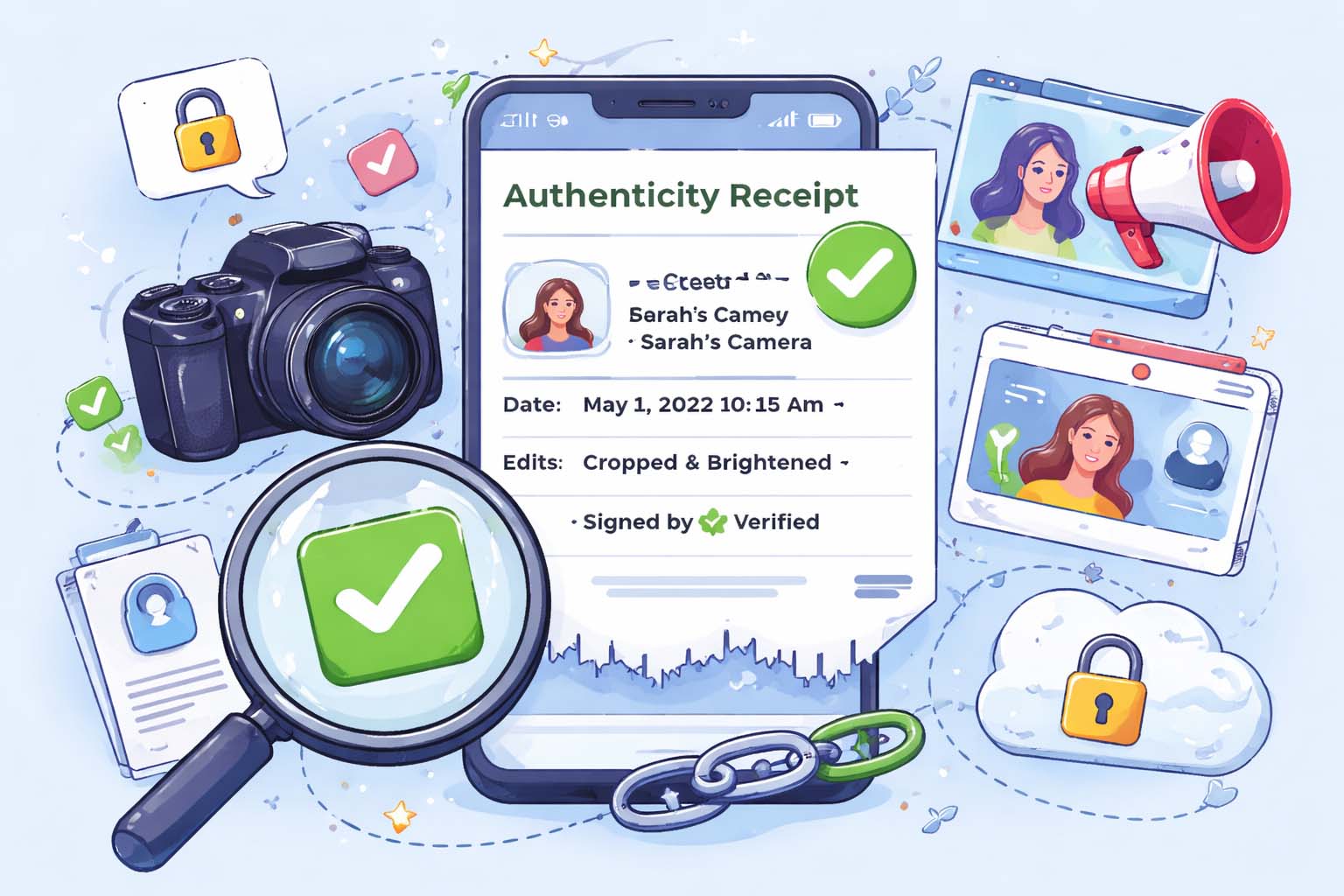
Imagine every photo and video on the internet came with a receipt. Not a shopping receipt—a “where did this come from and what happened to it?” receipt.
That’s digital provenance.
It’s the idea that when something is posted online—especially images, video, audio, documents—we should be able to check:
- Who made it (or what device/app made it)
- When it was created
- Whether it was edited
- Where it has been shared
- Whether it’s the original, or a copy that was changed
Because right now, the internet has a big problem: it’s getting harder to tell what’s real.
What “Digital Provenance” Means
Provenance = the story of where something came from.
Like:
- A painting in a museum has records proving it’s the real one.
- A football shirt signed by a player might come with a certificate.
Digital provenance does the same thing for online content.
Think of it like a passport + history log for a photo or video.
Why We Need It (Deepfakes, Scams, Fake News)
Here’s why it matters:
- Deepfake videos can make it look like someone said something they never said.
- Fake screenshots can ruin reputations in minutes.
- Scams use AI voices and “proof” images to trick people.
- Edited clips can remove context and change the meaning.
Digital provenance won’t stop people from lying—but it can make truth easier to prove.
The “Receipt” Concept: What Provenance Looks Like
A provenance-enabled image/video can include:
- ✅ Created by: iPhone 17 Pro / Adobe camera / etc.
- ✅ Date/time created
- ✅ Edits made: cropped, colour adjusted, background removed, face altered
- ✅ Signed by: the device/app using cryptography (fancy math locks)
- ✅ Publisher info: which verified organisation posted it first (if they choose)
Then, any platform or person can press something like:
“View authenticity details”
…and see the receipt.
How It Works
Digital provenance usually uses three ideas:
1) Metadata (Info Hidden Inside the File)
This is extra information stored with an image/video—like a label.
Problem: metadata can be removed or faked.
2) Cryptographic Signatures (Tamper Evidence)
A trusted tool (camera/app) adds a special “seal.”
If the content changes later, the seal breaks.
Like a tamper sticker on a medicine bottle.
3) Chain of Custody (A History of Changes)
Some systems record a timeline:
- created → edited → exported → published
So you can see what changed and when.
Is Digital Provenance the Same as a Watermark?
Not really.
Watermark
- visible text/logo over the image
- easy to crop out or blur
- doesn’t tell you the full history
Digital provenance
- can be invisible
- shows creation + edits
- can be checked by tools/platforms
A watermark says: “This is mine.”
Provenance says: “Here’s the evidence.”
The Big Standard You’ll Hear About: C2PA (Simple Explanation)
There’s a growing industry standard for this, often called C2PA (it’s like a “ruleset” for content receipts).
In simple terms:
- Cameras/apps can attach Content Credentials
- Viewers can inspect them to see what’s authentic
Big tech and media organisations have been working on this so different tools can “speak the same language.”
What Digital Provenance Can’t Do (Important!)
It’s powerful, but not magic.
It can’t guarantee truth
If someone films a staged event, the provenance can still say: “Yes, this is the original video.”
It won’t cover everything
Lots of content will still be posted without provenance.
Bad actors can still screenshot things
A screenshot removes the receipt unless platforms support carrying it forward.
So provenance works best when:
- cameras/apps add it by default
- platforms keep it attached
- viewers learn to check it
How You Can “Check What’s Real” Right Now
Even before provenance becomes normal everywhere, you can do basic checks:
- Reverse image search (to see if the image existed years ago)
- Look for original source (who posted it first?)
- Check context (date, location, other angles)
- Watch for AI clues (weird hands, warped text, odd reflections)
- Use platform labels when available (“AI-generated”, “edited”, etc.)
What This Means for the Future (2026+)
Over the next few years, you’ll likely see:
- Cameras and editing apps adding authenticity receipts automatically
- Social platforms showing “verified media” badges
- News organisations publishing with proof-of-origin
- Workplaces and schools requiring provenance for evidence and submissions
The goal isn’t to make fake content impossible.
It’s to make real content provable.
FAQs
What is digital provenance in simple terms?
It’s a digital receipt that shows where a photo/video came from and whether it was edited.
Does digital provenance stop deepfakes?
Not directly. It helps you spot what’s verified and what has no proof of origin.
Is provenance the same as “AI detection”?
No. AI detection guesses. Provenance provides evidence (a creation and edit record).
Can people remove provenance?
Sometimes, yes—especially if they screenshot or re-export. But new tools and platforms are working to preserve it.
Will platforms like social media show provenance automatically?
That’s the direction things are heading—more apps are adding “view details” style features as standards spread.