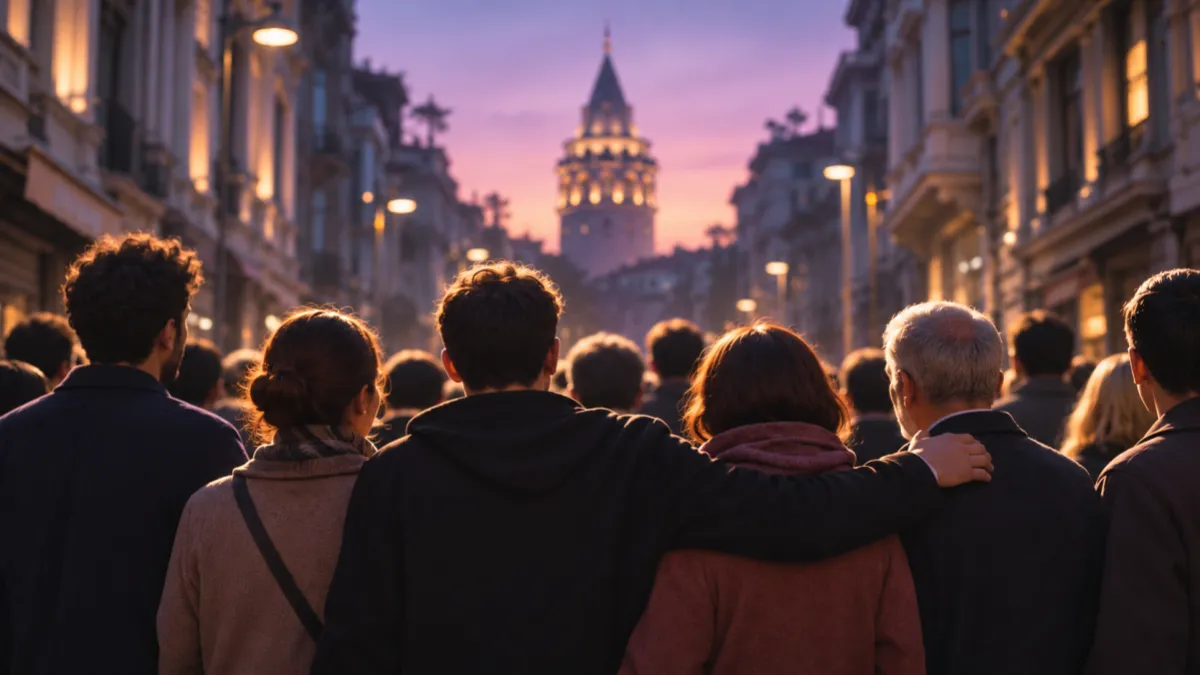
A bomb exploded on Istiklal Avenue in Istanbul on a Sunday afternoon in November 2022. Six people died. Eighty-one were injured. The attack shocked the city and triggered a wave of public response. In the days that followed, there was a surge of media coverage, public mourning, and calls for unity—many of which echoed the common narrative that tragedies bring people together. Source: psychologytoday.com.
By chance, however, researchers from Turkey had already begun a study on moral values in Istanbul a month before the bombing. The project was not designed to examine the effects of terrorism. It began as part of a broader inquiry into how individuals perceive and prioritize moral values. Of the 620 adults surveyed, nearly nine in ten lived in Istanbul. They were asked to rate their importance of various moral values and to make two real financial decisions: one involving an anonymous stranger, and another involving a shared group fund.
When the bombing occurred, the researchers realized they had a rare opportunity: a longitudinal dataset of the same individuals before and after a real terrorist attack. Most psychological studies on terrorism either examine different populations before and after an event or rely on hypothetical scenarios. This study, however, tracked the same people over time, providing a more accurate picture of how trauma and fear influence behavior and values.
After the attack, participants reported placing greater value on group-based moral values—such as loyalty, respect for authority, and sanctity. These values are part of a broader psychological framework known as ‘binding values,’ which emphasize group cohesion over individual rights. The increase in these values was modest—rising from 3.98 to 4.08 on a five-point scale—and it was consistent across political affiliations. This suggests that the experience of threat did not shift people toward more conservative moral views, as some theories predict.
Yet, the financial decisions revealed a more complex picture. Before the attack, participants gave an average of 36 Turkish liras (about $5.50) to an anonymous stranger. Afterward, that dropped to 29 liras. This decline was not just a statistical anomaly—it reflected real, tangible behavior. In the second decision, participants chose how much to contribute to a group fund. Whatever was contributed was doubled and shared equally among all members. The group benefits when everyone participates, but each individual gains only by keeping their own money.
Half of the returning participants were briefly reminded of the bombing before making their financial choices. The other half made their decisions without that reminder. Those who were reminded contributed less—about 40 liras—compared to 46 liras before. Those not reminded showed no significant change. This indicates that the memory of the attack directly influenced generosity, but only in specific contexts.
One well-known psychological theory suggests that when people feel threatened, they become more conservative in their values—especially liberals. After the 2005 London bombings, a British study found that liberal individuals shifted toward more conservative moral perspectives. In this study, however, no such shift was observed. The rise in binding values was similar across political sides, suggesting that the experience of threat may not uniformly reshape moral beliefs.
Still, a subtle difference emerged in how people valued individual care and equality. Participants on the political right showed a decline in these values after the attack, while those on the left showed little change. This divergence may reflect deeper ideological differences in how people interpret threats and personal responsibility. It also suggests that the emotional response to violence may not be uniform, and that pre-existing beliefs may shape how individuals interpret and react to trauma.
The setting is also important. In an earlier study, young voters in Türkiye already demonstrated strong endorsement of binding values. This implies that the observed changes may not be a direct result of the attack, but rather a reflection of long-standing cultural or social norms. The findings challenge the assumption that tragedies automatically foster social unity. While people may feel more connected to their group emotionally, they do not necessarily become more generous or cooperative in action.
Moreover, the study highlights a critical distinction: valuing a group is different from acting in ways that support shared well-being. The increase in loyalty and authority does not translate into increased generosity or solidarity. This gap between emotional values and actual behavior is a key insight for understanding human responses to violence.
While this study offers a rare look at how people in Turkey responded to a real attack, it is limited in scope. The sample was confined to Istanbul, and the findings may not generalize to other cities or cultures. Future research could explore how different types of threats—such as natural disasters or economic crises—shape values and behavior. It could also examine how cultural context influences the emotional and behavioral responses to violence.
Ultimately, this research does not claim to explain all human responses to violence. It simply shows that, in this case, people did not become more united in action. The idea that terrorism brings people together remains a powerful narrative, but the data suggest it is not always true—especially when measured through real behaviors like generosity and cooperation.
Sources & further reading
Featured image: original publisher image. Via original publisher. Image source