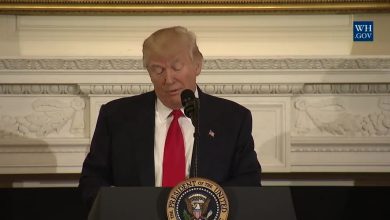
The dollar index (DXY00) on Friday rose +0.12%. The dollar recovered from a 2-week low on Friday and finished higher. Tariff tensions resurfaced on Friday, pushing the dollar higher, after President Trump threatened to raise tariffs on European automobile imports to as high as 25%.
The dollar initially moved lower on Friday after crude oil prices fell more than -3%, which eased inflation expectations, a dovish factor for Fed policy, and a negative factor for the dollar. The dollar fell to its low on Friday after the release of the weaker-than-expected Apr ISM manufacturing report.
Join 200K+ Subscribers:
Find out why the midday Barchart Brief newsletter is a must-read for thousands daily.
Heightened US-Iran tensions are boosting demand for the dollar as a safe-haven. The US and Iran are locked in a battle for control of the Strait of Hormuz, with both sides blocking the waterway to gain leverage during an extended ceasefire. President Trump said he was sticking with a naval blockade of Iran, and Iran’s Supreme Leader, Mojtaba Khamenei, vowed not to give up Iran’s nuclear or missile technologies and said Iran would keep control of the Strait of Hormuz.
The US Apr ISM manufacturing index was unchanged at 52.7, weaker than expectations of an increase to 53.2. The Apr ISM prices paid sub-index rose +6.3 to a 4-year high of 84.6, above expectations of 80.3.
Swaps markets are discounting the odds at 8% for a 25 bp rate cut at the next FOMC meeting on June 16-17.
EUR/USD (^EURUSD) fell from a 1.5-week high on Friday and finished down by -0.06%. The euro gave up early gains on Friday and turned lower as tariff tensions heated up after President Trump threatened to raise tariffs on European automobile imports to as high as 25%.
The euro initially moved higher on Friday due to hawkish comments from ECB Governing Council member Nagel, who said the ECB will have to raise interest rates in June unless the inflation outlook improves. Also, sharply lower crude oil prices on Friday were supportive of the Eurozone economy and the euro, as Europe imports most of its energy. Trading activity was well below normal on Friday, as markets in Europe were closed for the Labor Day holiday.
ECB Governing Council member and Bundesbank President Joachim Nagel said the ECB will need to increase interest rates in June if “the inflation outlook does not improve markedly.”
Swaps are discounting an 89% chance of a +25 bp rate hike by the ECB at the next policy meeting on June 11.
USD/JPY (^USDJPY) on Friday rose by +0.28%. The yen fell from a 2-month high against the dollar on Friday and turned lower as tariff tensions between the US and EU boosted the dollar. The yen also came under pressure on Friday from the weaker-than-expected Japan Apr Tokyo CPI report, which is dovish for BOJ Policy and negative for the yen.
The yen initially moved higher on Friday after Japan’s Apr S&P manufacturing PMI was revised higher to its strongest pace of expansion in 4.25 years. The yen also has carryover support from Thursday when the Japanese government and the BOJ conducted yen-buying operations in the forex market, spending about $34.5 billion to support the yen, according to Bloomberg analysis of central bank accounts. In addition, sharply lower crude oil prices on Friday were positive for the Japanese economy and the yen, as Japan imports more than 90% of its energy needs.
The Japan Apr S&P manufacturing PMI was revised upward by +0.2 to 55.1 from the previously reported 54.9, the strongest pace of expansion in 4.25 years.
Japan Apr Tokyo CPI rose +1.5% y/y, weaker than expectations of +1.7% y/y. Apr Toyo CPI ex-fresh food and energy rose +1.9% y/y, weaker than expectations of +2.2% y/y and the slowest pace of increase in 14 months.
The markets are discounting a +65% chance of a 25 bp BOJ rate hike at the next policy meeting on June 16.
June COMEX gold (GCM26) on Friday closed up +14.90 (+0.32%), and July COMEX silver (SIN26) closed up +2.403 (+3.25%).
Gold and silver prices moved higher on Friday, with silver up sharply at a 1-week high. Friday’s plunge in crude oil prices was supportive for precious metals as it eases inflation concerns and could prompt the world’s central banks to ease monetary policy, a bullish factor for precious metals. Friday’s rebound in the dollar from a 2-week low to higher on the day knocked precious metals down from their best levels.
Heightened Middle East tensions are positive for safe-haven demand of precious metals as both the US and Iran are maintaining blockades of the Strait of Hormuz. President Trump said he was sticking with a naval blockade of Iran, and Iran’s Supreme Leader, Mojtaba Khamenei, vowed not to give up Iran’s nuclear or missile technologies and said Iran would keep control of the Strait of Hormuz.
Bearish factors for precious metals include President Trump’s comments on maintaining the naval blockade against Iran, which could keep energy prices elevated and add to inflationary pressures that keep the world’s central banks from easing monetary policy. Also, hawkish comments on Friday from ECB Governing Council member Nagel weighed on precious metals, as he said the ECB will raise interest rates in June unless inflation improves.
Precious metals also remain supported by uncertainty over US tariffs, US political turmoil, large US deficits, and government policy uncertainty, which are boosting demand for precious metals as a store of value.
Recent fund liquidation of precious metals is bearish for prices, as long holdings in gold ETFs fell to a 4.5-month low on March 31 after climbing to a 3.5-year high on February 27. Also, long holdings in silver ETFs fell to an 8.5-month low on Thursday after rising to a 3.5-year high on December 23.
Strong central bank demand for gold is supportive of gold prices, following the recent news that bullion held in China’s PBOC reserves rose by +160,000 ounces to 74.38 million troy ounces in March, the seventeenth consecutive month the PBOC has boosted its gold reserves.
On the date of publication,
did not have (either directly or indirectly) positions in any of the securities mentioned in this article. All information and data in this article is solely for informational purposes.
For more information please view the Barchart Disclosure Policy
here.
The views and opinions expressed herein are the views and opinions of the author and do not necessarily reflect those of Nasdaq, Inc.