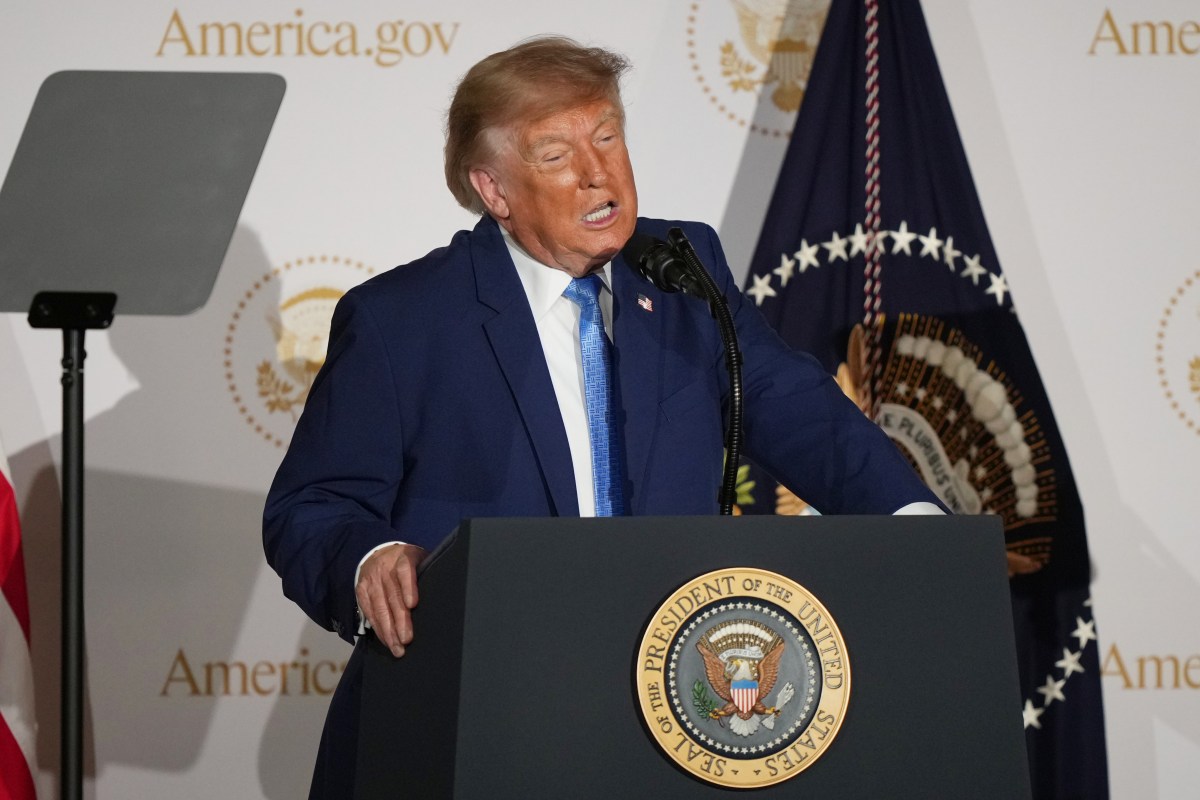
President Donald Trump launched America.gov on Tuesday, unveiling what the administration has billed as a new AI-powered gateway to federal information and services that aims to streamline Americans’ interactions with the government.
The website, which Trump introduced at Andrew W. Mellon Auditorium in Washington, features a chatbot-style interface that allows users to ask questions about government programs, benefits and services. The administration described America.gov as a “front door” to federal resources, consolidating information that is currently spread across dozens of agency websites.
“It’s not just simply a website. It’s a restoration of America’s founding promise, and it’s a reinvention of your government for the 21st century and beyond,” Trump said at the rollout.
The debut of America.gov comes as policymakers, technology companies and privacy advocates continue to debate the expanding role of artificial intelligence in public-facing services. While AI tools have been touted for their ability to simplify complex tasks and improve access to information, experts have raised concerns about accuracy, transparency and data privacy, particularly when such systems are used to help people access government programs or services.
Asked at the announcement about risks associated with AI and centralized government services, Centers for Medicare and Medicaid Services Administrator Mehmet Oz told Newsweek the administration does not want all user data stored in a single location. Instead, he described America.gov as a “federated system” in which individuals maintain control of their own records and choose whether to share them. Oz acknowledged that any system allowing access to sensitive information carries risks, but said federal officials are prioritizing cybersecurity and data protection as the platform evolves.
“We don’t want all the information in one link,” Oz said. “The real risk we have is if all your data is in one spot … anyone who hacks it gets it all.”
The president said Tuesday, “It cannot in theory be hacked into. And when they figure a way to do that, we’ll end it, because they always figure a way, right?”
Joe Gebbia, U.S. chief design officer, said America.gov is powered by Google’s Gemini and Elon Musk‘s Grok. Trump was joined by Musk, administration officials and tech leaders for the announcement.
Newsweek has reached out to the White House via email on Tuesday morning for comment.
What Trump’s America.gov Executive Order Does
Trump signed an executive order Tuesday that directs federal agencies to integrate their online services with America.gov, which the administration envisions as a single digital portal for accessing government information and completing transactions.
The White House said the platform will eventually allow users to perform tasks such as renewing passports and enrolling in Medicare, while Login.gov, the federal government’s existing sign-in system, will be incorporated into the service.
The order applies to public-facing federal services used by more than 100,000 people annually, although IRS tax-filing services and certain national security-related functions are excluded.
“This is the American government working for the American people. Come to America.gov, tell us what you need. We’ll help you get there and, ultimately, we’ll help you get it done,” Edward Forst, Administrator of the U.S. General Services Administration (GSA), told Newsweek at Tuesday’s announcement.
Expert Warns of Risks Alongside Benefits
Nicol Turner Lee, a senior fellow and director of the Center for Technology Innovation at the Brookings Institution, said AI could help simplify a federal bureaucracy that often requires people to navigate multiple websites and eligibility requirements.
“Using AI, in theory, could help alleviate some of that burden and enable people to find information relevant to their circumstances faster and more easily,” she told Newsweek via email, adding that the technology could free federal workers to focus on other tasks.
“However, users will need accountability when something goes wrong to ensure Americans do not bear the burden of missing out on government services if AI fails,” Turner Lee continued.
Turner Lee also warned against replacing traditional forms of government assistance with AI-driven tools.
“AI-powered services should not be a replacement for humans who are there to help Americans get the necessary information and access to services,” she said, arguing that agencies should carefully evaluate whether artificial intelligence is the most effective method for delivering specific government services.
“When it comes to government services, the results of this could be devastating if Americans miss a deadline, misunderstand eligibility, or are fed misinformation.”

Who Is Joe Gebbia?
The launch of America.gov also highlights the growing influence of Gebbia, the Airbnb co-founder whom Trump tapped in 2025 to lead the newly created National Design Studio. Established under the administration’s “America by Design” initiative, the office is responsible for modernizing federal websites and digital services.
The chatbot-based America.gov portal represents one of the most visible examples of Gebbia’s effort to apply Silicon Valley-style design principles to the federal government.
Testing America.gov
- In a test of the platform, America.gov responded to a question about disabled veterans’ benefits with a detailed breakdown of available VA programs, including disability compensation, health care, vocational rehabilitation and housing assistance. The chatbot cited official government resources and linked directly to VA webpages, providing a level of specificity comparable to a traditional agency help page but in a conversational format.
- In another test, America.gov handled a more complex, real-world scenario involving a move from New York to Virginia. Rather than providing a generic answer, the chatbot explained that there is currently no single federal address-change system and walked through the steps required to update records with multiple agencies, including the U.S. Postal Service, IRS, Social Security Administration and Department of Veterans Affairs. It also distinguished between federal and state responsibilities, directing users to Virginia agencies for matters such as driver’s licenses and taxes. The response included numerous links to official government resources and concluded by noting that America.gov plans to eventually offer a centralized address-update function, illustrating the administration’s vision for the platform as more than just an informational chatbot.
- When asked whether a 12-year-old could enroll in Medicare, the chatbot correctly responded that children generally are not eligible for the program, before outlining a narrow exception for minors with end-stage renal disease whose families meet certain eligibility requirements. It also pointed users toward Medicaid and the Children’s Health Insurance Program (CHIP) as more common sources of coverage for children, while linking to official Medicare and Social Security resources. The response suggested the system can provide nuanced answers to unusual questions rather than simply defaulting to a generic explanation of Medicare eligibility.
- The America.gov chatbot provided direct answers Tuesday to a series of questions about the 2020 election, presidential term limits, impeachment proceedings and other politically sensitive topics when Newsweek tested the system shortly after its debut. Newsweek submitted 15 prompts to the chatbot between 12:54 p.m. and 1:06 p.m. ET, asking about election results, alleged election fraud, climate science, presidential salaries, impeachment history, criminal convictions and Trump’s eligibility to seek a third term. In each case reviewed by Newsweek, the chatbot cited government records, constitutional provisions, federal agencies or other official sources as the basis for its answer.


Tech Titans Gather at White House for AI Summit
The launch of America.gov coincided with a high-profile White House gathering of some of the technology industry’s most influential executives.
Trump hosted a lunch focused on AI shortly after unveiling the new portal Attendees include Amazon founder Jeff Bezos, Nvidia CEO Jensen Huang, OpenAI co-founder Greg Brockman, Anthropic CEO Dario Amodei, Microsoft CEO Satya Nadella, Tesla and SpaceX CEO Elon Musk, Palo Alto Networks CEO Nikesh Arora and Altimeter Capital CEO Brad Gerstner.
The technology leaders joined Vice President JD Vance, House Speaker Mike Johnson, Treasury Secretary Scott Bessent, Commerce Secretary Howard Lutnick and White House Chief of Staff Susie Wiles. The meeting comes as artificial intelligence is playing an increasingly prominent role in both the private and public sectors, with governments around the world grappling with how to harness the technology while addressing concerns about accuracy, privacy and security.
Later Tuesday, Trump said the major artificial intelligence companies had agreed to a voluntary framework featuring internal and external reviews.
“I think I’m seeing tremendous self-policing. And they understand that they have to self-police,” Trump told reporters outside the West Wing.
Amodei, one of the technology industry’s most prominent advocates for slowing the pace of AI development, warned that the technology carries “very real risks.”
“The mechanism, how we address those risks, is still under discussion,” Amodei said.
Meta CEO Mark Zuckerberg said the voluntary accord establishes a framework for internal safeguards and independent oversight, including audits designed to identify potential problems with AI systems.
“We’re going to have all of our boards of directors independently review the reports that come from the auditors,” Zuckerberg said.
Trump said the agreement would include a committee of roughly 10 people tasked with overseeing compliance and described the accord as “morally binding.” The president added that he expects to name an individual to oversee the initiative in the coming days following consultations with industry leaders.
Newsweek’s reporters and editors used Martyn, our AI assistant, to produce this story. Learn more about Martyn here.
Contact Newsweek editors on this story: Gabe Whisnant and Dave Siminoff.