
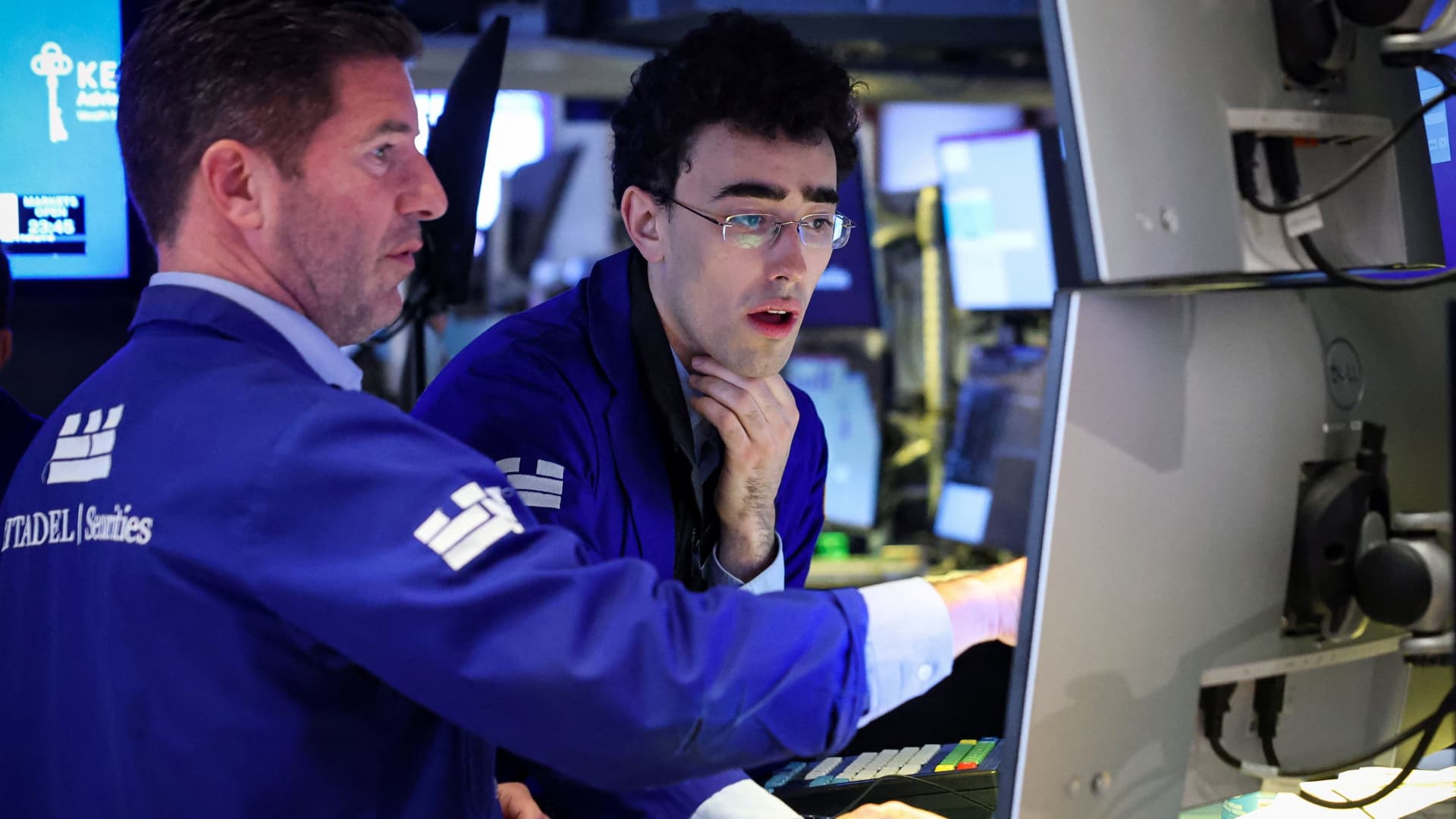
Stocks finish sizably higher
The three major averages finished with solid gains on Monday.
The S&P 500 jumped 1.02% to end the day at 6,886.24, while the Nasdaq Composite advanced 1.23% to close at 23,183.74. The Dow Jones Industrial Average climbed 301.68 points, or 0.63%, to 48,218.25.
— Sean Conlon
Tom Lee says the market has a way of discounting outcomes
Tom Lee, Fundstrat head of research, said the current rally suggests investors expect a favorable resolution, with equities climbing despite what he described as a “fog” of war.
“The market does have a really good way of discounting outcomes. And I think the reason it’s going up is … we’re gonna end up with a favorable outcome,” Lee said on CNBC’s “Power Lunch” Monday.
Lee said markets have historically shown an ability to anticipate turning points even amid conflict, pointing to World War II. The stock market bottomed in May 1942, just months after the U.S. entered the war and before troops were deployed in major regions, he noted.
— Yun Li
History shows stocks are poised for a recovery, UBS says
Traders work on the floor of the New York Stock Exchange during morning trading on April 13, 2026 in New York City.
Michael M. Santiago | Getty Images
The historical pattern from previous geopolitical conflicts show that the stock market is poised for a solid recovery, according to UBS. Indeed, when the S&P 500 drops 5% to 10% within three to four weeks, the firm found that it is typically above its pre-conflict level just six months later.
That could help explain in part the stock market’s resiliency in the face of a breakdown in U.S.-Iran negotiations over the weekend, with the major averages mostly taking it in stride. The S&P 500 was little changed, even in spite of a spike in oil prices.
But the Wall Street firm warned investors against complacency, as an escalation of tensions between the two countries is not at all priced into the market. At the same time, the effect of oil prices on the consumer, while expected to be temporary, could take months to understand.
“This is not an argument against a constructive medium-term investment outlook, and relatively light investor positioning is poised to be a near-term market tailwind,” read a Monday note from the UBS Global Wealth Management (GWM) Chief Investment Office (CIO). “But geopolitics are hard to predict and often full of unexpected plot twists, and the US-Iran conflict is unlikely to be any different.”
— Sarah Min
Loop Capital reiterates buy rating, $325 price target for Apple after MacBook Neo unveiling
Apple is poised to see strong growth as its most affordable laptop ever hits the market, according to Loop Capital.
The investment firm reiterated its buy rating on Apple. It also maintained its $325 price target on shares.
With a starting price of $599, the Neo is almost half the cost of some of Apple’s higher-end laptops. Apple’s new MacBook Air 13-inch M5 model starts at $1,099, whereas the 16-inch MacBook Pro with M5 Max starts at $3,899.
The laptops were unveiled during the company’s three-day hardware blitz last month.
“Simplistically we are looking for 3 million Neo’s in [2026] to start, and we are adjusting Product [gross margin] to 35.0% once we reach the Sep [quarter] from 40.7% in the Dec [quarter] and 37.7% in the Mar [quarter] (after seeing 33.0% – 34.0% in the Jun [quarter]),” Loop Capital analysts wrote.
— Liz Napolitano and Morgan Chittum
Evercore sees more than 20% upside for Toll Brothers, Pulte Group
Evercore ISI upgraded both Toll Brothers and PulteGroup to outperform from in line on Monday.
Homebuilders have had a rough several months and continue to face rising mortgage rates and volatile consumer confidence, analyst Steven Kim said in a note Monday. In this environment, active adult and move-up segments have outperformed.
“Accordingly, PHM and TOL have sustained meaningfully higher operating margins than the majority of their peers and have seen considerably less deterioration relative to 4Q19,” he wrote. “While we wait for a broader-based turn in fundamentals to materialize, we expect the strength in the higher-end segments to remain more resilient and help sustain PHM’s and TOL’s earnings and cash flow, particularly on a relative basis.”
His $176 price target on Toll Brothers suggests nearly 26% upside from Friday’s close and his $146 target on PulteGroup implies 21% upside.
Kim also upgraded building products company Masco to outperform from in line, citing its favorable price/cost relationship to the group and its minimal exposure to new residential volumes.
— Michelle Fox
S&P turns positive for the year
Traders work on the floor of the New York Stock Exchange during morning trading on April 13, 2026 in New York City.
Michael M. Santiago | Getty Images
The S&P 500 in midday trading on Monday briefly went into the green for 2026.
The broad based index was up nearly 0.5% on the day, putting it just up 0.05% for the year. At the closing lows of the U.S.-Iran war, the S&P was off more than 7% for 2026. The Nasdaq Composite and Dow Jones Industrial Average remain negative for the year by 0.3% and 0.8%, respectively.
Stocks have rallied back from those lows on the hopes there will be a resolution soon to the conflict in the Middle East and that its consequences to the U.S. economy so far have been minimal.

.SPX year-to-date chart.
— Davis Giangiulio
Stocks making midday moves: Oracle, Conagra, Allogene Therapeutics
Here are some of the stocks making headlines in midday trading:
- Oracle — Shares of the cloud platform provider popped more than 9% as Oracle touted some of its artificial intelligence capabilities at its Customer Edge Summit. The company highlighted its Oracle Utilities Opower AI-driven platform, noting that it helped residential utility customers save $369 million in 2025.
- Conagra — The Duncan Hines and Slim Jim packaged food company saw shares fall more than 5%. Conagra announced John Brase would take the helm as CEO, effective June 1. Brase, an alumnus of J.M. Smucker, will replace Sean Connolly. Share are down more than 17% in 2026.
- Allogene Therapeutics — The biotech company soared nearly 30% on the back of positive phase 2 data, which showed that the company’s CAR T treatment showed improved eradication of cancer cells in lymphoma patients.
Read here for the full list of stocks.
— Davis Giangiulio
Analysts spotlight Goldman Sachs’ FICC revenue miss
Goldman Sachs shares were last lower by more than 2% Monday following its earnings report, as Wall Street analysts’ attention turned to the downside risk versus the headline strength: although the bank posted record equities trading revenue for the first quarter, its reported revenue on fixed income, currencies, commodities (FICC) fell 10%, missing expectations.
Bank of America said Goldman’s results for the quarter overall were “solid” but “clouded by [the] FICC miss.”
Wolfe Research was less optimistic. “On balance, these results are disappointing (albeit vs. lofty expectations), with pressure on FICC … indicating some ‘bad volatility’ towards the end of the 1Q,” with higher commodities and foreign exchange trading “more than offset by weakness in “interest rate trading, mortgage-related trading and credit trading.
Wells Fargo said the FICC loss wasn’t just weak, it was “a little surprising relative to peer guidance and balance sheet growth.”
—Tanaya Macheel
T-Mobile gets an upgrade from KeyBanc
Signage at a T-Mobile store in New York, US, on Wednesday, Oct. 22, 2025.
Michael Nagle | Bloomberg | Getty Images
KeyBanc Capital Markets sees T-Mobile returning to levels it hasn’t traded at in a year, and thinks it’s time to get into the stock.
The investment bank upgraded its rating on the telecommunications company to overweight from sector weight in a Sunday note. Analyst Brandon Nispel has a $260 price target, which indicates a nearly 33% gain from Friday’s close. Nispel wrote that accelerating organic earnings growth, a competitive advantage for fixed wireless access and mobile share gains and a strong balance sheet should send shares higher.
“With valuation compressed relative to history and peers, we think there is reasonable downside protection,” Nispel wrote. “While we don’t dismiss incremental competition (VZ/Starlink), we don’t see either as changing T-Mobile trajectory.”
Nispel added he thinks the company’s first quarter earnings report, set to be released on April 28, will deliver a beat and raise that could be a catalyst higher for the stock.
— Davis Giangiulio
Stablecoin stock Circle surges on renewed optimism around Clarity Act talks
Circle climbed to start the week as the Senate returns from a two-week recess, after leaving unresolved disputes over the Clarity Act (the bipartisan bill designed to establish clear regulatory roles for crypto assets), mainly over stablecoin rules.
Circle, the issuer of the USDC stablecoin, surged more than 9%. Coinbase, a major distributor of USDC and partner in its ecosystem, gained more than 2%.
Clear Street analyst Owen Lau cited investor “anticipation of some positive news coming out from the Senate on the Clarity Act this week” and “speculation that the Clarity Act could be presented to the Senate Banking Committee this week.”
“There is still a belief that the Clarity Act could get passed this year,” he told CNBC.
— Tanaya Macheel
Existing home sales fell in March to lowest since June
Homes in Daly City, California, US, on Monday, March 23, 2026.
David Paul Morris | Bloomberg | Getty Images
Existing home sales hit a nine-month low in March as rising mortgage caused a hit to the housing market, the National Association of Realtors reported Monday.
The seasonally adjusted annual sales rate of 3.98 million marked a 3.6% monthly decline and missed the Dow Jones consensus estimate for 4.05 million. It was also the lowest total since June 2025.
Mortgage rates climbed sharply in March, hitting a peak of 6.64% for a 30-year loan near the end of the month, according to Mortgage News Daily. The rate has since fallen by a bout a quarter percentage point during the U.S.-Iran ceasefire.
The median home sales price rose 1.4% from a year ago to $408,800.
— Jeff Cox
Trump threatens to destroy Iranian ships that violate Hormuz blockade
US President Donald Trump speaks the the media after disembarking from Air Force One on April 12, 2026 at Joint Base Andrews, Maryland.
Tasos Katopodis | Getty Images
President Donald Trump issued a warning Monday against Iranian ships trying to thwart a U.S. blockade of the Strait of Hormuz.
“Iran’s Navy is laying at the bottom of the sea, completely obliterated – 158 ships. What we have not hit are their small number of, what they call, ‘fast attack ships,’ because we did not consider them much of a threat,” Trump posted on his social network. “Warning: If any of these ships come anywhere close to our BLOCKADE, they will be immediately ELIMINATED, using the same system of kill that we use against the drug dealers on boats at Sea.”
The threat came just minutes after the U.S. began block ships entering the strait in an attempt to accelerate pressure on Iran to reopen the vital waterway. Earlier, Trump had accused Iran of “WORLD EXTORTION” for its efforts to block traffic in the area.
— Jeff Cox
Bitcoin pulls back following its best week since October
Bitcoin fell back to the $70,000 level over the weekend after talks to end the Iran war ended without a resolution.
On Friday, the flagship cryptocurrency finished above $73,000 and gained about 9% for the week — posting its second up week in a row and strongest week since Oct. 3.
ETFs that track the price of bitcoin collectively saw net inflows of $786.31 million last week, marking the group’s best week since Feb. 27.
Bitcoin gave back gains over the weekend
— Tanaya Macheel
Stocks open lower
U.S. equities began Monday’s trading session in negative territory.
The Dow Jones Industrial Average fell 251 points, or 0.5%. The S&P 500 and Nasdaq Composite each lost 0.2%.
— Sean Conlon
Volatility Index back above 20 Monday after tumbling Wednesday-Friday
Traders work in the S&P options trading pit at the Cboe Global Markets exchange on March 31, 2026 in Chicago, Illinois.
Scott Olson | Getty Images
The CBOE Volatility Index (VIX), a gauge of future expectations for moves in the S&P 500 based on options prices, climbed back above 20 to a high of 21.58 early Monday after closing Friday at its lowest since the start of the Iran war in late February.
The VIX tumbled 18.4% to 21.04 last Wednesday after the two-week U.S.-Iran ceasefire was announced late Tuesday, another 7.4% to 19.49 last Thursday and 1.3% to 19.23 on Friday.
Since the war began, the VIX peaked at a a close of 31.05 on March 27, touching an intraday high of 31.65 the same day.
— Scott Schnipper
UK ‘not supporting’ U.S.’ Strait of Hormuz blockade, PM Starmer says
Prime Minister Keir Starmer, issues a statement regarding the Manchester Synagogue attack, at Downing Street on October 2, 2025 in London, England.
Wpa Pool | Getty Images News | Getty Images
The U.K. is “not supporting” the U.S. blockade of Iranian ports, Prime Minister Keir Starmer said on Monday, insisting that the country would not get “dragged in” to the Iran war.
It came as President Emmanuel Macron confirmed France and the U.K. would, in the coming days, co-host a conference aimed at restoring freedom of navigation in the Strait of Hormuz.
Macron has not explicitly ruled out France’s involvement in the U.S. blockade but said the planned conference would create a “peaceful multinational” and “strictly defensive” mission, separate from the belligerents. Read more.
— Holly Ellyatt
Revolution Medicines says pancreatic cancer drug passes key test
Revolution Medicines reported Monday that its drug for pancreatic cancer had passed a key late-stage trial, opening up potential new treatment for the deadly disease and sending shares soaring.
The said a daily pill called daraxonrasib met all requirements in the Stage 3 trail. People who took the medication lived for 13.2 months, more than double those on chemotherapy.
“These are dramatic, practice-changing outcomes, and our focus now is moving quickly to bring this potential new treatment option to patients who urgently need new treatment,” RevMed CEO Mark Goldsmith said in an interview.
RVMD, 1-day
Shares of Revolution surged 71% in premarket trading.
— Jeff Cox and Angelica Peebles
Williams-Sonoma, Best Buy, Fastenal among the names making moves before the bell.
Check out the companies making the biggest moves premarket:
- Williams-Sonoma — The kitchen and cookware retailer gained more than 2% after getting an upgrade to buy at Goldman Sachs. Analysts at the bank said the stock is trading at attractive levels, adding Williams-Sonoma has “one of the strongest portfolio of brands in retail.”
- Best Buy — Goldman Sachs downgraded the electronics and appliances retailer to sell at Goldman, sending shares down 4%. “While Best Buy will likely see a benefit to [same-store sales] from a pull-forward of PC demand and higher tax returns in Q1, we think there will be risk to sales post Q1 as higher memory costs start to work their way into the price of laptops and computers,” Goldman analysts wrote.
- Fastenal — The industrial and construction supply distributor slid more than 4% after it reported first-quarter earnings that met the Street’s expectations. Fastenal reported 30 cents in earnings per share and $2.2 billion in revenue, meeting the consensus of analysts polled by FactSet.
Read the full list here.
— Davis Giangiulio
Goldman Sachs shares drop despite bank’s quarterly results topping estimates
David Solomon, CEO of Goldman Sachs, speaks during the Reuters NEXT conference, in New York City, U.S., December 10, 2024.
Mike Segar | Reuters
Shares of Goldman Sachs fell more than 3% in premarket trading on Monday, even after the bank’s first-quarter earnings and revenue topped Wall Street’s expectations.
The bank earned $17.55 per share on revenue of $17.23 billion for the period, while analysts surveyed by LSEG had estimated $16.49 in earnings per share and $16.97 billion in revenue.
However, trading in the bank’s fixed income, currencies and commodities unit came in at $4.01 billion. That was far below the $4.92 billion for FICC trading that analysts polled by FactSet had penciled in.
GS, 1-day
— Hugh Son and Sean Conlon
Goldman Sachs upgrades Williams-Sonoma
The kitchen and cookware retailer gained more than 2% after getting an upgrade to buy at Goldman Sachs. Analysts at the bank said the stock is trading at attractive levels, adding Williams-Sonoma has “one of the strongest portfolio of brands in retail.”
WSM 5-day chart
— Fred Imbert
Best Buy falls on Goldman downgrade
Shoppers at a Best Buy store on Black Friday in New York, US, on Friday, Nov. 28, 2025.
Victor J. Blue | Bloomberg | Getty Images
Goldman Sachs downgraded Best Buy to sell at Goldman, sending the electronics retailer down nearly 4% in the premarket.
“While Best Buy will likely see a benefit to [same-store sales] from a pull-forward of PC demand and higher tax returns in Q1, we think there will be risk to sales post Q1 as higher memory costs start to work their way into the price of laptops and computers,” Goldman analysts wrote.
BBY falls
— Fred Imbert
Asia markets close mostly lower as U.S. set to blockade Iran shipments
Asia-Pacific markets fell Monday, as the U.S. announced a naval blockade against Iranian shipments after Washington and Tehran failed to reach an agreement to end the conflict in the Middle East.
The breakdown of negotiations over the weekend in Islamabad reignited concerns that the U.S.-Iran war could last longer than feared, leading to higher oil prices that continue to strain economies worldwide.
Japan’s Nikkei 225 ended Monday’s session 0.74% lower, while the Topix declined 0.45%. South Korea’s Kospi closed the session 0.86% lower at 5,808.62, though the small-cap Kosdaq gained 0.57% to 1,099.84 in choppy trade. The S&P/ASX 200 fell 0.39% to 8,926.
Mainland China’s CSI300 index ended the session 0.21% higher, while Hong Kong’s Hang Seng index was 1.01% lower in afternoon trade.
India’s Nifty 50 and the BSE Sensex were last down about 1%.
Crude oil prices surged on Sunday after the talks ended without an agreement and the U.S. moved toward a blockade of Iranian port traffic. The West Texas Intermediate jumped 7.07% to $103.40 per barrel as of 03:34 a.m. ET. Brent crude gained 6.79% to $101.67 per barrel.
— Justina Lee
Asia markets decline after U.S. moves to blockade Iran ports led to oil price surge
Asia-Pacific markets traded lower Monday, as investors mull over a U.S. naval blockade on Iran’s ports, following talks between Washington and Tehran that failed to yield an agreement to end the Middle East conflict.
The breakdown of negotiations over the weekend in Islamabad reignited worries that the U.S.-Iran war will last longer than feared, leading to higher oil prices that will continue to strain economies worldwide.
India’s Nifty 50 was the worst-performing major Asian index, declining nearly 2%.
Japan’s Nikkei 225 fell 1.09%, while the Topix declined 0.67%. South Korea’s Kospi declined 1.26%, while the small-cap Kosdaq rose 0.26% in choppy trade. In Australia, the S&P/ASX 200 was 0.53% lower.
Mainland China’s CSI300 index inched 0.12% lower, while Hong Kong’s Hang Seng index extended early losses and was 1.22% lower.
Crude oil prices surged on Sunday after the talks ended without an agreement and the U.S. moved toward a blockade of Iranian port traffic. The West Texas Intermediate jumped 8.54% to $104.82 per barrel as of 11:45 p.m. ET. Brent crude gained 7.27% to $102.51 per barrel.
— Justina Lee
Asia markets fall as Trump’s move to blockade Hormuz Strait sends oil soaring
The Nikkei 225 Stock Average and the rate of the yen against the US dollar displayed outside a securities firm in Tokyo, Japan, on Monday, April 13, 2026.
Kiyoshi Ota | Bloomberg | Getty Images
Oil rallies as U.S. Navy gets ready to blockade Iranian ports
A view of the vessels passing through Strait of Hormuz following the two-week temporary ceasefire reached between the United States and Iran on the condition that the strait be reopened, seen in Oman on April 8, 2026.
Shadi J. H. Alassar | Anadolu | Getty Images
Crude oil prices surged on Sunday, as the U.S. Navy prepares to impose a blockade on Iran’s ports after peace talks failed over the weekend.
U.S. crude oil futures for May delivery jumped 8% to $104.35 per barrel by 6:21 p.m. ET. International benchmark Brent for June delivery advanced 7% to $101.97.
U.S. Central Command said Sunday the military will blockade all maritime traffic entering and exiting Iranian ports on Monday at 10 a.m. ET. It added that the U.S. will not impede vessels transiting to and from non-Iranian ports.
Oil surges
— Spencer Kimball
Trump weighs limited strikes on Iran, Wall Street Journal reports
U.S. President Donald Trump and his advisers are considering resuming limited military strikes in Iran, following a breakdown in negotiations with the country, according to the Wall Street Journal, citing officials and people familiar with the situation.
The president was reportedly weighing the option on Sunday. He could also ramp up his bombing campaign to full force, though officials said that was less likely so as to avoid destabilizing the region further, the report said. He could also pursue a temporary blockade as he pressures allies to take the lead in military escort through the strait.
— Sarah Min
Trump says U.S. will blockade Strait of Hormuz after Iran peace talks fail
US President Donald Trump speaks the the media after disembarking from Air Force One on April 12, 2026 at Joint Base Andrews, Maryland.
Tasos Katopodis | Getty Images
President Donald Trump on Sunday said the U.S. will blockade the Strait of Hormuz after talks held in Pakistan to end the Iran war hit the skids.
“Effective immediately, the United States Navy, the Finest in the World, will begin the process of BLOCKADING any and all Ships trying to enter, or leave, the Strait of Hormuz,” Trump said in a post to his social media platform Truth Social. “The Blockade will begin shortly. Other Countries will be involved with this Blockade. Iran will not be allowed to profit off this Illegal Act of EXTORTION.”
— Garrett Downs
Stock futures open lower
Stock futures opened lower on Sunday night.
Dow Jones Industrial Average futures dropped by 517 points, or 1.1%. S&P 500 futures lost 1.1% and Nasdaq 100 futures shed 1.2%.
— Sarah Min
