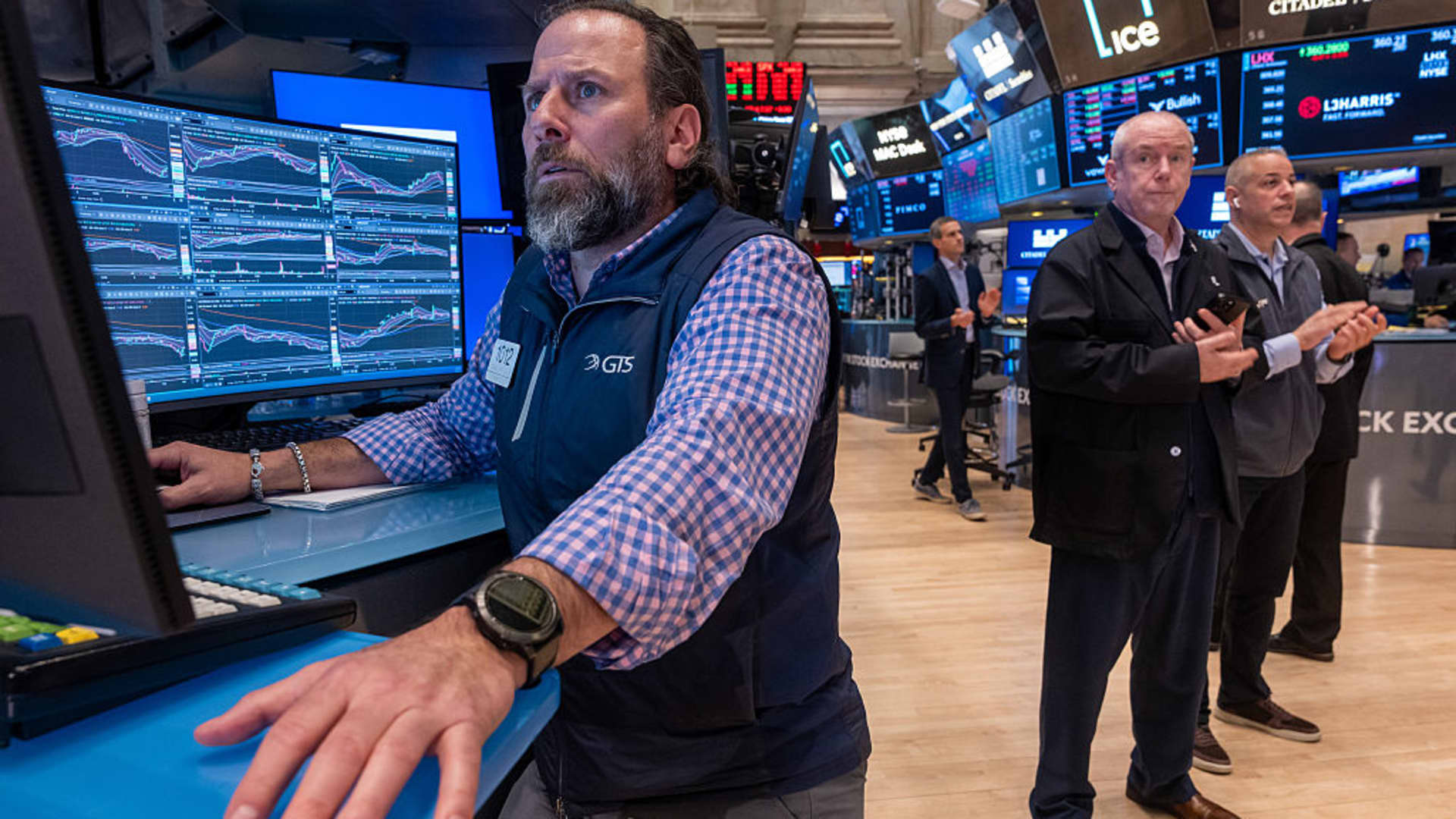
Stocks close in the red
The three major averages finished lower on Friday.
The S&P 500 dropped 1.33% to end at 6,740.02, while the Nasdaq Composite declined 1.59% to 22,387.68. The Dow Jones Industrial Average lost 453.19 points, or 0.95%, to 47,501.55.
— Sean Conlon
BlackRock shares tumble after firm limits fund withdrawals for first time
BlackRock shares slipped 7% on Friday after the investment management firm capped withdrawals for the first time from one of its private credit funds. The stock is having its worst day since April 4.
Per a report from the Wall Street Journal, the HPS Corporate Lending Fund, a business development company that doesn’t trade on a public exchange, said Friday that it will repurchase up to 5% of its shares this quarter, the minimum amount it has committed to buy back in a given quarter.
The decision drew attention because investors requested to redeem 9.3% of the fund’s shares, according to a letter sent to investors Friday by BlackRock. It was the first quarter in the four-year history of the fund, known by its Hlend ticker, in which withdrawal requests were higher than 5%, the WSJ reported.
Friday’s decline put shares of BlackRock down 9.9% for the year. The stock was among the worst performers in the S&P 500 in midday trading.
— Pia Singh
Bank of America upgrades data center play Ciena, expects more than 18% upside ahead
Bank of America just got more bullish on near-term cloud spending, leading the firm to upgrade shares of optical networking equipment provider Ciena to buy from neutral.
Analyst Tal Liani raised his price target on shares by $95 to $355, which implies about 18.6% potential upside ahead. Ciena shares are up nearly 31% year to date, as the company has benefitted from growing optical networking hardware needs in AI data centers.
The stock added nearly 3% on Friday on the back of this upgrade.
Liani said that the firm’s recent cautious call on the networking sector was “too early,” and that recent checks on the expected data center buildout and the updated spending outlooks from major cloud companies supports a stronger outlook for the optical market. Ciena is a notable leader in the optical market, having grown its share of the optical transport market from 25% in 2021 to 30% in 2025, he said.

Ciena stock over the past year.
“The optical market is still cyclical, but Cloud spending remains robust, with key Cloud players, including Hyperscalers, Tier-2 Clouds and Neoclouds, adding significant data center capacity in the next three years,” Liani wrote in a Friday note to clients, saying that the current cycle can be viewed as a “super-cycle” expected to continue well into 2027.
“Ciena’s portfolio, including a dominant share in 800G pluggables, growing share in 400G, growth in RLS (line systems), DCOM passive optical network solution for out-of-band management and Nubis, is well suited to address the growth opportunities,” he wrote.
— Pia Singh
Dollar index heads for best day since August
The U.S. dollar index is on pace for its best week since August.
The index, which measures the greenback against a basket of U.S. currencies, has climbed 1.4% since Monday. It’s on track to record its biggest one-week gain since it climbed more than 1.5% during the week ended Aug. 1.
The U.S. dollar index, 5-day
— Alex Harring
Job market growth has been ‘pretty weak’: Goldman’s Hatzius
Friday’s weaker-than-expected jobs report is the latest sign that the U.S. economy could be entering a period of “stagflation,” a period with high inflation and unemployment, according to Jan Hatzius, chief economist at Goldman Sachs.
“I don’t think we’re in a stagflationary environment yet,” Hatzius said Friday on CNBC. “But, yeah, the shocks have been pointing that way.”
Hatzius said the U.S. is remains in a “low hire, low fire” environment and that the job market’s growth picture has been “pretty weak.”
— Alex Harring
Gold and silver fall for the week
One kilogram and a five hundred gram gold bars next to one kilogram silver bars at The Vaults Group gold dealers arranged in Barcelona, Spain, on Monday, April 28, 2025.
Bloomberg | Bloomberg | Getty Images
Gold and silver started March in the red.
Bullion ended Friday up 1.58% at 5,158.7, but it was down 1.7% for the week. It was the metal’s first weekly loss in five.
Silver fell 9.63% in the week, its first weekly loss in four, but ended Friday up 2.59% at 84.311.
Meanwhile, Aluminum jumped 9.75% in the week, its largest weekly gain since January 2023. Aluminum is now up nearly 15% in 2026.
@GC.1 vs. @SI.1 5-day chart.
— Davis Giangiulio & Gina Francolla
First-quarter Atlanta GDPNow plunges to 2.1% Friday from 3.0% Monday
The Atlanta Federal Reserve’s GDPNow tracker of estimated first-quarter gross domestic product plunged to an annual rate of 2.1% on Friday, down from 3.0% on Monday.
Projections of January-March real personal consumption expenditures growth falling to 1.8% from 2.8%, and real gross private domestic investment growth slowing to 6.8% from 7.9%, accounted for most of the decline, the regional Fed bank said.
The projection “is not an official forecast of the Atlanta Fed. Rather, it is best viewed as a running estimate of real GDP growth based on available economic data for the current measured quarter. There are no subjective adjustments made to GDPNow — the estimate is based solely on the mathematical results of the model,” the bank says.
— Scott Schnipper
U.S. will create $20 billion reinsurance program for oil tankers
The U.S. Development Finance Corporation will create a $20 billion reinsurance facility in effort to get oil tankers moving through the Strait of Hormuz again.
U.S. crude oil is up more than 12% Friday as some Gulf countries shut down oil production because they cannot export their crude through the Strait.
— Spencer Kimball
Materials on pace for worst week in nearly a year
The S&P 500 materials sector is down 7% this week. If that loss holds, it would mark the space’s worst weekly performance since the week ended April 4, when it plunged more than 8%. The worst performers week to date are:
- PPG Industries: Down more than 12%
- Freeport-McMoRan: Down more than 12%
- CRH: Down 11%
- Amcor: Down 11%
- Vulcan Materials: Down 10%
— Fred Imbert
Boeing pops on report of big China airplane order
A Boeing 737 Max airplane at the company’s manufacturing facility in Renton, Washington, Nov. 20, 2025.
David Ryder | Bloomberg | Getty Images
Boeing shares popped to session highs, up more than 2% after Bloomberg News reported the aerospace maker was in talks with the Chinese government for an order of 500 737 Max jets. CNBC reached out to Boeing for comment.
BA 5-day chart
— Fred Imbert
Target is boasting strong technicals amid its turnaround efforts, Josh Brown says
Sign at the entrance to a Target in Venice, Florida.
Erik Mcgregor | Lightrocket | Getty Images
Target is one of the best buying opportunities in the market right now, according to Josh Brown, CEO of Ritholtz Wealth Management.
Shares of the retailer have significantly outperformed the broader market this year, gaining about 22%, and are faring decent amid the broader decline in value stocks on Friday. Investors appear to be counting on Target’s turnaround efforts, which involve a new leadership team focused on ramping up store growth and remodels and doubling the size of its retail media network “Roundel” within the next five years.
“The Street has decided things are changing here, at least so far, and that’s why it’s on our radar … And the more you dig into this, you realize there’s something powerful happening with this turnaround,” Brown said Friday on CNBC’s “Halftime Report.” “It’s very straightforward here from a risk management standpoint.”
According to Brown, the share price level on Target between $99 and $100 is the “obvious level of support” for traders to watch. The stock is sitting at a golden cross with short-term momentum behind it, he said, adding that there’s plenty of room overhead given the stock’s all-time high of $175 per share.
— Pia Singh
Decliners lead advancers 4-1 in latest market rout
Equity markets were under pressure again on Friday, and a look under the surface shows bears are in control intraday.
FactSet data shows that four stocks declined for every one advancer at the New York Stock Exchange. Overall, 2,131 names were lower, while just 518 traded higher.
— Fred Imbert
Stocks making midday moves: Western Alliance Bancorp, CF Industries, United Airlines
Check out the companies making headlines in midday trading:
- Bank stocks — All 101 stocks in the State Street SPDR S&P Bank ETF (KBE) were down Friday as the spread widened between the 2- and 10-year Treasury yield in a move known as a bear steepening that often suggests increased expectations of future inflation. A steeper yield curve can compress banks’ net interest margins, devalue assets, raise credit risk and curb loan demand. Western Alliance Bancorp is down almost 12%, Rocket Companies is off 4% and ServisFirst Bancshares is lower by nearly 5%.
- Fertilizer stocks — Fertilizer stocks rallied once again on Friday, as the companies are likely to benefit from tight supplies and higher prices due to the war with Iran. More than a third of raw materials used in fertilizer travel through the Strait of Hormuz. CF Industries climbed 5%, hitting a fresh 52-week high and putting it on pace for a record close. Week to date, shares have surged about 17%. Intrepid Potash surged 9%, also hitting a 52-week high. Its week-to-date gains are likely to tally almost 17%. Nutrien shares added 2%, but the stock is only up 1% this week.
- United Airlines — Shares tumbled nearly 4% after CEO Scott Kirby said the recent spike in fuel prices since the U.S. and Israel struck Iran last weekend will have a “meaningful” impact on United’s first-quarter results. Shares of Delta Air Lines lost 4% and Southwest Airlines dropped 6%, both falling in sympathy. Cruise operators Norwegian and Carnival also fell about 6% each. U.S. oil futures are up more than 34% on the week, and jet fuel and diesel are petroleum distillates.
Read here for the full list.
— Liz Napolitano
U.S. crude oil surpasses $90 per barrel
Oil storage tanks at the 76 Terminal in Richmond, California, US, on Monday, March 2, 2026.
David Paul Morris | Bloomberg | Getty Images
U.S. crude oil broke $90 per barrel Friday after President Donald Trump demanded unconditional surrender from Iran, raising fears of a prolonged war that will cause a cascading disruption to global oil supplies.
West Texas Intermediate crude futures were last up 11.27% to $90.14 per barrel, while global benchmark Brent was 8.09% higher at $92.32 per barrel. U.S. crude has gained nearly 35% this week, while Brent has advanced nearly 28%. Read more.
— Spencer Kimball
Financials tumble again. Bank ETF falls below 200-day moving average
Financial stocks are tumbling Friday as the spread widens between the 2- and 10-year Treasury yield in a move known as a bear steepening that often suggests increased expectations of future inflation. A steeper yield curve can compress banks’ net interest margins, devalue assets, raise credit risk and curb loan demand.
Each of the 101 banks in the State Street SPDR S&P Bank ETF (KBE) is lower Friday, and the ETF itself is down 3.6%, led by Western Alliance Bancorp, down 13%, Rocket Companies, off 4% and ServisFirst Bancshares, lower by 5%.
The $1 billion KBE has fallen below its 200-day moving average level of $59.24 for for the first time since November 19, 2025.
Street Street Bank ETF down almost 8% in a month.
— Scott Schnipper, Gina Francolla
February jobs report complicates interest rate call, San Francisco Fed’s Daly says
Mary Daly, President and CEO of the Federal Reserve Bank of San Francisco, speaks during WSJ Tech Live conference hosted by the Wall Street Journal at the Montage Laguna Beach in Laguna Beach, California, on October 21, 2024.
Frederic J. Brown | Afp | Getty Images
San Francisco Federal Reserve President Mary Daly said Friday the weak February jobs report adds to a difficult policymaking environment.
In a CNBC interview, Daly did not commit to a position on interest rates, but said a softening labor market combined with inflation still running above the central bank’s 2% target complicate future decisions.
“This jobs market report has got my attention,” she said during a “Squawk Box” interview. “I don’t think you can look through this report, but I also don’t think you should make more of it than one month of data.” Read more.
— Jeff Cox
Treasury yields rise
Treasury yields pushed higher Friday. The benchmark 10-year Treasury yield gained more than 3 basis points to 4.177%. The 30-year Treasury yield rose 2.6 basis points to 4.777%. The 2-year Treasury yield was almost 1 basis point higher, at 3.606%.
The spread between 2-year and the 10-year Treasury widened to 57.1 basis points, which might reflect higher expectations of future inflation.
— Sarah Min, Scott Schnipper
Stocks open lower
U.S. equities opened Friday’s session in negative territory.
The Dow Jones Industrial Average lost 673 points, or 1.4%. The S&P 500 and Nasdaq Composite were down 1.2% and 1.4%, respectively.
— Sean Conlon
Gap, Marvell Technology, Exxon Mobil among the stocks making premarket moves
People walk by a Gap store in Times Square on March 05, 2026 in New York City.
Spencer Platt | Getty Images
Check out the companies making headlines before the bell:
- Gap — The apparel maker’s stock slid about 8% after Gap reported fourth-quarter earnings of 45 cents per share, just shy of analysts’ forecast of 46 cents a share, per LSEG. Gap’s revenue came in line with expectations at $4.24 billion.
- Marvell Technology — The company, which makes integrated circuits and semiconductor products, saw shares surge 11% on the back of strong quarterly results led by artificial intelligence demand. For its fourth quarter, Marvell reported adjusted earnings of 80 cents per share on revenue of $2.22 billion. Analysts polled by LSEG were expecting earnings of 79 cents per share and revenue of $2.21 billion. Management said Marvell expects its year-over-year revenue growth to increase each quarter in fiscal 2027.
- Oil stocks — The group rose alongside crude prices, as tensions grew overnight around the U.S.-Iran conflict. Exxon Mobil and Chevron each gained more than 1%. Occidental Petroleum climbed 3.3%. U.S. oil and Brent scaled to levels not seen since 2024.
Read the full list here.
— Liz Napolitano
U.S. jobs fall unexpectedly by 92,000 in February
U.S. payrolls fell by 92,000 in February, marking a surprise decline out of the labor market, while the unemployment rate rose to 4.4%. Economists polled by Dow Jones expected payrolls increased by 50,000 in February as unemployment remained steady at 4.3%.
— Fred Imbert
Why Trump’s plan to have the U.S. Navy escort tankers through the Gulf may not work
A person points at a page on the Marinetraffic website that shows commercial boats traffic on the edge of the Strait of Hormuz near the Iranian coast, in Paris on March 4, 2026.
Julien De Rosa | Afp | Getty Images
President Donald Trump is ready to use the U.S. Navy to escort oil tankers through the Strait of Hormuz as the war against Iran rages, but providing safe passage to the volume of traffic that typically passes through the waterway will prove challenging.
U.S. oil prices have surged 28% to above $86 a barrel this week as Iran attacks tankers, effectively bringing ship traffic through the Strait to a standstill. Brent crude is up 22% this week to $89 a barrel.
Global benchmark Brent would shoot above $100 per barrel if the waterway is closed for a prolonged period, Wall Street analysts say. At that level, oil prices could tip the global economy into a recession, they say.
The narrow Strait is the only way for tankers to enter and exit the Persian Gulf. More than 14 million barrels per day of crude passed through the Strait in 2025, about a third of all the oil that is exported by ship worldwide, according to energy consulting firm Kpler. Read more.
— Spencer Kimball
Oil rally resumes as Brent tops $89 a barrel
Crude oil futures
On Friday morning, the Financial Times reported that Qatar’s energy minister said the war in the Middle East could see Gulf energy exporters halt oil shipments within days. Saad al-Kaabi told the FT crude prices could reach $150 a barrel in the coming weeks if oil tankers are unable to pass through the Strait of Hormuz.
— Chloe Taylor
European stocks open higher as oil prices oscillate
European stock markets opened in positive territory on Friday, as oil prices oscillated.
The pan-European Stoxx 600 rose 0.5% in morning trade, with the German DAX leading with a 0.6% gain and London’s FTSE 100 up 0.2%, as the French CAC 40 added 0.2% and the Italian FTSE Mib notching 0.1%.
For the week, the pan-European Stoxx 600 is on course for a 4.6% loss — its deepest since last April, at the height of market fears about a U.S.-China trade war.
— Chloe Taylor, Hugh Leask
Asia markets mostly rise as investors assess Iran conflict impact on energy supplies
Journalists and television camera crews film the closing market figures displayed on a large electronic screen at the Korea Exchange (KRX) in Seoul, South Korea, on March 5, 2026.
Chris Jung | Nurphoto | Getty Images
Most Asia-Pacific markets staged a late comeback on Friday, after Wall Street declined on worries over energy supplies.
Japan’s Nikkei 225 rose 0.62% at 55,620.84, also reversing earlier losses, while the Topix ended 0.39% higher to close at 3,716.93.
South Korea’s Kospi reversed course to finish marginally higher at 5,584.87, after marking its best day since 2008 in the prior session.
In contrast, Australia’s S&P/ASX 200 fell 1% to 8,851, dragged by basic materials stocks.
Hong Kong’s Hang Seng index was 1.69% higher as of its last hour of trading, extending gains from Thursday and leading Asian markets, while the mainland Chinese CSI 300 advanced 0.27% to 4,660.44.
India’s Nifty 50 was down 0.69%, while the BSE Sensex fell 0.72% as of 2:42 p.m. local time (03.12 a.m. ET).
— Lim Hui Jie
Asia markets mixed as oil crosses $80 mark
Markets in Asia were mixed on Friday, after oil prices breached the $80 mark as the Iran conflict continued into a sixth day.
South Korea’s Kospi tumbled once again, falling 1%, after marking its best day since 2008 in the prior session. The small-cap Kosdaq, however, extended gains to rise 1.52%.
Japan’s Nikkei 225 was up 0.24%, reversing earlier losses, while the Topix was marginally down.
Australia’s S&P/ASX 200 was down 1.06%, dragged by basic materials stocks.
Hong Kong’s Hang Seng index was up 1.14%, extending gains from Thursday, while mainland China’s CSI 300 was down 0.4%.
— Lim Hui Jie
What to expect from Friday’s jobs report
A “Join Our Team” flyer at the Appalachian State University internship and job fair in Boone, North Carolina, US, on Wednesday, Oct. 1, 2025.
Allison Joyce | Bloomberg | Getty Images
More clues on where the employment picture is headed will come Friday when the Bureau of Labor Statistics releases its monthly nonfarm payrolls report for February at 8:30 a.m. ET.
Economists surveyed by Dow Jones expect payroll growth of 50,000, following January’s surprisingly high 130,000. The unemployment rate is expected to hold at 4.3%, another sign of that, yes, stable labor market that certainly isn’t going gangbusters but is just strong enough to keep that jobless level steady.
However, the so-called stability may not be all it appears. Most of the payroll gains in 2025 came from health-care-related industries. Without the sector, even the meager 15,000 monthly average gains last year would have evaporated, and this year’s environment looks largely the same to those on the ground.
“One of the things that is very interesting-slash-potentially problematic is that we have almost all the growth happening in this health care and social [assistance]” sectors, said Laura Ullrich, director of economic research at Indeed. “I don’t really see it as balanced or stable if you’re seeing so much growth in just one subsector.” Read more here on CNBC.
— Jeff Cox
Costco, Marvell Technology among stocks moving Thursday evening
Check out the companies making headlines in after-hours trading:
- Costco Wholesale — Shares of the big-box retailer dipped less than 1% in the after-hours session. Costco reported $4.58 cents per share in earnings on revenue of $69.6 billion in the fiscal second quarter, while analysts polled by LSEG expected $4.56 cents per share in earnings on revenue of $69.29 billion. Membership fees totaled $1.36 billion, reflecting a 13.6% gain year over year.
- Marvell Technology — The company, which makes integrated circuits and semiconductor products, saw shares surge 14% on the back of strong quarterly results led by artificial intelligence demand. For its fourth quarter, Marvell reported adjusted earnings of 80 cents per share on revenue of $2.22 billion. Analysts polled by LSEG were expecting earnings of 79 cents per share and revenue of $2.21 billion. Management said Marvell expects its year-over-year revenue growth to increase each quarter in fiscal 2027.
- Gap — The apparel maker’s stock slid almost 8% after Gap reported fourth-quarter earnings of 45 cents per share, just shy of analysts’ forecast of 46 cents a share, per LSEG. Gap’s revenue came in line with expectations at $4.24 billion.
For the full list, read here.
— Pia Singh