
- Studies warn that climate change could slash hydropower generation across the Amazon by up to 40%, with controversial Belo Monte among the most exposed plants in Brazil.
- Researchers and regulators say relying on historical river flows is no longer viable as droughts intensify and rainfall patterns drop.
- Belo Monte’s operator argues the plant remains strategic for Brazil’s energy security, despite growing climate risks.
Brazil’s largest Amazon hydropower plants are becoming increasingly vulnerable to climate change, and Belo Monte may be the clearest warning sign yet. Built on the Xingu River after years of debate over its environmental impacts and the reliability of its energy output, the mega-dam is facing a problem its planners could not solve with engineering: less water.
This reality is reflected in two major studies published in late 2025 — one led by Brazil’s water and sanitation agency, ANA, and the other by the federal energy research office, EPE. From different angles, both reports conclude that climate change is fundamentally reshaping the country’s water and energy systems, requiring urgent adaptation — 43.7% of Brazil’s energy comes from hydropower plants.
ANA’s report warns that hydropower plants across the Amazon region could lose up to 40% of their generation capacity over the next 20-30 years if planning continues to rely on historical water flow data rather than climate-adjusted projections. The Xingu River Basin in particular will face significantly longer and more intense dry seasons over the coming decades. Maximum river flows could decline by up to 50%, according to the study published in November 2025, while consecutive dry periods — historically around 20 days — may extend to as many as 40 days by the end of the century, with some dry spells lasting up to 150 days.
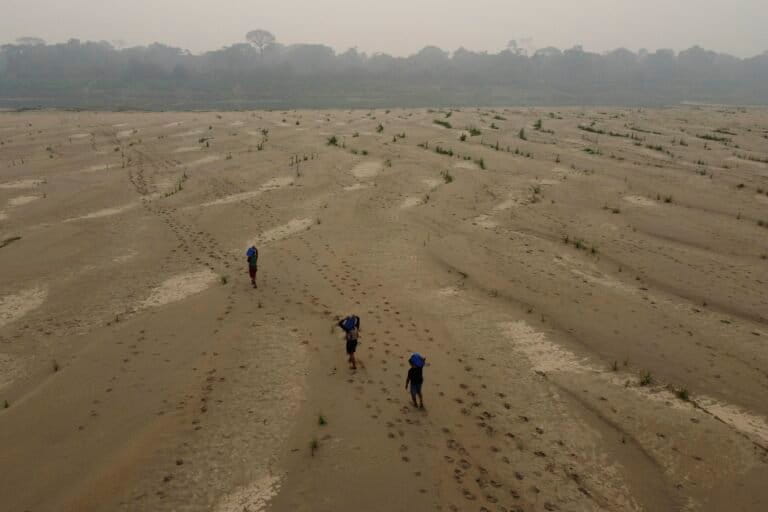
Those numbers look into the future, but the severity of droughts and their impact on Amazon dams are today’s reality. In 2024, during the peak of the dry season between September and November, Belo Monte reportedly generated an average of only 145 MW per day, a little more than 1% of its capacity of 11,233 MW, according to data from Brazil’s National Electric System Operator.
“This performance reflects the most severe drought recorded in Brazil since the beginning of historical records in 1950,” Saulo Aires, coordinator for climate change at ANA, told Mongabay. “What we are seeing now is that the hydrological reality has already changed.”

EPE’s study, published in November 2025, examines the energy consequences of these changes. It finds that compensating for reduced hydropower reliability will require major investment in alternative energy sources. Building a resilient, low-emissions electricity portfolio could require deploying 121 GW of additional capacity, particularly in storage, solar, wind and complementary technologies. Even with lower operating costs, total system investment could rise by 70%, or 144 billion reais ($28 billion), reflecting the scale of adaptation needed to maintain energy security.
ANA’s and EPE’s studies also show that while the north will see harsher dry seasons, the south should experience increased rainfall. However, this shift doesn’t translate into hydroelectricity potential. Rafael Kelman, executive director at energy consultancy PSR and coordinator of the EPE study, told Mongabay that southern Brazil’s topography makes it very hard to build new dams. “In general, the balance is negative for Brazil. There will be less hydroelectricity,” he said.
At the same time, rising temperatures are expected to drive up electricity demand, particularly for air conditioning. “Less precipitation means less hydroelectricity, and more temperature means more demand,” Kelman said. “It is a double pressure on the system.”

Exposure to climate danger
Belo Monte started operations in 2016 in a so-called run-of-river plant, meaning it lacks a large reservoir to store water during wet periods. That design choice was central to years of controversy over the dam, touted by planners as a way to reduce flooded area and environmental damage. But it also left the project highly exposed to prolonged dry seasons.
In 2024, for example, the plant did not reach its designed output on any single day. Its highest daily generation was recorded on April 30, when it briefly produced 10,397 MW, before output dropped sharply with the return of the dry season. By late August, even before the dry season’s peak, only one of the dam’s 18 turbines was operating, each with a capacity of 611 MW.
Rodrigo Paiva, a professor at the Federal University of Rio Grande do Sul’s Institute of Hydraulic Research and one of the authors of ANA’s study, stresses the fragile status of Belo Monte, being in a region where climate models show the strongest signals of future declines in river flows.
“What we got as a result is a projection for the next decades of a great reduction of the Amazonian rivers, especially in the most affected southern tributaries, such as the Xingu and the Tapajós,” Paiva said. “Even when we considered a moderate greenhouse gas emission scenario, this great reduction of rains and flows still appeared.”
Paiva added that the study did not simulate a full transformation of forest into savanna — a feared, imminent Amazon tipping point — meaning the projections may be conservative. “This could further amplify these changes in the hydrological regime,” he said.

Taking science into account
For ANA’s Aires, the worst mistake in today’s hydrological practice is looking to the past. “But the future will not repeat the past. We are already at a point of no return in terms of hydrology. The effort now is to minimize the impacts.”
Kelman said Belo Monte exemplifies the risks of designing megaprojects without fully accounting for climate science. “Science already pointed out that this region of the Amazon would have a great reduction in precipitation,” he said. “It is certainly a project where climate change should have been considered more seriously in the dimensioning of the plant.”
Kelman recalled that studies conducted around 2010, when Belo Monte was being planned, already suggested the dam should have been around 30% smaller. “That scope was for economic reasons. Considering climate change, it should probably have been even smaller.”
According to Kelman, the lack of long-term hydrological data for rivers like the Xingu compounded the uncertainty. “Nobody knows what the flow of the Xingu was in 1930 or 1940,” he said. “You infer it statistically, sometimes using data from 2,000 kilometers [1,240 miles] away. The confidence in that is very low.”
The dam’s troubled history has long fueled criticism from environmental groups. Belo Monte’s licensing process was one of the most contentious in Brazil’s history, marked by legal challenges and allegations that key environmental conditions were not met before construction moved forward. Federal prosecutors filed 26 lawsuits over the project, and Indigenous organizations repeatedly warned of social and ecological damage, including deformed fish. The plant is now facing a contentious license renewal process.

From promise to reality
Belo Monte’s operator, Norte Energia, disputes the idea that the plant is becoming obsolete. In an official statement to Mongabay, the company said the dam remains fundamental to Brazil’s system and has, at times, supplied up to 19% of national electricity demand on its own.
“During the week spanning the turn of the year from 2025 to 2026, amid a heat wave in Brazil’s Southeast, Belo Monte generated an average of 8.55 GW, corresponding to 9.3% of the country’s total consumption,” the company said. “This is equivalent to the demand of 28 million households.”
Norte Energia emphasized that the plant’s operating rules, including its hydrograph — which determines how much water can be used for generation, one of the contentious issues with local communities — were defined during the licensing process and are subject to decisions by environmental authorities and the courts. The company said it continues to advocate maintaining the so-called “consensus hydrograph,” a model that selects the safer and more viable of two possible hydrographs, allegedly balancing environmental protection with energy security.
Locals and scientists argue, however, that the water flow is too low to reproduce the natural outflow of the Xingu, collapsing fish populations.

The company also highlighted investments of more than 8 billion reais ($1.6 billion) in environmental mitigation measures, including 1.4 billion reais ($271.4 million) dedicated to Indigenous programs. These include monitoring of fauna, flora and water, as well as infrastructure improvements in nearby municipalities, such as Altamira and Vitória do Xingu.
Even so, researchers say adaptation will be unavoidable. “Unfortunately, this project will not deliver what was intended,” Paiva said of Belo Monte. “What can be done now is to adapt the operation, to incorporate climate scenarios and accept that the guaranteed energy of the past no longer exists.”
For Brazil, the lesson from Belo Monte may shape future decisions on its license renewal and across the Amazon. “New projects in this region should already consider that we will have less flow in the rivers,” Paiva said. “Planning based on historical conditions alone is no longer viable.”
Banner image: Residents transport drinking water along the dry Madeira River, a tributary of the Amazon River, during the dry season, in 2024. Image by AP Photo/Edmar Barros.
Fish deformities expose ‘collapse’ of Xingu River’s pulse after construction of Belo Monte Dam
Amazon villages build autonomous energy systems after mega-dam failed pledges
FEEDBACK: Use this form to send a message to the author of this post. If you want to post a public comment, you can do that at the bottom of the page.
Credits

