- An increase in animal cruelty content prompted Asia’s largest coalition of animal protection experts and nonprofits to organize the first dedicated international meeting on the issue in Indonesia in June this year.
- Research published by the Social Media Animal Cruelty Coalition (SMACC), which organized the Bali summit, showed Indonesia was by far the largest source country of distressing content, which includes abuse of threatened species such as macaques.
- A conservation official said online animal cruelty formed part of the illegal wildlife trade, which the U.N. estimates is worth $23 billion annually.
BALI, Indonesia — The booming market for animal abuse content brought dozens of international animal protection organizations to Indonesia in June for the first in-person summit to confront a growing online entertainment industry founded on suffering.
The Asia for Animals Coalition (AfA), a network of more than 400 animal welfare and conservation organizations around the world, established the Social Media Animal Cruelty Coalition (SMACC) in 2020 in response to the spread of animal cruelty online. Afa is the world’s largest network of animal welfare nonprofits.
SMACC then organized its first international summit in Bali on June 11 and 12 to gather advocates and experts to plan tangible steps to address online abuse of animals.
“Online animal cruelty is spreading at a scale no single organisation, platform or government can solve alone,” Nicola O’Brien, lead coordinator of the Social Media Animal Cruelty Coalition, said in a statement.

The rise of animal cruelty influencers
Animal cruelty influencers, who storyboard, produce, film and edit scenes of anguish and pain for casual viewers and paying subscribers via social media and other content platforms, are on the rise
A 2021 SMACC report identified 5,480 videos depicting animal cruelty that had amassed more than 5.3 billion views across platforms.
Of the channels that distributed these videos, 17 had more than 1 million subscribers with two of these counting more than 30 million subscribers each.
Online cruelty often involves wildlife listed as endangered by the IUCN, the international wildlife watchdog, including several species of macaques.
How Indonesia contributes to the trend
In terms of upload location, Indonesia, the host of the SMACC summit and the world’s fourth most populous country, was by far the largest identified source of content, accounting for 1,569 videos in SMACC’s report.
The videos viewed by researchers featured a range of animals, including pets, wildlife and working animals. Cats, dogs, rabbits, pangolins, primates and snakes were among the most commonly exploited animals.
An emerging trend for staged animal rescues, an additional concern for animal rescue professionals and volunteers reliant on donations, was detailed in a subsequent report published by SMACC in 2024.
The report documented thousands of videos exploiting wildlife for fake rescue content. Researchers identified more than 1,000 links across major social media platforms in just six weeks, finding that many content creators deliberately endangered the animal before staging its “rescue” to attract clicks and, in some cases, gain donations.
The effect on children’s development
Availability of content depicting pain and anguish by lesser intelligent species poses clear harms to children’s developing brains and can negatively impact behavior control into later life, child psychologists stress.
“Witnessing violence of any type, particularly animal abuse, is a traumatic event for a child, as it changes how the brain develops,” according to Mary Lou Randour, senior adviser for animal cruelty programs at the Animal Welfare Institute.
The most recent Animal Kindness Index published in 2025 by the Royal Society for the Prevention of Cruelty to Animals (RSPCA), the UK’s largest animal welfare charity, showed 37% of children age 7-15 had viewed animal cruelty on social media in the previous 12 months. In 2024, the figure was 34%.

Part of the illegal wildlife trade
Krismanko Padang, an experienced conservation official with Indonesia’s state conservation agency, the BKSDA, pointed to animal cruelty as a significant part of the international illegal wildlife trade, which the U.N. estimates is worth more than $23 billion every year.
“These days, animals are sold as products,” Krismanko said. “And secondly, they’re sold as torture content.”
Social media companies and online marketplaces continue to face criticism over their commitments to tackling the illegal wildlife trade.
Meta, the parent company of social media platform Facebook, previously closed nine groups on the social network after reporters from Mongabay and Bellingcat presented evidence of illegal wildlife transactions openly conducted on the platform in Indonesia.
The platforms on which animal abuse videos identified by SMACC were published included household names Facebook, Instagram, TikTok, YouTube and X.
“This is not just an animal welfare crisis,” SMACC’s O’Brien said in statement. “It is a digital safety issue, a governance issue, and a public trust issue.”
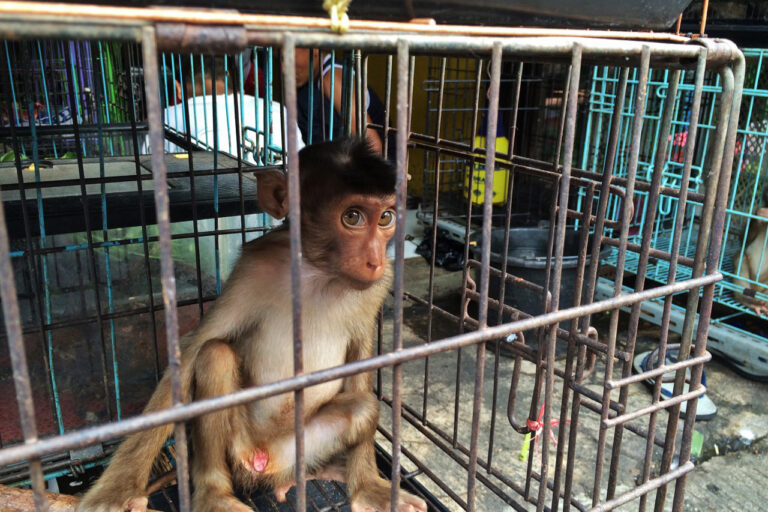
Banner image: A macaque in a pet market in Jakarta. Image by Animal People Forum via Flickr (CC BY-NC 2.0).
This story was first published here in Indonesian on June 14, 2026.
Facebook shuts Indonesia groups after Mongabay and Bellingcat report illegal wildlife trade
When “cute” is cruel: Social media videos stoke loris pet trade, study says