For the First Time, Four Radiation Belts Formed Around Earth in 2024
Earth’s near-space environment has seen a rare and unprecedented shift. In 2024, scientists observed four distinct radiation belts forming around our planet—something not seen before in scientific records.
This event followed a powerful geomagnetic storm on 11 May 2024, known as the ‘Mother’s Day event.’ It was the strongest such storm in over two decades.
How the Observation Was Made
Researchers used the Energetic Particle Telescope (EPT) aboard ESA’s PROBA-V satellite. The satellite orbits Earth at 820 kilometers in a Sun-synchronous polar path. This orbit allows consistent, global monitoring of Earth’s magnetic field and solar interactions.
The EPT detected a complex reorganization of electron radiation zones. This revealed a configuration that had never been documented before.
Earth’s Normal Radiation Belts
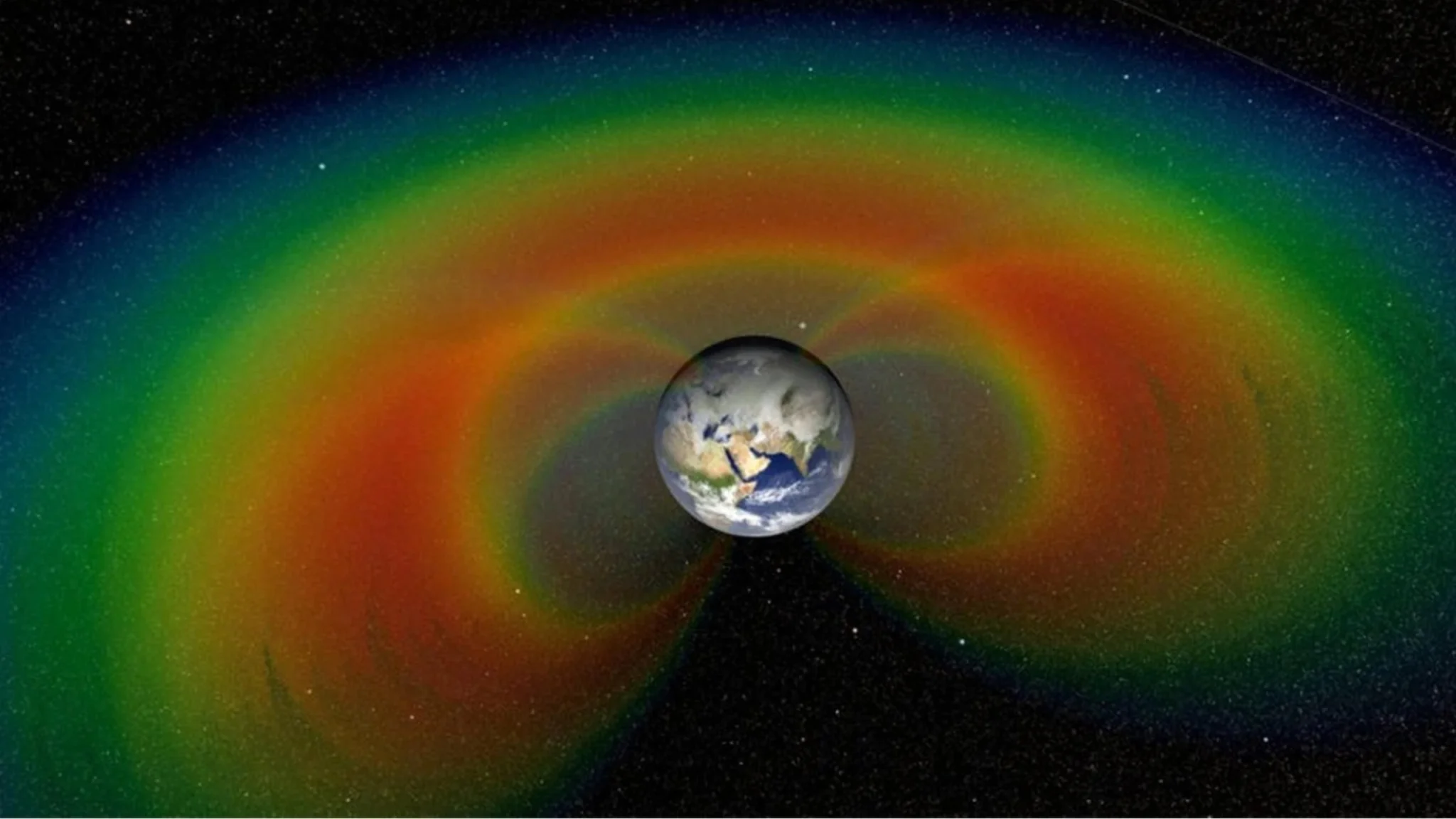
Normally, Earth’s magnetic field traps charged particles in two main radiation belts: the inner Van Allen Belt and the outer Van Allen Belt.
These belts were first discovered in 1958 by the U.S. satellite Explorer 1, named after physicist James Van Allen.
The inner belt holds mostly high-energy protons. The outer belt holds mostly high-energy electrons. Both exist beyond low-Earth orbit.
After the May 2024 storm, the outer electron belt split into four distinct structures. This did not happen during solar maximum in Solar Cycle 24, which ended in December 2019.
During that peak, solar particles were injected directly into the inner belt.
The four-belt structure did not appear during the storm’s peak. Instead, it evolved over days and weeks after.
Electromagnetic interactions caused a local depletion of electrons from the belts. These interactions scattered electrons into Earth’s upper atmosphere.
As electrons were lost, temporary gaps—called slot regions—formed between the belts. This fractured the outer belt into multiple, distinct segments.
Similar Events in the Past
Scientists had seen a three-belt configuration in 2012. It reappeared in October 2024, after a strong geomagnetic storm.
These events suggest a recurring pattern. Yet the mechanisms behind them remain poorly understood.
Viviane Pierrard, senior research scientist at the Royal Belgian Institute for Space Aeronomy, explains: ‘The emergence of multiple belts indicates new mechanisms of electron loss and trapping have become active recently.’
Risks to Space and Human Health
High-energy electrons and protons in these belts pose serious risks.
They can damage solar panels, disrupt electronics, and increase health risks like cancer and cataracts for astronauts.
Even a single particle impact can cause critical failures in sensitive instruments.
What Drives These Changes?
These shifts result from solar activity, especially coronal mass ejections.
These events disturb Earth’s magnetic field and drive electrons to different depths in the radiation belts.
Electrons may be deposited into existing belts or trapped between them.
They interact with electromagnetic waves. These waves scatter electrons into the atmosphere, creating slot regions.
Over time, the trapped electrons drift along Earth’s magnetic field lines. This process takes weeks to months.
By August 2024, the normal two-belt structure had fully returned.
Why This Matters for Future Space Missions
As space missions expand to the Moon, Mars, and beyond, understanding radiation belts becomes vital.
These belts can shift unpredictably. The 2024 event shows how solar activity can temporarily reconfigure Earth’s magnetic environment in ways once thought impossible.
Scientists stress the need for ongoing research. They aim to better understand how particles are trapped and removed in Earth’s magnetic field.
The study was published in the journal npj Space Exploration.
This article was fact-checked and edited by Fiona MacDonald. If you spot a mistake, please let us know.
For more on space science and Earth’s magnetic environment, visit ScienceAlert.
ScienceAlert stories are written, fact-checked, and edited by humans. They are not generated by AI.
Sources & further reading
Featured image: For The First Time, 4 Radiation Belts Appeared Around Earth in 2024. Via original publisher. Image source