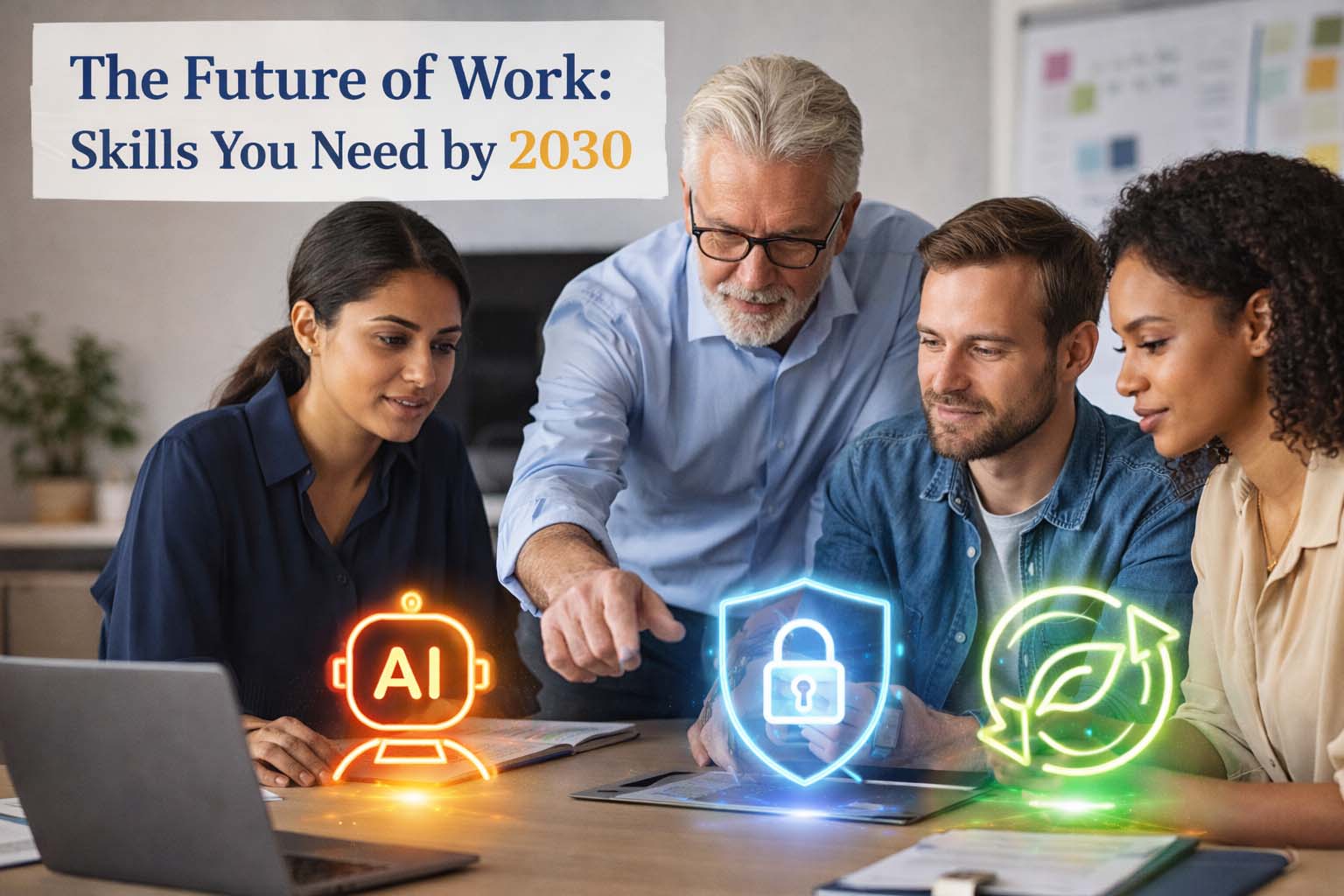
& How to Learn Them Now
By 2030, the biggest advantage won’t be having one perfect qualification—it will be having a skill stack that lets you adapt as roles evolve. Employers already expect major change: the World Economic Forum reports that 39% of key skills required in the job market are expected to change by 2030.
So what should you learn—starting in 2026—to stay employable, grow your income, and keep options open?
This guide breaks it down into future-proof skill clusters, role-based examples, and a practical roadmap you can follow.
Why work is changing so fast (the 5 forces shaping 2030)
These trends keep showing up across major research and hiring platforms:
- AI + automation in everyday work (not just tech jobs)
- Digital security risks expanding as everything goes online
- Green transition creating demand for sustainability skills across industries
- Ageing populations + healthcare growth shifting labour demand
- Constant re-skilling becoming normal (skills change mid-career, not once)
The 12 Skills You’ll Need Most by 2030 (Skill Clusters)
A) Tech skills (even for non-technical roles)
1) AI literacy (the new “basic computer skills”)
LinkedIn flags AI literacy as one of the fastest-growing skills, and also highlights LLM proficiency as a fast-growing capability.
In the UK, the government has also expanded free AI training initiatives aimed at building practical workplace AI skills by 2030.
What “AI literate” looks like in real life:
- Writing clear prompts and checking outputs for errors/bias
- Using AI to draft, summarise, brainstorm, and analyse
- Knowing what NOT to put into AI tools (privacy and confidentiality)
2) Data literacy (reading data, not just collecting it)
You don’t need to be a data scientist. You do need to:
- Understand basic metrics (conversion, churn, costs, time saved)
- Spot misleading charts and “fake certainty”
- Make decisions using evidence
3) Cyber hygiene + security basics
WEF puts networks and cybersecurity among the top skills rising in importance.
Security awareness is now a core workplace competence: phishing, MFA, password managers, data handling.
4) Automation mindset (workflow + process optimisation)
McKinsey’s modelling suggests a significant share of work hours could be automated by 2030, accelerating task changes across many roles.
People who can redesign workflows will stand out.
B) Human skills (harder to automate)
WEF highlights fast-rising “human” skills like creative thinking, resilience/flexibility, curiosity/lifelong learning, leadership/social influence, and analytical thinking.
5) Critical thinking + analytical thinking
- Break problems into parts
- Challenge assumptions
- Explain decisions clearly
6) Creative thinking (yes, even in “serious” jobs)
Creativity is not only art—it’s:
- Better solutions with fewer resources
- New ways to serve customers
- Innovative process improvements
7) Communication (writing, speaking, async clarity)
Clear communication scales your impact—especially with remote/hybrid teams.
8) Collaboration + relationship building
LinkedIn’s UK list includes relationship building and communication among fastest-growing skills.
9) Resilience, adaptability, and agility
Change tolerance is now a job skill, not a personality trait.
10) Leadership and social influence (at any level)
Leadership isn’t just management—it’s:
- Taking ownership
- Aligning people
- Driving decisions forward
C) “Future economy” skills (growing across industries)
11) Environmental stewardship / green skills
WEF lists environmental stewardship among skills rising in importance.
This includes carbon literacy, sustainable procurement, compliance basics, and energy efficiency thinking.
12) Learning-to-learn (meta-skill)
OECD frameworks group future-ready competencies into cognitive/meta-cognitive skills (like learning-to-learn), plus social/emotional skills (like collaboration and empathy).
Skill stacks by job type (examples)
If you work in admin / operations / customer support
- AI literacy + automation mindset
- Data literacy (KPIs, reporting)
- Communication + conflict handling
If you work in marketing / content / media
- AI-assisted content workflows (with originality + fact-checking)
- Analytics literacy (SEO, funnels, retention)
- Creativity + brand strategy
If you work in IT / cybersecurity
- AI + data skills (detection, analysis, automation)
- Security fundamentals + threat awareness
- Documentation + stakeholder communication
If you work in healthcare / care roles
- Digital tools + data handling
- Empathy + communication
- Process improvement and compliance
(McKinsey forecasts rising demand in STEM-related and healthcare roles alongside declining demand in some routine-heavy roles.)
A practical upskilling roadmap (starting this month)
Step 1 (Weeks 1–2): Build your base
- AI literacy fundamentals (tools + safe usage)
- Cyber hygiene: MFA, password manager, phishing awareness
- Data basics: spreadsheets + simple charts + metrics
Step 2 (Weeks 3–8): Add one “power skill”
Pick ONE track:
- Data track: Excel/Sheets → dashboards → basic analysis
- Automation track: workflow mapping → no-code automations → documentation
- Security track: security basics → incident awareness → practical labs
- Green track: sustainability basics → industry-specific compliance knowledge
Step 3 (Months 3–6): Prove it with a portfolio
Create 2–3 proof pieces:
- Before/after workflow improvement (time saved, errors reduced)
- A small data project (dashboard + insights)
- A security hygiene guide for a small team
- A sustainability checklist relevant to your industry
The safest bet for 2030 is a balanced stack:
- AI literacy + data + security basics (the new workplace foundation)
- Creative + analytical thinking + communication (human advantage)
- Adaptability + lifelong learning (staying employable as roles shift)