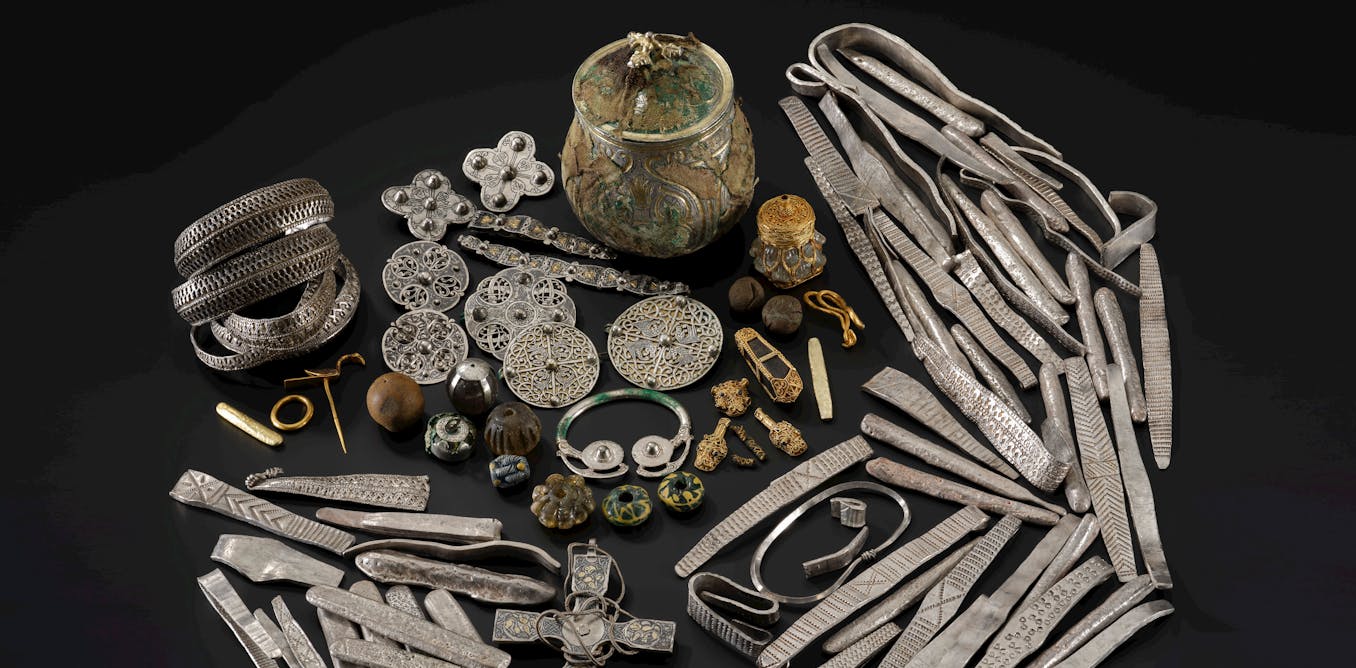
In the popular imagination, the phrase “Viking hoard” might evoke images of plunder stashed by marauding Norse pirates. Or perhaps you picture sacred objects hidden by frantic monks in the uproar of a violent raid.
The Galloway Hoard reveals the truth of the Viking expansion was less dramatic. But as the richest Viking-era hoard discovered so far in the United Kingdom and Ireland, it also exposes a more complex and intriguing past.
The hoard was buried in southwestern Scotland around 900 CE. We owe its recovery to a gold-standard cooperation between Derek McLennan, the metal detectorist who uncovered it in 2014, and the archaeologists who helped preserve it – and are now hard at work to unlock its mysteries.
Traces of a complex maritime world
The hoard, which consists of more than 100 items of mostly silver and gold, is currently on display in Sydney at the National Maritime Museum.
This is a particularly fitting venue, as it embraces the hoard as a mirror of the Vikings’ legendary seafaring culture. The exhibition greets visitors with a replica of a Viking-era boat stempost from the Isle of Eigg in Scotland’s Inner Hebrides. It reminds us of the importance of ships for this world, where voyaging the sea lanes was as important as taking the land.
Some of the hoard’s most unique and exotic items open its northern world up to the south and the east parts of the globe. In the exhibit, 3D-printed replicas allow visitors to see these items in all their original splendour.
These include an ornate silver vessel from the ancient Persian Sasanian Empire, a jar carved from Roman-era rock crystal, and Scotland’s earliest surviving fragments of silk.

AAP Image/Joel Carrett
Even the more “local” objects have unexpected features indicating cultural and linguistic complexity around the Viking-occupied perimeter of the Irish Sea.
Viking-era silver armbands inscribed with Old English runes, for instance, point to the persistence of the earlier language in this area despite Scandinavian incursion.
One such armband states its owner is Egbert – definitely a pre-Viking English name. Other pre-Viking English treasures include a cross, rare for having its neck-chain still attached, and seven brooches with Christian and pagan features.

AAP/Joel Carrett
This so-called “Viking hoard” then, is actually a material record of overlapping times and places that have been deliberately gathered and buried together.
But who gathered these goods together for burial, and why? What did these items mean to them? Were they venerating them, hiding them, or keeping them safe?
And did they mean for the hoard to remain undiscovered for more than a thousand years – or perhaps forever?
The mystery of hoards
These questions may never have definitive answers.
Hoards, broadly defined by British archaeologist Eleanor Ghey as buried or concealed items “kept together, perhaps gathered all at once or gradually amassed over time”, fascinate us because they’re as mysterious as they are revealing.
Ghey notes, though, that there are clues to be found in the objects themselves, and where and how they’ve been deposited. The Galloway Hoard’s 900 CE dating comes from its silver and textile items. Inscriptions on some armbands point to possible collective or even communal ownership.
One especially intriguing feature is the hoard’s two layers: a bed of gravel separates a less valuable upper deposit of silver bullion from a lower deposit containing gold and exotic goods from afar.
The upper layer might simply be a later deposit. But some speculate it’s a decoy, designed to stop finders from digging down to the more cherished goods. Perhaps we’ll know someday.
Detecting the past
The Galloway Hoard’s 2014 discovery is part of a broader explosion of similar significant finds by amateur detectorists.
In 21st-century Britain alone, detectorists have uncovered dozens of Iron Age, Roman, Pictish, Saxon, Viking and late medieval hoards. In 2009, for example, they attracted worldwide coverage after discovering the vast 7th-century Staffordshire Hoard. The public frenzy wasn’t just due to the splendour of the 4500+ objects, but to the serendipity of its discovery by an amateur.
British detectorists have shown commitment to establishing good practice. The National Council for Metal Detecting cooperates with professional archaeology bodies and promotes legal and ethical detecting.
The Galloway Hoard’s finding was a model of good practice. When he realised he’d found something significant, detectorist Derek McLennan downed his tools and contacted archaeologists, who protected the site and goods and contacted the national Treasure Trove Unit.
That said, detectorist conduct hasn’t always been so exemplary, as I discovered when researching for my forthcoming Exeter University Press book Detectorists: Feeling for the Past.
In 2015, the discovery of the Viking-era Hereford Hoard resulted in the conviction of detectorists and coin dealers for illegal finding, concealing, and black-market selling of items.
McLennan, by contrast, kept his allotted 50% of the £1.98 million (about A$3.7 million) paid by the National Museum of Scotland. This is surely a modern parable for the importance of sharing, rather than hoarding, the spoils.
Treasures of the Viking Age – The Galloway Hoard is showing at Sydney’s Australian National Maritime Museum until October 11