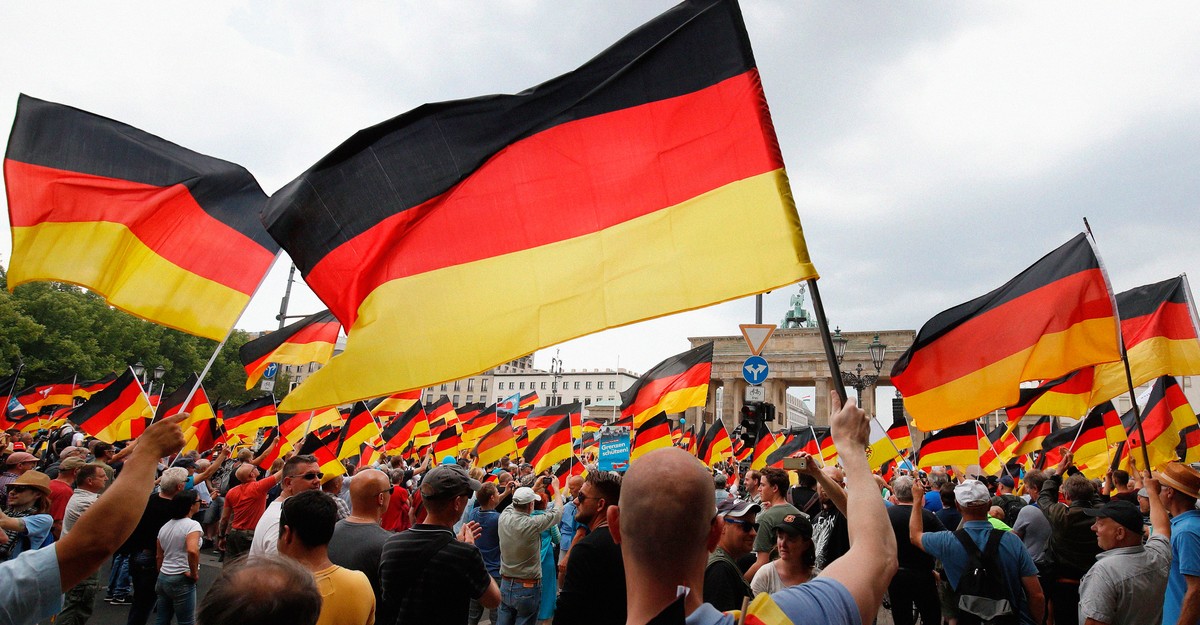
Imagine that it’s October 2026, and one of Germany’s 16 federal states has come under the control of a far-right government for the first time since the Nazi era. With an absolute majority in the state Parliament and one of its own installed as state premier, the Alternative for Germany, or AfD, quickly begins implementing its agenda. The interior minister announces an emergency remigration program: abolishing asylum, revoking the residence permit of any foreigner convicted of a crime, pledging to review all naturalization decisions made during this century, and incarcerating those designated for deportation. The government stops classifying Ukrainians as war refugees and ends their social benefits. European Union flags disappear from public buildings. The mainstream press is shunned in favor of influencers aligned with the party’s ideology. The government authorizes vigilante groups to act as an auxiliary police force in regions with high crime rates.
This hasn’t happened, but it’s not merely hypothetical either. The AfD is projected to win an election next month in Saxony-Anhalt, a central German state of some 2 million people. An anti-racism NGO in Berlin, the Amadeu Antonio Foundation, created this scenario based on the far-right party’s own election manifesto and the statements of its representatives. For decades, right-wing politics have carried particular weight in Germany, where atonement for the Holocaust includes mandatory education about the rise of National Socialism. The far right was long relegated to the fringes, its most ardent members easily identified as skinheads decked out in leather. But the AfD, founded in 2013 as a mild euroskeptic party led mostly by conservative economists opposed to eurozone bailouts, is now Germany’s most important right-wing force since the Nazis.
At the national level, the AfD is the most popular party, supported by more than a quarter of voters in recent polls. It leads both of the traditional broad-based parties, the center-right Christian Democrats and the center-left Social Democrats. Its base of support is in the formerly Communist east—generally poorer, older, and angrier than the rest of Germany. And that’s where it’s poised for a breakthrough later this summer. In past state elections, other parties have contorted themselves to keep the far-right faction out of governing coalitions, maintaining a so-called firewall even when the AfD has won the most votes. That may not be possible in Saxony-Anhalt, where ahead of a September 6 vote, the AfD is polling at more than 40 percent. If smaller parties fail to reach the required 5 percent threshold to enter Parliament, this kind of showing by the AfD could be enough for it to win an outright majority, meaning that it wouldn’t need cooperation from other parties to govern. Suddenly, Saxony-Anhalt would become a testing ground for AfD policies.
If the AfD doesn’t reach that threshold, the spotlight would turn to the Christian Democratic Union, the party of German Chancellor Friedrich Merz. The Christian Democrats would face a dilemma: whether to breach the firewall and work with the AfD or join hands with the far-left party Die Linke in a last-ditch effort to keep the far right from taking power. In fact, the Christian Democrats have a policy, formalized in 2018 and known as an incompatibility resolution, against working with either party. Andreas Rödder, a historian who previously headed the center-right party’s fundamental-values commission, told me that the decision didn’t generate much controversy within the party at the time because the matter was mostly symbolic; the center-right party, then dominated by Chancellor Angela Merkel, had other choices for governing partners. At that time, German politics remained fairly stable, relatively speaking, as anti-establishment forces shook up other Western democracies. For many in Germany, this was a point of pride, a sign that the country had learned from its history, that it knew where political fanaticism led.
Less than a decade later, Germany no longer appears immune to extremism, and the stable politics that once attested to its moral redemption are “on the brink of being fundamentally shattered,” Rödder said. The country’s domestic intelligence agency has classified Saxony-Anhalt’s branch of the AfD as a right-wing extremist group. Some voters support the party because of that hard-right agenda. Others are drawn to it for contrarian reasons: to register their dissent against elite gatekeepers, whether in the security service, the judiciary, or the media. In this way, their vote is a version of the declaration once made by the Russian literary critic Vissarion Belinsky: “Negation is my god.”
“Every organ of elite opinion tells people they can’t vote for the AfD,” a German diplomat told me. “And many people respond by saying, ‘Hell yes, we can.’”
Why does an election in a relatively small German state matter? Because what happens in Germany matters. That’s been the nature of the German problem for almost two centuries—what to do with this country, larger and more prosperous than its neighbors, that has caused so much torment for Europe and for the world. The problem arose with the Franco-Prussian War and the unification of Germany in 1871. It returned in monstrous form during both world wars. And it recurred with German reunification in 1990.
The German question is back as the country breaks with postwar taboos. Germany is rearming, spending billions to turn its army into the strongest in Europe. Its steadfast support for Israel has been shaken by the extremism of Prime Minister Benjamin Netanyahu’s government. And in Saxony-Anhalt as well as other German regions, even if not yet nationally, the far right appears on the cusp of claiming power.
From the January issue: The new German war machine
Germany’s situation isn’t unique; what’s striking in a country where historians have debated whether a Sonderweg, or “special path,” produced destructive nationalism is how much it mirrors what’s happening elsewhere in Europe. Marine Le Pen, the far-right French firebrand, is leading in polls ahead of a presidential election next year. Nigel Farage’s Reform UK remains in a strong position in Britain. Giorgia Meloni already leads a far-right government in Italy, representing a party that traces its roots to the country’s postwar neofascist movement. Saxony-Anhalt is following these same trends. But the circumstances command greater attention. As Henry Morgenthau Jr., President Franklin D. Roosevelt’s treasury secretary, titled his postwar book on the defeated Axis power, Germany Is Our Problem.
Saxony-Anhalt is sometimes called the heartland of German history. It’s the birthplace of the Protestant Reformation, where Martin Luther nailed his 95 theses to the church door in Wittenberg. Cities such as the capital, Magdeburg, were important centers of the Holy Roman Empire. In the 20th century, modernism flourished in the region, which has Germany’s highest concentration of Bauhaus architecture. It’s long been a hub of the chemical and coal-mining industries. During the Cold War, the territory fell on the eastern side of the Iron Curtain, and the state still faces structural problems left over from post-reunification deindustrialization and out-migration, including higher rates of poverty and unemployment than the national average. The psychic effect also lingers. Until 1990, there was no genuine democracy; freedom and civil rights were curtailed. “In some quarters,” Detlef Gürth, a member of the ruling Christian Democrats in Saxony-Anhalt’s state Parliament, told me, there is still a “pronounced desire for a ‘strongman,’ a messiah who dictates the course of action and takes care of everything.”
Two recent events crystallize the state’s misfortune and the feeling among many residents that things aren’t working. In December 2024, a Saudi-born doctor drove a rented SUV through a crowded Christmas market in Magdeburg, killing six people and injuring hundreds more. Authorities said the perpetrator was an anti-Islam activist sympathetic to far-right groups, but terrorist violence of any kind, the facts notwithstanding, played into the far right’s hands. The following year, the California-based Intel Corporation canceled plans for a €30 billion chip factory in Magdeburg, which would have been the biggest-ever foreign direct investment in Germany. The episodes were unrelated; the company said it had simply grown too fast, although a government minister also found an explanation in “Donald Trump’s ‘America First’ philosophy.” Together, however, they contributed to a gathering feeling of precarity and bad luck.
The AfD promises to shake up the system. Its 35-year-old front man, Ulrich Siegmund, is a perpetually smiling social-media sensation. He is a salesman by trade, the founder of a fragrance company called Berlin-Duftet, whose name means literally “Berlin smells good.” Der Spiegel, the prestigious German news magazine, recently branded him “the most dangerous man in Germany,” which turned out to be great publicity; at campaign events, he autographed copies of the magazine cover.

As Siegmund racks up likes on social media, he leaves the most incendiary topics to others in the party. When some members of the state AfD branch traveled to the United States last year to attend a gala of the Trump-aligned New York Young Republican Club, Siegmund stayed home. The party’s ideological engine in Saxony-Anhalt is said to be Hans-Thomas Tillschneider, who has likened Islam to a fungus, condemned the “sacralization of the Holocaust,” and suggested that Jewish institutions are using Muslim immigration to achieve the “abolition of our people.” He has called AIDS patients the “price we pay for a decadent social model” and argued that the Bauhaus movement “raped the human need for comfort.” On foreign policy, Tillschneider sides with Russia in its assault on Ukraine, praising President Vladimir Putin as “a real man with a sound set of values” and insisting that Moscow is “defending itself.”
When I asked Tillschneider to explain his party’s success in the region, he said it didn’t stem from one particular issue or another but amounted to a rejection of the mainstream’s whole approach to policy making. He argued that the “established parties have formed a consensus against the interests of the citizens” and refuse to entertain ideas that go against their orthodoxy. The AfD is testing the limits of what’s acceptable in German political culture, especially on immigration. The party’s election manifesto declares ominously, “Our streets and squares are no longer safe.” And it promises a “deportation and remigration offensive.” The term remigration, once a fringe concept linked to ethnic cleansing, is now a focus of far-right immigration discourse, and has flexible meanings. Tillschneider defined it as “the maximum possible deportation within the framework of the constitutional order.” In addition to a “180-degree turn” in migration policy, the party is also vowing to revamp education and art, instill pride in German identity, and end the country’s “guilt complex.” The AfD also objects to the established parties’ anti-Russia policies and seeks to expand Russian-language instruction in schools and revive student exchanges with Russia.
The Christian Democrats, who currently govern Saxony-Anhalt in a coalition with the Social Democrats and the liberal Free Democrats, have struggled to respond. The state premier, Sven Schulze, took umbrage at the far right for “constantly belittling Saxony-Anhalt and acting as if everything here is doomed to failure.” AfD representatives can sense the desperation. Tillschneider said the firewall had become a “tomb wall” that the Christian Democratic Union has built for itself. He envisioned only two possibilities after the September election: either an AfD government or an “all-party government against us.” On this there seems to be some agreement. Gürth, the Christian Democratic lawmaker, said his party can’t justify cooperation with the AfD, which “operates like the Nazi Party” in its methods: “It exaggerates real or perceived problems, taps into public discontent, and paints a dystopian picture of Germany teetering on the brink of collapse. All other parties are blamed, and only the AfD can save Germany.”
Read: J. D. Vance is definitely against foreign election interference
In the scenario outlined by the Amadeu Antonio Foundation, an AfD-led government soon turns the state into a platform for international self-promotion, hosting conferences and opening offices in Washington and Moscow. Vice President Vance, who met with an AfD leader on the sidelines of the Munich Security Conference last year, visits the state and offers to support American companies that choose to invest in Saxony-Anhalt. In the next federal election, in 2029, the AfD wins. The party may soon get the chance to give this scenario a shot.