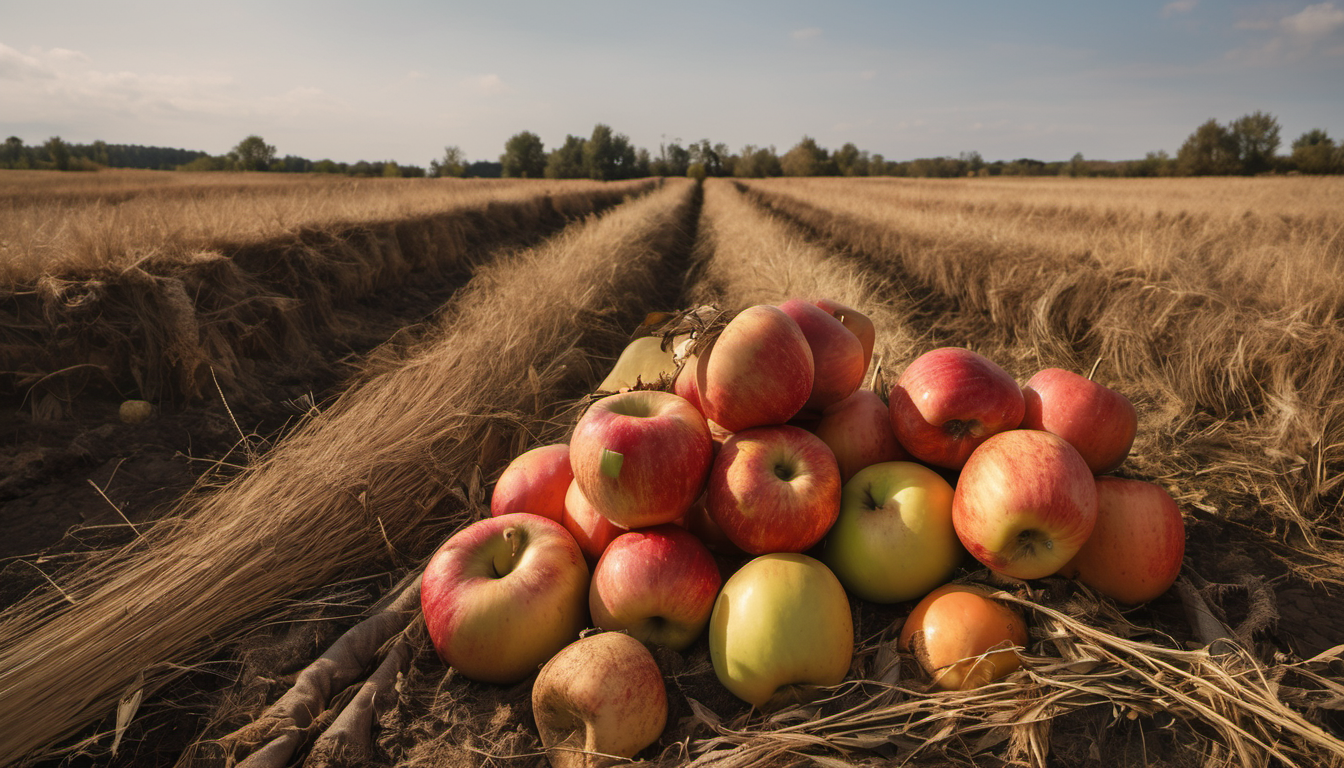
Featured image: A pile of apples, mostly red and green, rests on a bed of dried straw and hay. AI-generated image; not a photograph of the reported event.
A volunteer-led gleaning group in Cornwall collects surplus produce from farms and fields, delivering it to food banks and community kitchens across the South West. Source: bbc.co.uk.
What Happened
Gleaning Cornwall has repurposed over 460 tonnes of surplus produce since 2020.
The group gathers leftover crops from harvested fields and delivers them to 160 food banks, community larders, and kitchen services in the South West.
Despite this success, the group says more funding is needed to meet growing demand.
Key Facts
- Gleaning Cornwall delivers food to 160 food aid settings in the South West.
- Since 2015, food aid providers in Cornwall have grown from 20 to 180.
- Between April 2024 and March 2025, Cornwall’s Trussell Trust gave out over 35,500 emergency food parcels.
- 30% of children in Cornwall live in food poverty, according to a Cornwall Council study.
- Transport, storage, and coordination costs have risen sharply, threatening the group’s long-term operation.
How It Works
Volunteers collect surplus produce after harvest from local farms and fields.
They sort, store, and transport the food to food banks and community kitchens.
All food distributed is free — no cost is passed to recipients.
Why It Matters
This model reduces food waste while helping those facing food insecurity.
It uses existing food supplies without needing new supply chains or expensive donations.
For Cornwall, where food poverty is rising, it offers a practical and scalable solution.
Challenges Facing the Group
Gleaning Cornwall says it now faces financial pressure.
Founder Holly Whitelaw said: ‘There is less money around and we need to do more with it.’
She noted that rising costs for transport, storage, and coordination are straining operations.
Without more funding, the group may not be able to keep up with demand.
What to Watch Next
As food insecurity grows in Cornwall, demand for such programs will likely rise.
Other areas may adopt this model if similar funding gaps are found.
Public awareness of food waste and its costs may also increase.
Whitelaw urged people to reduce household food waste, saying: ‘If we waste food, we waste the substantial energy that went into producing it.’
She added that using existing food saves money and helps the environment.
For more on food access and sustainability, see Jersey Politician Calls for More Food Funding Amid Rising Costs.
For the original report, visit BBC News.