One of the most striking aspects of the war with Iran is the extent to which it has highlighted the irrelevance of international organisations and multilateral approaches to resolving global conflicts.
If we take war as an indicator of the viability of the rules-based international order established after World War II, then we may well conclude that the “patient” is showing a very weak pulse.
The United Nations and the European Union are two organisations that epitomise the post-1945 global normative order – an order which is founded on principles such as the rule of law, non-aggression, and respect for sovereign states’ territorial integrity and political independence.
These principles, and the international organisations that embody then, are among the first casualties of the US-Israeli military campaign. How did this happen and what could be done in order to revitalise the patient?
The United Nations – a tale of a great power struggle and double standards
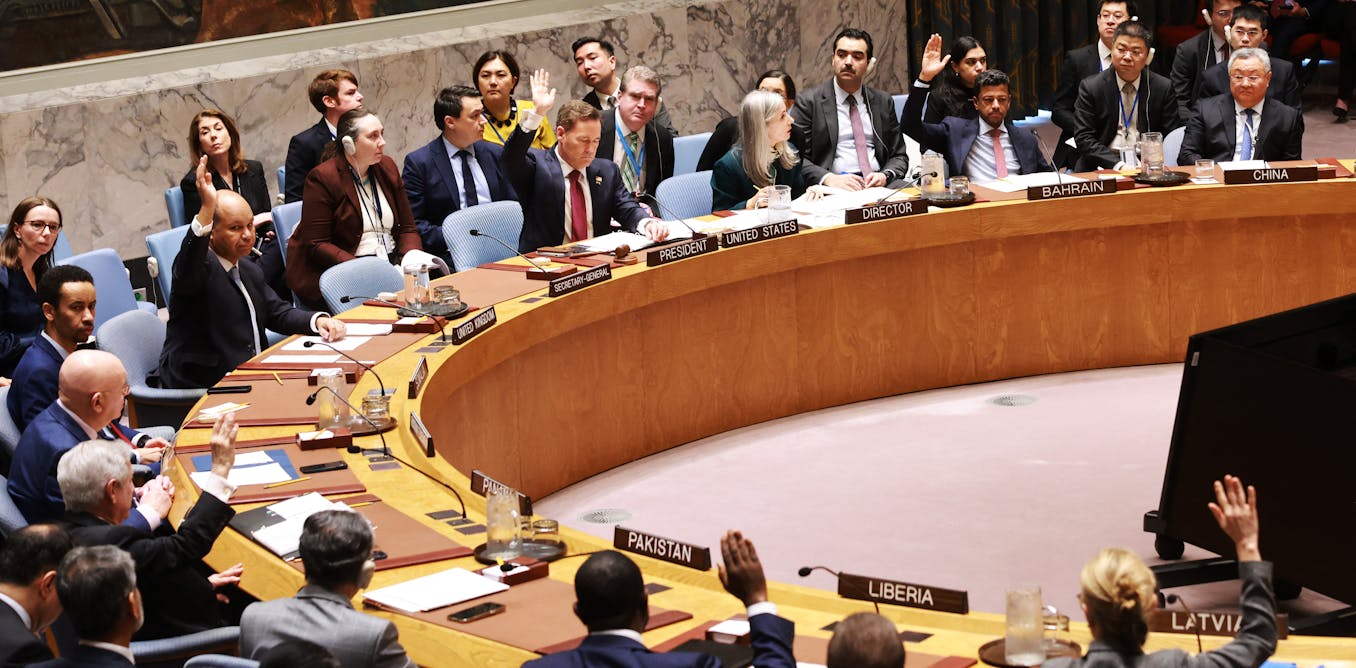
Beginning with the UN, the war with Iran has made it abundantly clear that the system of collective security system established after 1945 is largely disabled when a major power decides to go it alone. The UN Security Council was designated as the guardian of international peace and security, yet has been paralysed by the veto powers of its permanent members, which have time and again used their influence to shield their own actions and those of their allies from international scrutiny.
When the US and Israel launched strikes against Iran in late February 2026, the Security Council initially failed to come up with any kind of meaningful response, let alone authorise any measures to de-escalate the crisis. Instead, the conflict unfolded outside the framework of international law, with unilateral military actions becoming the norm rather than remaining the exception.
The Security Council eventually adopted a resolution on March 11, which focused narrowly on condemning Iran’s attacks on Gulf states. The resolution, passed with 13 votes in favour and abstentions from Russia and China, labelled Iran’s actions as “egregious attacks” and demanded an immediate halt to its regional aggression.
While the resolution is an important signal that the patient is still alive and that the UN has some residual willingness to protect the fundamental norms on which it was built, the resolution’s one-sided approach underscores the Security Council’s persistent double standards: the resolution makes no mention of the initial US-Israeli strikes on Iran that triggered the escalation, nor does it address the broader context of the conflict, such as the legality of those strikes or the killing of Iran’s supreme leader.
The deafening silence of the UN Security Council in the face of US and Israeli breaches of peremptory international law suggests, once more, the use of double standards and further undermines the credibility of the UN Security Council as the guardian of international peace and security.
However, while the Council is currently more or less paralysed, there is a procedure that could revitalise the UN in this geopolitical crisis, namely the Uniting for Peace procedure.
This mechanism empowers the UN General Assembly in the case of Security Council deadlock. If this has not been used yet in the Iran crisis, it is because there has not been sufficient political will to do so.
The EU: an actor with geopolitical ‘muscle’ but no willingness to use it
Another noteworthy (yet unsurprising) aspect of the Iranian conflict is the complete irrelevance of the European Union as a mediator and peacemaker.
The founding impetus for the EU was to build peace on the basis of multilateral cooperation and the non-violent resolution of disputes.
The EU sees itself as a normative power which seeks to project its values worldwide through the use of soft power but tends to shy away from applying coercion.
Unfortunately, the world we live in is one where the most powerful states in the system have decided that violence is now the preferred tool for pursuing foreign policy objectives – either by removing unfriendly regimes from power or by usurping foreign territories through armed aggression.
In this dog-eat-dog world, Europe seems helpless. The EU was neither consulted in the run-up to the Iran war, nor is it actively taking part in hostilities. Instead, it is watching from the sidelines, issuing futile calls for restraint and sabotaging itself in internal quarrels. This is regrettable, given Europe’s historical leadership in negotiating the Iran nuclear deal.
Why does the EU find itself watching from the sidelines in the most important geopolitical event of 2026?
For one, because it – again – has failed to speak with one voice. Member states have adopted divergent positions, with some expressing support of US-Israeli actions and others calling for restraint.
Spain, for instance, has risked open conflict with the Trump administration over the use of its military bases for the war effort, while other critical players, including Germany and France have expressed a certain degree of sympathy for the air strikes.
While it is easy to criticise the EU for its lack of unity on important geopolitical questions, this multiplicity of voices is actually an intended design feature of this hybrid entity, which combines both supranational and intergovernmental elements in its institutional architecture.
At the same time, this design feature actively undermines EU agency in important geopolitical matters. Another factor condemning the EU to futility in geopolitical crises is Europe’s dependency on the US for security and the lack of a common defence policy underpinned by a European army.
However, the biggest obstacle to EU agency in geopolitics is neither institutional nor material. It is psychological. There is no will to lead, no will to use a muscular approach to counter Trump’s blatant disregard of multilateralism and international law (values that are at the heart of Europe’s identity), and a naive belief that the transatlantic relationship will somehow repair itself.
Instead of leveraging its economic and diplomatic weight to push back against unilateral US actions, the EU has often defaulted to reactive, conciliatory gestures, hoping that transatlantic harmony will somehow be restored by goodwill alone. This reflects a fundamental miscalculation: the belief that the US, under Trump or any other leader, will eventually recognise and reward European loyalty, even as Washington’s actions demonstrate the opposite.
The good news is that this can be changed. Mindsets can be changed, identities can be reconstructed, and agency can be built.
The patient is weak, yet there is hope
So no, multilateralism isn’t dead. International organisations such as the UN and the EU have not only put in place norms and mechanisms that would allow them to play a critical role in geopolitical crises, they also have enormous resources at their disposal that would enable them to play such a role.
The patient’s pulse is thus weak, but there are effective remedies available to strengthen it. Now, we must muster the political will to implement them.

A weekly e-mail in English featuring expertise from scholars and researchers. It provides an introduction to the diversity of research coming out of the continent and considers some of the key issues facing European countries. Get the newsletter!