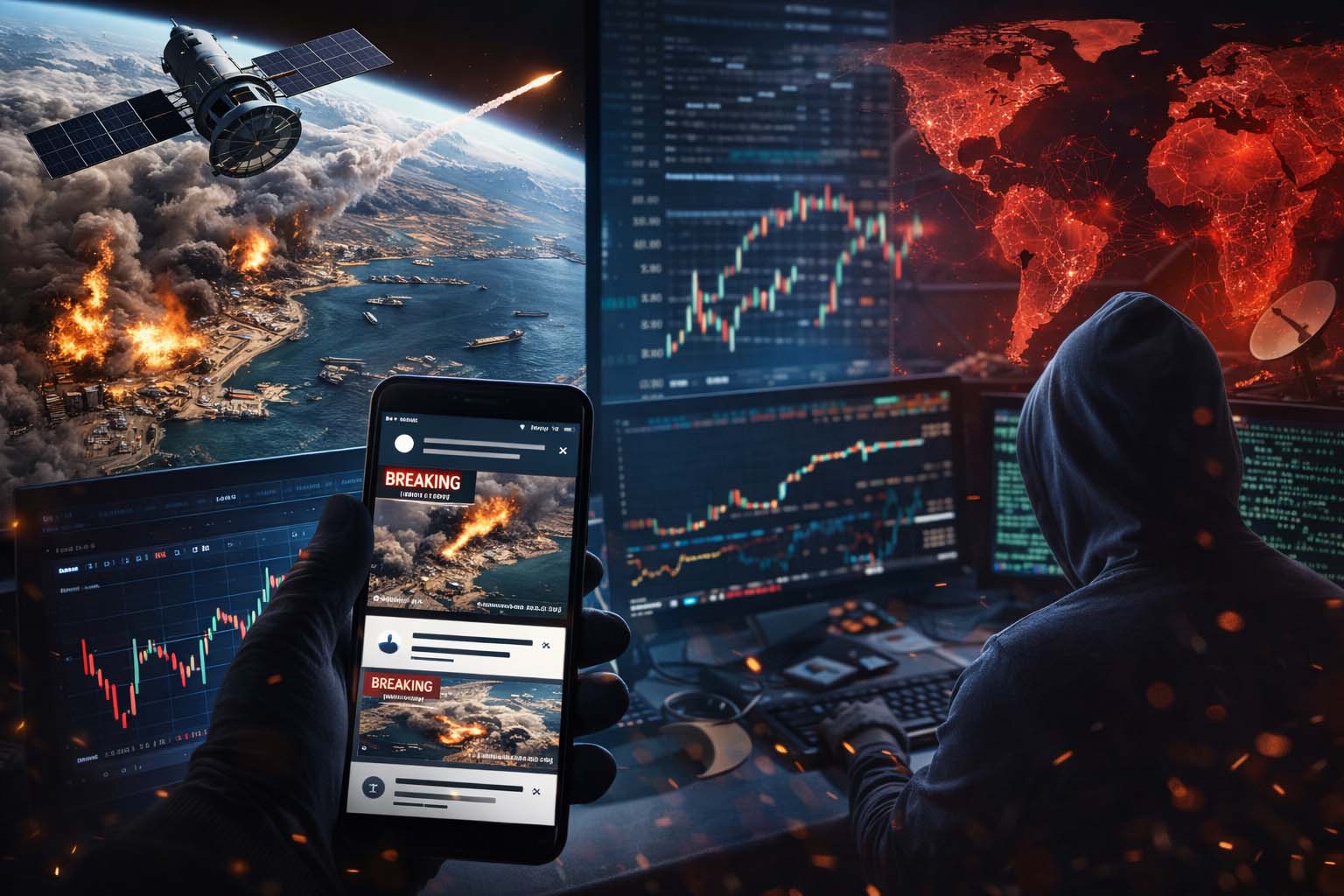
When conflict erupts, markets don’t wait for official press conferences. Prices move on signals—a satellite image of a port, a sudden drop in ship transponders, a cyber outage, or a viral “breaking” post that turns out to be fake.
Today, geopolitics travels through data pipelines: satellites, sensors, shipping feeds, cyber telemetry, and social platforms. That means investors, businesses, and even everyday savers need a new kind of literacy—how to tell real risk from noise before the chart does.
This guide breaks down the modern “information battlefield” and how it pushes stocks, oil, currencies, and crypto around—often in minutes.
Why markets react to conflict so fast now
1) Trading is automated and headline-driven
Algorithms scan news wires, social signals, and volatility spikes. The first reaction is often mechanical: risk-off selling, oil up, defense up, airlines down, safe-haven FX moves.
2) Data is public, global, and near-real-time
Commercial satellites, ship trackers, flight radar, and open-source intelligence (OSINT) reduce the “fog of war” for anyone who knows where to look.
3) Information warfare targets psychology
In conflict, controlling the narrative is a weapon. Markets are a giant psychology machine—so rumor, fear, and uncertainty become leverage.
The three channels that move markets: “Eyes, Pipes, Stories”
Think of conflict market signals in three layers:
A) Eyes (satellites + sensors): what is physically happening
- Port congestion, refinery fires, pipeline shutdowns
- Troop or equipment build-ups near borders
- Power outages visible by night-light changes
- Damage to runways, bridges, rail links, factories
Market impact: energy spikes, shipping costs rise, supply-chain equities reprice, regional FX weakens.
B) Pipes (networks + logistics): what is functioning or broken
- Cyberattacks on banks, exchanges, telecoms, utilities
- Disruption to shipping lanes and insurance premiums
- Payment rails and sanctions enforcement (SWIFT bans, export controls)
- Undersea cables and connectivity chokepoints
Market impact: volatility jumps, regional stocks drop, safe-haven flows increase (USD/CHF/JPY and gold), crypto can swing depending on capital controls and risk sentiment.
C) Stories (media + influence ops): what people believe is happening
- Viral videos (often old footage), fake “official” statements
- Bot amplification, coordinated hashtags, meme warfare
- “Leak” narratives designed to trigger panic or euphoria
- Conflicting casualty/damage claims
Market impact: whipsaws—sharp moves that reverse when verified info arrives.
Satellites: the new “early warning system” for markets
What investors watch
- Energy infrastructure: refineries, LNG terminals, pipelines, storage tanks
- Ports: queues, container backlogs, idle cranes, visible damage
- Shipping chokepoints: straits, canals, narrow corridors
- Industrial output: smoke plumes, flaring patterns, night lights
Why it matters
Markets price future shortages. A single verified satellite frame of disruption can change oil curves, freight rates, and inflation expectations.
Practical takeaway: satellite data is most powerful when it confirms something that’s still disputed in headlines.
Shipping & logistics intelligence: AIS, freight, and “silent ships”
Commercial ships broadcast positions via AIS. During conflict, you’ll often see:
- Ships anchoring outside risk zones
- “Going dark” (AIS disabled)
- Detours that add days and cost
- Higher war-risk premiums and insurance pricing
Market impact: oil price risk premium, higher transport costs, pressure on import-dependent economies, and margin hits to airlines and retailers.
Cyber and electronic warfare: the hidden market mover
Cyberattacks don’t need to destroy buildings to move markets. They can:
- Pause exchange connectivity
- Freeze payment systems
- Disrupt logistics scheduling
- Shut down parts of the grid
- Leak internal documents that change perception
The market pattern
- First move: panic/uncertainty (volatility up)
- Second move: “what’s affected?” sector rotation
- Third move: recovery or deeper selloff once scope is confirmed
Tip: watch for secondary effects—credit spreads, bank liquidity chatter, and business interruption insurance.
Information warfare: how “fake certainty” moves real money
Conflict disinformation typically targets:
- Fear: “massive escalation,” “bank run,” “closed strait,” “attack confirmed”
- Hope: “ceasefire agreed,” “talks scheduled,” “leader removed”
- Confusion: contradictory claims to slow verification
Common tactics
- Reposting old footage as “today”
- Fake screenshots of “official statements”
- Edited audio, mistranslated captions
- Bot swarms to simulate consensus
Market impact: fast spikes and reversals—especially in oil, defense names, regional banks, and FX.
A simple verification checklist before you believe a “market-moving” post
Use this 60-second process:
- Source: Is it from a primary outlet, verified official channel, or anonymous?
- Time: Is the video/photo from today? Check weather, daylight, landmarks.
- Location: Can it be geolocated? Are there consistent details?
- Corroboration: Do at least two independent credible sources confirm?
- Incentive: Who benefits if you panic-buy or panic-sell?
If it fails 2+ checks, treat it as noise.
What markets typically do in the first 24–72 hours of a crisis
Common “risk-off” playbook
- Oil/energy: up on supply risk
- Defense stocks: up on procurement expectations
- Airlines/travel: down (routes + fuel costs)
- Regional equities: down (uncertainty + capital flight)
- Safe havens: gold up; USD/CHF/JPY often strengthen
- Volatility (VIX equivalents): up
Then comes the second phase: pricing the duration and spillover (sanctions, shipping, cyber).
How to think about this as a regular person (not a hedge fund)
If you’re investing long term
- Avoid emotional trading on unverified headlines.
- Expect higher volatility; dollar-cost averaging can help.
- Watch your sector concentration (energy/airlines/defense/EM ETFs).
If you’re running a business
- Build scenario plans for shipping delays, fuel costs, and cyber disruptions.
- Review suppliers in high-risk corridors; diversify routing where possible.
If you’re actively trading
- Define “no-trade zones” during rumor spikes.
- Use smaller position size when volatility regime shifts.
- Trade confirmed second-order impacts, not the first tweet.
FAQ
How can satellites move stock or oil prices?
They can confirm real supply disruption (ports, refineries, pipelines) before official reports, so markets reprice risk quickly.
What is OSINT and why does it matter for markets?
OSINT is open-source intelligence—public data like satellite images, ship tracking, flight data, and verified social posts that can reveal real-world changes.
Do cyberattacks really affect markets that much?
Yes—if they disrupt payments, logistics, power, or trust. Often the uncertainty and second-order effects move markets more than the technical damage.
How do I avoid being tricked by disinformation?
Check source credibility, timing, location, and independent confirmation. If it’s only “viral,” don’t treat it as truth.
Which assets are most sensitive to conflict headlines?
Oil, shipping, defense, regional banks, major FX pairs, and volatility instruments often react first.