The forward axle of the rear tandem is known as the torque drive axle (TDA) and is activated when maximum torque is needed, such as hard acceleration and climbing grades. At steady highway speeds, Tesla says the two-motor TDA disengages to reduce drag, allowing the rearmost efficiency drive axle (EDA) to power the truck by itself. The single-motor EDA is always on, while the TDA’s dual motors come on only when needed. Tesla’s engineers claimed we wouldn’t be able to feel any kind of change when the TDA is on or off. We’ll see about that.
About Its Battery
One of the biggest changes from the preproduction pilot vehicles is that the production Semi uses the same Tesla 4680 battery cells that power the Cybertruck. These cells are manufactured in Austin, at GigaTexas, and arranged in eight “bandoliers” of 28 cells for each battery module. Fourteen modules are in each pack, and the long-range Semi uses three packs to achieve a total of 850-ish kWh of power or 500 miles of driving range. The standard-range Semi needs only two battery packs for 325 miles of driving range. Tesla claims the batteries are rated for 1 million miles of use and can be charged to 60 percent in 30 minutes.
This is one of three structural battery packs that wedge between the Semi’s frame rails to create a heavy-duty skateboard chassis. Per Semi boss Dan Priestley, the long-range pack holds “850-ish kWh” of power, which is good for 500 miles of range.
During the “Semi Rollout” launch event we attended, Tesla plugged in a Semi at the start of the keynote address by Lars Moravy, Tesla’s vice president of vehicle engineering, and Dan Priestley, Tesla Semi program director. At various points during the program, Lars and Dan cut to a live feed of a Semi charging to show that it was indeed charging at close to its 1.2-megawatt (1200-kW) limit. While that charging rate tapered off, the Semi’s state of charge showed well over 60 percent before the roughly 40-minute program finished.
So What? How Does It Drive?
In the last year, I’ve put approximately 10,000 miles on MotorTrend’s long-term 2023 Tesla Model Y, which makes me eminently qualified to evaluate almost any Tesla. My Achilles’ heel in this situation is that I have zero Class 8 truck driving experience. The largest trucks I’ve ever driven have been heavy-duty versions from Ford, Chevrolet, GMC, and Ram, which sometimes have dual rear wheels, fifth-wheel receiver hitches, and the ability to tow upwards of 30,000 pounds, but I’ve never towed that kind of weight, as that would require a commercial driver’s license (CDL). So I’m a big-rig rookie. And yet, driving the Semi was surprisingly familiar, shockingly easy, and dare I say, several tons of fun.
It starts when you approach the Semi, which you’d unlock if you have the Tesla mobile app on your phone keyed to the vehicle. If not, you can simply swipe a keycard on the door handle to open up the large, rear-hinged door. Inside is a huge cabin with two seats—a jump seat mounted on the rear wall of the cab, behind and to the right of the center-mounted driver’s seat.
Sitting down in the driver’s seat doesn’t turn the Semi on, as it does in all other Tesla vehicles. But you’d be forgiven for thinking that, as the steering wheel, screens, and levers all look very familiar because they’re essentially tweaked and repurposed controls from the Model 3, Y, and Y L.
To adjust the driver’s seat and mirrors, you can use the left touchscreen or familiar steering-wheel rollers. As the driver’s seat is built for long-haul truckers who spend all day behind the wheel, it’s a comfortable, suspended seat, with many more position adjustments than the seats found in Tesla passenger vehicles. The steering-wheel position is manually adjustable but electrically power assisted. More on this later.
Among the many shared parts are the twin 16.0-inch touchscreens that come from the Tesla Model Y L, the steering wheel, and shift lever (from the first-generation Models 3 and Y).
To start the vehicle, you simply depress the brake pedal and push the end of the right gear selector stalk to turn the vehicle on and then shift it into gear by pushing down on the lever into drive. Before I could go anywhere, I had to push down on a yellow, diamond-shaped parking brake release on the right side of the dash.
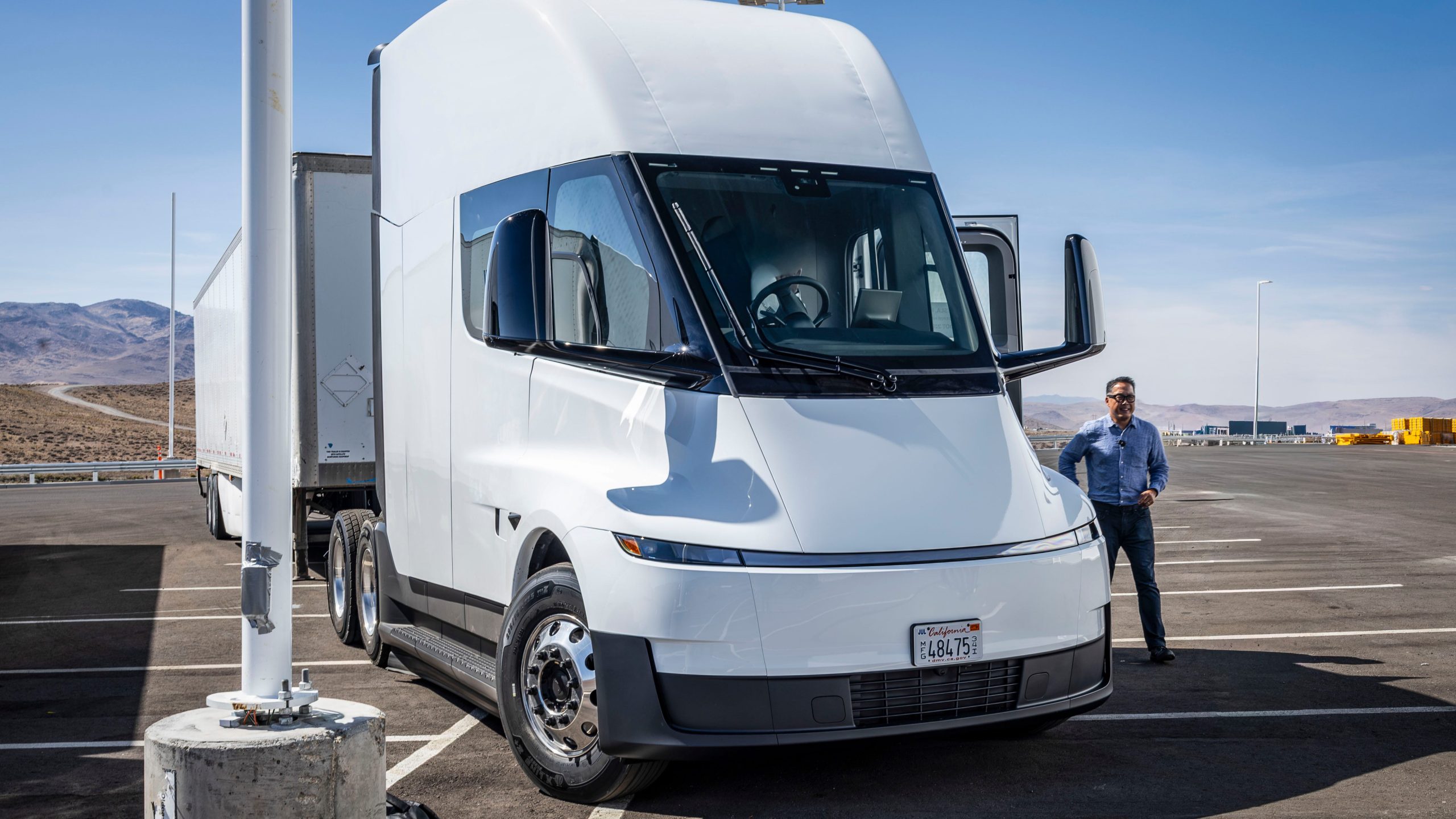
And then? You just drive it. Like any other Tesla. Yes, the central seating position feels odd at first, but I quickly got used to it. Lane centering wasn’t a problem, thanks to fantastic visibility straight ahead and out of the tall side windows. The view to the rear is also excellent because of the enormous side mirrors and two cameras mounted on each supporting arm. These four cameras (two on each mirror arm facing down and back) show different blind spots on the twin 16.0-inch screens mounted on the left and right sides of the steering wheel. There’s a top-down view of the blind spot ahead of the front wheels and a view looking directly down along the side of the cab, below the side glass.
Although it’s comforting to have all this visibility, the views out, back, and down reinforce how high and centered you sit inside the Semi. But any unease fades away as you start quickly oozing down the road. The smooth, shiftless acceleration and light yet direct control of the electric power steering (EPS) drive home the Tesla-ness of the Semi. It’s both unmistakable and reassuring, as is the feedback of the scrolling buttons on the steering wheel and the menu system on the screens, where you adjust the temperature and airflow of the HVAC system, bring up Spotify or Apple Music, and punch in your route home.
Tesla claims its new Semi factory in Sparks, Nevada, will eventually be able to build 1,000 Semis a week, using 3,000 employees working in four shifts five days a week.
I only spent about 12 minutes driving the Semi around Tesla’s Reno Gigafactory and new Semi Factory but got to see a few of its tricks. Thanks to the independent front suspension and the attention Semi engineers paid to increasing the steering angle of the front wheels, the Semi has an impressively tight turning radius. Tesla claims the Semi needs only a little more room to make a U-turn than a Model Y, and it certainly felt that way after I turned around on a two-lane road about the width of a residential street. It takes around five complete turns of the steering wheel to go lock to lock, and the feeling is light yet precise, thanks to the EPS.