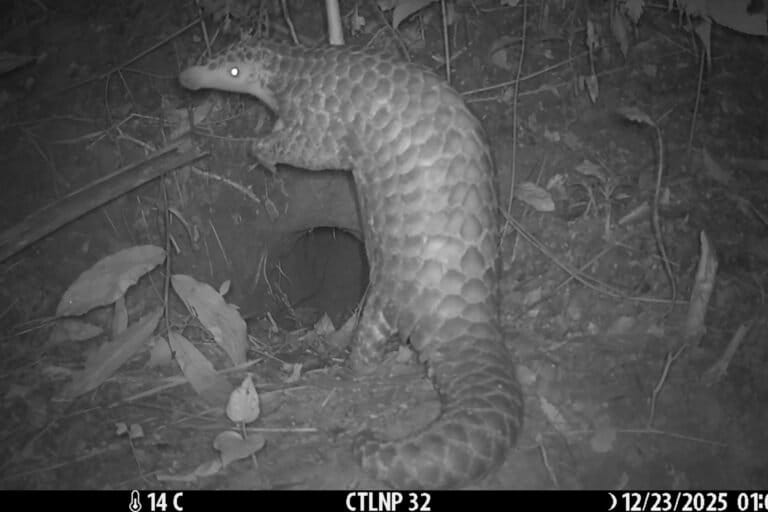
- Chinese pangolins are one of the most trafficked mammals on Earth.
- In Bangladesh, scientists are tracking rescued and released individuals to learn about their ecology, behavior and habitat requirements.
- Using radio trackers, camera traps and burrow surveys, researchers found these elusive animals stay surprisingly close to home, and readily integrate with wild populations, even sharing burrows with other species.
- With very little known about the species, every new insight could help conservation teams better protect them across their range in Asia.
In a forest reserve in northeastern Bangladesh, two Chinese pangolins rescued from trafficking have been given a second chance at life in the wild. As poaching pushes the critically endangered species toward extinction, the releases aim to do more than boost flagging local populations. With the help of tiny radio transmitters, scientists are tracking each individual to learn about their survival, movements and behavior.
Equipped with an armor-plated body, elongated snout and sticky tongue the length of their body, Chinese pangolins (Manis pentadactyla) are beautifully adapted to a life spent grubbing out ant and termite nests and resting in burrows dug into the forest floor.
However, like all eight of the world’s known pangolin species, Chinese pangolins are among the most trafficked mammals on Earth. They’re plucked from forests across their range to feed an illegal trade driven by demand in China and Vietnam for pangolin meat, and scales and other body parts used in traditional medicines.
While no global population counts exist, the IUCN, the global wildlife conservation authority, classifies the species as critically endangered, due to the combined threats of poaching, habitat loss and deforestation. High poaching rates in China in the late 20th century caused local extinctions, displacing hunting pressure to other parts of the species’ range, which spans from northern India and Nepal, through Bangladesh and northern parts of Southeast Asia to southern China and Taiwan.
Yet very little is known about the species in many countries, including Bangladesh, says Shahriar Caesar Rahman, co-founder and CEO of Creative Conservation Alliance (CCA), a Bangladesh-based nonprofit leading the pangolin tracking. “The problem is that nobody knows how many there are and how best to monitor them,” he tells Mongabay.
In 2017, Rahman was involved in the first, and still the only, study of pangolins in Bangladesh. That work revealed the species was becoming increasingly rare in areas where they were once common, such as along the country’s remote border with Myanmar, a well-known hotspot of cross-border wildlife trafficking. “In the hill tracts in the southeast of Bangladesh, they’ve been wiped out,” Rahman says.


Multiple survey methods
When the Bangladesh Forest Department confiscated two pangolins from traffickers, a female in October 2025 and a male in January 2026, and brought them to the Jankichara Wildlife Rescue Centre operated by CCA in Lawachara National Park, Rahman says he recognized the opportunity to learn more about the species.
“We really wanted to find out how they move about and use burrows,” Rahman says. “But considering their very elusive nature, we had to use multiple survey methods.”
Before each pangolin was released, vets checked them for injuries, dehydration and stress. They then attached small VHF radio transmitters to the scales at the base of each pangolin’s tail so they could track them on foot as they explored their new surroundings.
Initially, the team followed the newly released pangolins from dusk until dawn, recording their behavior and microhabitat preferences. According to Rahman, it took them roughly one week to select and settle into a burrow system.
Once they knew where the pangolins were resting during the day, the team set up camera traps outside the burrow entrances and reduced their VHF tracking to several hours per night. They also carried out burrow occupancy surveys throughout the 1,250-hectare (3,090-acre) release site to monitor the wild pangolin population. They estimate six wild individuals live in the vicinity of the release site.
Now, more than six months into the fieldwork, Rahman says he’s hopeful that what they’ve learned could prove useful for other reintroduction programs across the species’ range.


Both pangolins recovered remarkably well from short periods in captivity at the rescue center once they were hydrated and fed on natural foods like ants found inside rotting wood. Upon release, each individual also explored a relatively small territory, staying within a home range comprising similar microhabitats. This surprised the researchers, given previous studies of other species indicate released animals often roam far while exploring their new surroundings, expending energy sometimes to their detriment.
A particularly intriguing moment during the monitoring was the sighting of a wild male pangolin visiting the burrow occupied by the released female. “We hope that we will get a little pangolin pup on camera soon,” Rahman says.
The VHF tracking also revealed the pangolins frequently use old burrows, rather than digging out new ones. This could have implications for population monitoring, which typically relies on signs of burrow occupancy, such as fresh piles of soil outside entrances, as a proxy of abundance. “You might assume there is no pangolin present, because it’s an old burrow,” Rahman says. “It shows that to really understand pangolin populations, we need to use a combination of survey methods.”
Camera-trap photos indicated the pangolins seemed to readily integrate with wild populations, even sharing burrows with other species, such as bats, pythons and tortoises. Deer and pigs were also recorded snuffling out insects and grubs in fresh soil around burrow entrances. Considered with the Chinese pangolin’s capacity to eat tens of thousands of insects per night, Rahman says these observations demonstrate the species’ crucial role as ecosystem engineers and the importance of restoring them and their functions to forests across their range. “If the pangolins weren’t there, termites and ants would ruin the forest.”
Species survival depends on curbing the trade
Experts say post-release monitoring to find out what happens to rewilded pangolins is a vital step in securing a viable future for Chinese pangolins.
“Understanding more about ecological aspects, home range and behavior is critical, particularly in densely populated countries like Bangladesh where pangolin habitats are shrinking rapidly,” says Kumar Paudel, vice chair of the Asia region for the IUCN’s Pangolin Specialist Group, who wasn’t involved with the pangolin tracking in Lawachara. Situated in the center of the species’ range, Bangladesh is also “a crucial point in terms of biogeography,” he adds.


While the tracking work offers valuable insights, Paudel says he advises against drawing species-wide conclusions from observations of rescued animals. Confiscated animals often have unclear origins, meaning they might be unfamiliar with the types of habitats at release sites, potentially resulting in unnatural behaviors. “Any insights we get from this kind of monitoring using confiscated animals is already a little bit limited in and of itself,” he says.
According to Paudel, the long-term survival of the species ultimately depends on tackling the illegal trade. “We need to work along every stage of the supply chain,” Paudel says, from reducing demand among consumers in China and Vietnam, to improving law enforcement and prosecutions, to engaging with communities living alongside pangolins to ensure they choose protection over poaching.
Over the long-term, Rahman says, CCA aims to reintroduce confiscated pangolins into more remote and challenging sites where forest protections are scarcer and populations are still hunted. Reducing poaching pressure in these areas will be key, Rahman says, adding he hopes to build on a proven community-centric approach that has reduced hunting of Asian giant tortoises (Manouria emys) in the Chattogram Hill Tracts. Through that project, CCA supports local schools and livelihoods in exchange for biodiversity protection, and hires former hunters as “parabiologists” who patrol forests and monitor species.
Paudel urges caution when applying such community-based approaches to pangolins, however. As a highly trafficked species, the financial incentives to hunt them might outweigh what conservation initiatives can provide locals in return for their protection, he says. Therefore, achieving community buy-in for pangolin conservation can be tricky.
“We need to convert more poachers to become conservationists,” Paudel says. “Without that, we cannot change things. But at the same time, we need to make sure we’re balancing expectations so people will not go back to exploiting pangolins.”
For now, though, Rahman says CCA will continue its tracking research in Lawachara National Park. Well-protected and accessible, it’s an ideal experimental site to learn more about pangolins and refine rescue and release protocols.
“Tracking is a very powerful method of protecting pangolins,” Rahman says. “Once you’re in the field tracking the animal every day, you are basically protecting the habitat and the species.”
Banner image: Camera-trap image of one of the radio-tagged pangolins released into Lawachara National Park. Image courtesy of Creative Conservation Alliance.
Carolyn Cowan is a staff writer for Mongabay.
Citations:
Challender, D. W., Harrop, S. R., & MacMillan, D. C. (2015). Understanding markets to conserve trade-threatened species in CITES. Biological Conservation, 187, 249-259. doi:10.1016/j.biocon.2015.04.015
Trageser, S. J., Ghose, A., Faisal, M., Mro, P., Mro, P., & Rahman, S. C. (2017). Pangolin distribution and conservation status in Bangladesh. PLOS ONE, 12(4), e0175450. doi:10.1371/journal.pone.0175450
Al-Razi, H., Maria, M., Rabbi, R. A., Shimu, M. S., Rahman, S., Sultana, R., … Nekaris, K. (2026). A new home is a death trap: Reinforcement at a translocation release site leads to fatalities in an endangered primate species. Global Ecology and Conservation, 66, e04072. doi:10.1016/j.gecco.2026.e04072
See related story:
FEEDBACK: Use this form to send a message to the author of this post. If you want to post a public comment, you can do that at the bottom of the page.