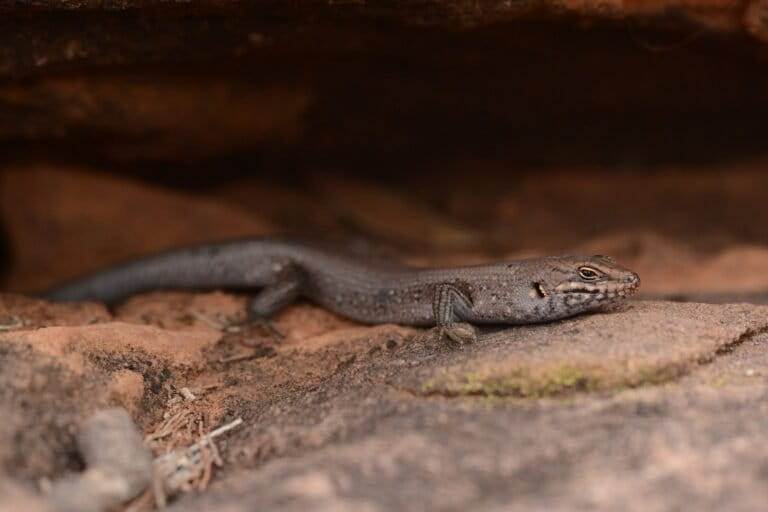
Researchers have described a new-to-science species of skink that may be one of Australia’s most threatened reptiles.
The small population of the skink, possibly fewer than 20 individuals, lives in a pocket of rocky gorge within the arid Mutawintji National Park in New South Wales state, the researchers report in a new paper.
The skink has been named Liopholis mutawintji, in a nod to the park, the only place it’s currently known from. Its common name is Kungaka, meaning “the Hidden One” to Wiimpatja Aboriginal Owners. This refers to the species’ habit of hiding in crevices and burrows.
Scientists from the Australian Museum Research Institute (AMRI) partnered with Wiimpatja Aboriginal Owners and the New South Wales National Parks & Wildlife Service to confirm the Kungaka as a distinct species.
Thomas Parkin, the study’s lead author with AMRI, told Mongabay by email that the Kungaka was previously thought to be a highly isolated population of White’s skink (L. whitii), a species widely distributed in southeastern Australia.
But with Mutawintji roughly 500 kilometers (300 miles) away from the closest White’s skink population, the team decided to revisit the reptile’s taxonomy. The team analyzed DNA samples and compared physical traits of White’s skinks from different populations across Australia.
Their analyses revealed that White’s skink is not one species, but three deeply divergent lineages. The three species in the revised taxonomy are the southern White’s skink (L. whitii), northern White’s skink (L. compressicauda), and the Kungaka.
Parkin said the Kungaka can be distinguished from the other two White’s skinks “by the presence of dark-tipped scales on the palms of its hands and feet, a proportionately longer tail, and subtle differences in overall body proportions.”
Alex Slavenko, a member of the Skink Specialist Group at the IUCN, the global wildlife conservation authority, who wasn’t involved in the analysis, told Mongabay by email: “The team here have done a fantastic job bringing together genetics, morphological data from museum specimens, Traditional Owner knowledge and ecological data to resolve a long-standing taxonomic issue.”
Monitoring of the skinks over 25 years suggests the Kungaka may already be critically endangered, the authors say. Threats include damage to their habitat from feral goats, drought, and introduced predators like feral cats.
“[T]he formal description of Kungaka as a distinct species will allow its listing under state and federal threatened species lists, which is a crucial first step for planning and implementing management plans,” Slavenko said.
Parkin said efforts are underway to manage threats and that captive breeding and genetic management are also being considered.
Warlpa Thompson, study co-author from the Mutawintji Board of Management, said in a statement: “Our people have been leading the way for looking after this extremely rare lizard. Now that it’s about to be given the name Kungaka, the Hidden One, in Wiimpatja parlku, the world will soon know how special they are.”
Banner image: Kungaka in Mutawintji National Park. Image by Tom Parkin (CC BY-ND 4.0).