Before we start, let me qualify that the ‘four notes’ part of this lesson’s title refers to four fretted notes (E, F#, A, B), plus whatever string bends I can use to squeeze more out of them!
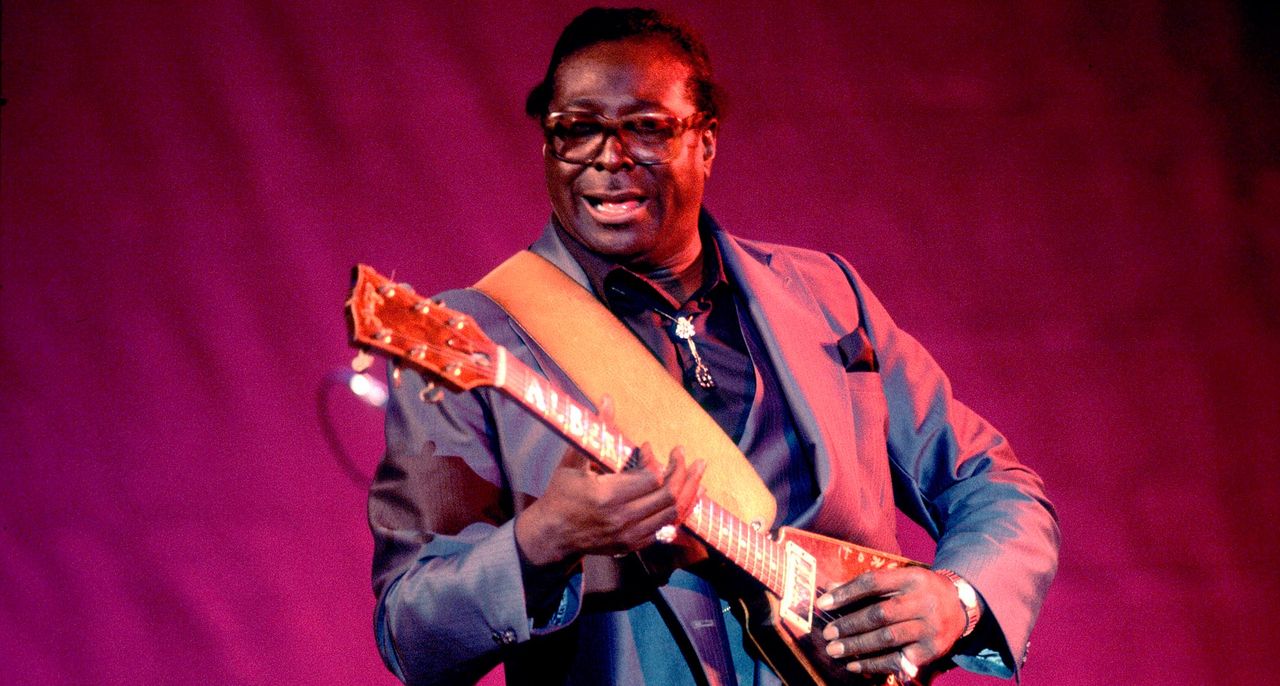
This is an exercise in getting a lot out of a little, inspired by the likes of Albert and B.B. King and Peter Green. If you’ve never tried this before, it’s really surprising to discover how much we rely on patterns and shapes when we’re playing – and this can potentially be at the expense of thinking melodically or rhythmically.
A slow blues like this example is the ideal way to experiment with such minimalism, not because it’s easy, but because it’s so challenging! We’re really exposed here… One thing that isn’t particularly emphasised here is the use of space. But just as Albert King advised Gary Moore to play “every other lick”, we should consider each phrase and try to put ourselves in the place of the listener.
We encourage you to ask yourself questions such as: am I using enough rhythmic variation? Am I always starting or finishing on the root note? and so on. The idea isn’t to completely disregard the vocabulary and chops you’ve already developed, but rather to, ultimately, put you more in control of them.
The nature of the guitar does make it tempting to rely completely on the patterns and shapes we’ve discovered over the years and not venture outside of them. This can lead to us becoming a little jaded about our own playing. But a four-note blues such as this one is a great way to break out of that cycle.
As you play through the examples here, consider other details such as bends, vibrato and slides. Recording our playing and listening back later with an objective ear is also enlightening. I hope this approach is useful and see you next time!
Blues Headlines: Four Note Solo – YouTube

Example 1

This first example makes use of short staccato notes and contrasting longer held ones. Though all these examples are transcribed as faithfully as possible, there is a little bit of ‘push and pull’ in the timing, which is to be encouraged.
One of the things great players such as Albert King, Jimmy Page and B.B. King have in common is that they don’t always play squarely across the beat. It’s also a good idea to check out the rhythmic phrasing of other instruments, or even vocals, to see if there are any ideas worth stealing.
Example 2

Making use of the note groupings on the fretboard, this second example begins with a few doublestop-type ideas. There is potential to space these out more or play with the rhythms, but that didn’t seem the best use of the space available here.
In the following bar, there’s a tone and a half bend from B up to D, the only way we can get this note without breaking our self-imposed ‘four-note’ rule… The pre-bend to C immediately afterwards follows the same rationale.
Example 3

Another tone-and-a-half bend here – it was really tempting to just play a G at the 12th fret, but that’s not in the spirit of this idea! Also, Albert King and David Gilmour are no strangers to this type of bend, and it does force us to concentrate on the pitching, which can’t be a bad thing.
As mentioned earlier, do experiment with pushing and pulling against the beat. None of this is written in stone.
Example 4

Having held a note over from the end of Example 3, we’re rejoining the action here with this Albert (or perhaps B.B.) King-style lick. Another wide bend up to D leads to a quick shift in hand position.
This allows for changing the fretting hand fingers around, giving the strength to bend the E at the 9th fret of the third string up rhythmically up to F#. This finally lands back on the E to finish.
Hear it here
Albert King – Various
Albert’s solos are a masterclass of economy and wild string bends. This is partly facilitated by his unusual tunings and ‘upside down’ playing orientation, but there’s no reason why we can’t take lessons from this to use in our own playing.
Check out Born Under Bad Sign, the version of Oh Pretty Woman where he duets with Gary Moore, and Laundromat Blues to get a taste of how he creates excitement and dynamics without moving far around the fretboard.
B.B. King – Various
Another player who wasn’t afraid to leave space and didn’t feel compelled to play long complicated runs was B.B. King, who maintained that his objective was to play simply and honestly – in his words, “like never lying”.
Check out his sparse phrasing on The Thrill Is Gone, Don’t Answer The Door and Why I Sing The Blues. It’s also worth pointing out that B.B. felt it was important to improvise and play from the heart, rather than rehearse his licks.
Peter Green – Various
Revered by players as diverse as B.B. King and Gary Moore, Peter brought a finesse to simple lines that reached players and non-players alike.
The tracks most people know are Need Your Love So Bad and Albatross, but it’s worth investigating a little more deeply to find gems like Long Grey Mare, A Fool No More and Apostle.
It’s often said that the primary objective of solo guitar playing should be to benefit the song; Peter certainly seemed to agree with this.