Britain is signalling a fresh attempt to deepen defence cooperation with the European Union, after earlier negotiations over UK access to the bloc’s flagship Security Action for Europe (SAFE) loan programme broke down last year. The shift, led by Keir Starmer, matters because it could shape UK defence industry opportunities, Europe’s wider security posture, and the politics of the post-Brexit “reset” narrative.
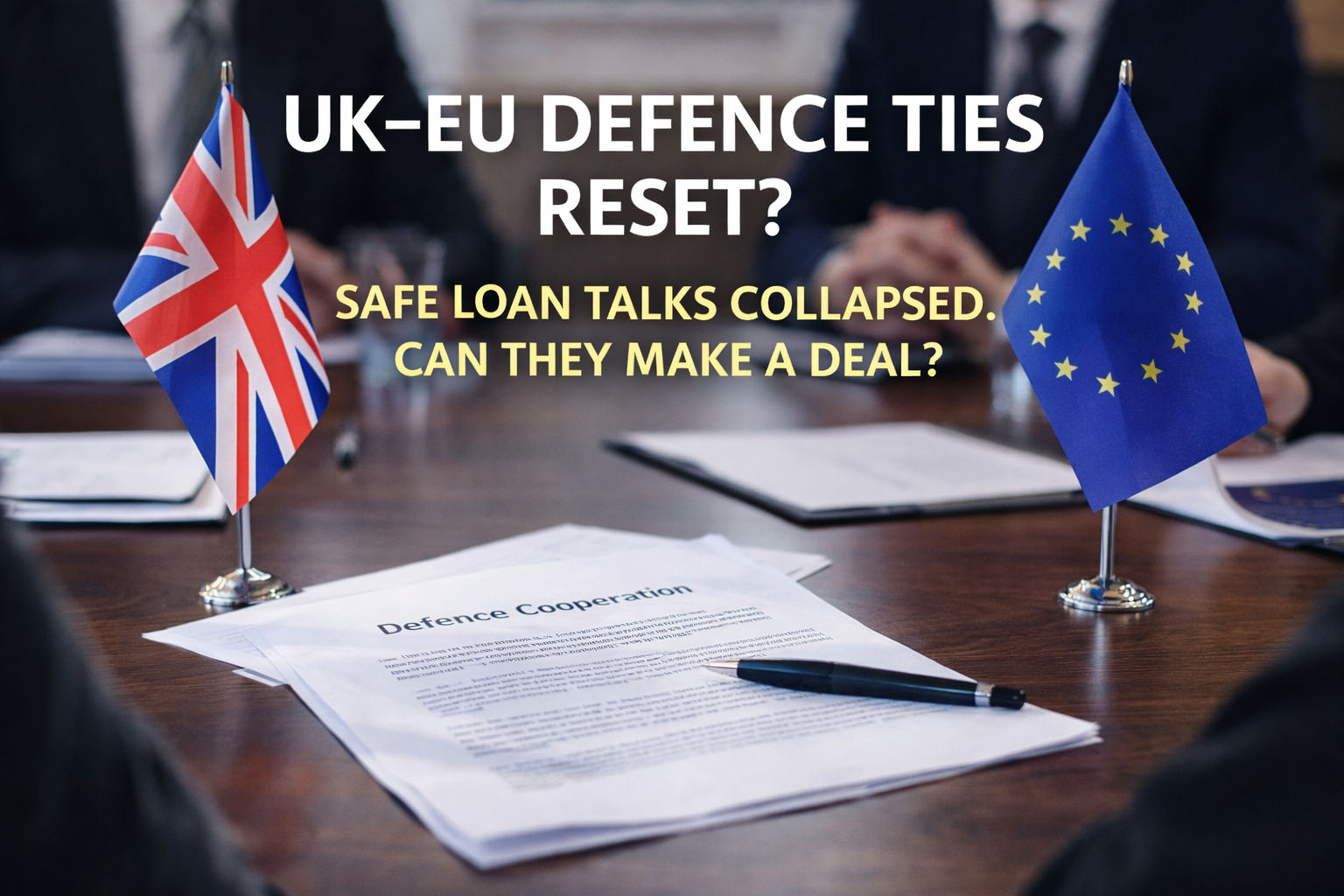
Photo (Hero image): UK–EU security briefing vibe (neutral, non-partisan).
Image prompt: Realistic photo, modern conference table with UK and EU flags subtly visible, documents titled “Defence Cooperation”, calm lighting, professional setting, high detail.
What is SAFE (and why the UK wants in)?
SAFE is an EU financial instrument designed to support defence procurement by offering up to €150 billion in long-maturity, competitively priced loans to EU member states for defence capability investments. It’s intended to speed up joint procurement and strengthen Europe’s defence industrial base.
Why that matters for the UK: even as a non-EU country, UK firms could benefit if UK participation (or structured third-country access) allows British industry to supply equipment, components, and services into SAFE-backed projects—subject to rules set by the EU and participating states.
Photo: Defence manufacturing line (generic).
Image prompt: Realistic photo, UK defence manufacturing facility, engineers inspecting components, safety gear, clean industrial lighting, no logos, high detail.
Why talks collapsed last year
The previous push for UK involvement fell apart in late 2025 amid disputes over financial contributions/entry costs and access terms. Reports highlighted sharp disagreement over the price of UK participation and the conditions attached—issues that became politically and diplomatically difficult on both sides.
Some reporting described entry-fee demands in the billions of euros (with figures varying by source and scenario), and concerns that the UK would face tighter limits than EU members on how much it could lead projects or contribute components under third-country rules.
Photo: “Negotiations” visual.
Image prompt: Realistic photo, hands exchanging documents across a table, UK and EU folder labels, neutral tones, shallow depth of field, high detail.
What changed now: why the UK is “ready to try again”
Recent statements indicate a renewed willingness to explore a new route—potentially tied to a second round or revised approach to UK involvement—amid a tougher security environment and pressure for closer European coordination.
Reporting also points to active political engagement with EU counterparts, including meetings involving Maros Sefcovic, as the government looks for practical areas of cooperation even while ruling out rejoining core EU economic structures.
Geopolitics is a big driver: the war in Ukraine, European rearmament discussions, and uncertainty around US security guarantees—especially with Donald Trump back in office—have intensified the argument for tighter European defence alignment (including with non-EU partners).
What the UK could gain (and what it may have to accept)
Potential gains
- Industrial upside: more routes for UK defence firms to participate in European procurement pipelines (depending on eligibility and rules).
- Strategic coordination: closer planning and interoperability with European partners at a time of heightened risk.
- Political signal: reinforces the “reset” narrative without reopening the full Brexit settlement.
Likely trade-offs / constraints
- Money + conditions: participation is unlikely to be free; previous talks broke on costs and terms.
- Third-country limits: non-EU suppliers can face caps and restrictions compared with EU members, affecting competitiveness and control.
- Domestic politics: any closer EU alignment invites criticism—figures like Nigel Farage have already framed this as a slippery slope.
Photo: A simple “pros/cons” desk scene.
Image prompt: Realistic photo, notebook page titled “UK–EU Defence: Pros & Cons”, pen, coffee cup, soft daylight, calm minimal aesthetic, high detail.
What to watch next: 5 signals that a deal is real
- Official UK/EU statements referencing SAFE participation terms (not just “cooperation”).
- Any clarity on financial contribution levels and what the UK gets in return.
- Movement on third-country supplier rules that affect UK industry access.
- Confirmation of timing via UK–EU diplomatic calendars (councils/summits).
- Parliamentary and industry reactions as details emerge.
FAQ
Is this the UK “rejoining the EU”?
No. The discussion is about defence cooperation and access to a specific EU financing/procurement framework, not rejoining EU membership structures.
Would UK taxpayers pay into SAFE?
Any arrangement would depend on negotiated terms; prior talks reportedly hinged on cost and conditions, which is why they collapsed.
What is SAFE actually used for?
SAFE supports member-state defence procurement and capability investment via EU-backed borrowing and loans—aimed at faster procurement and industrial scaling.
Bottom line
This is a pragmatic attempt to reopen a channel that previously failed: the UK wants a workable route into Europe’s evolving defence financing ecosystem, and the EU has to decide how far it’s willing to integrate a major non-member partner into a flagship programme. Whether it succeeds will come down to price, access rules, and politics—not slogans.