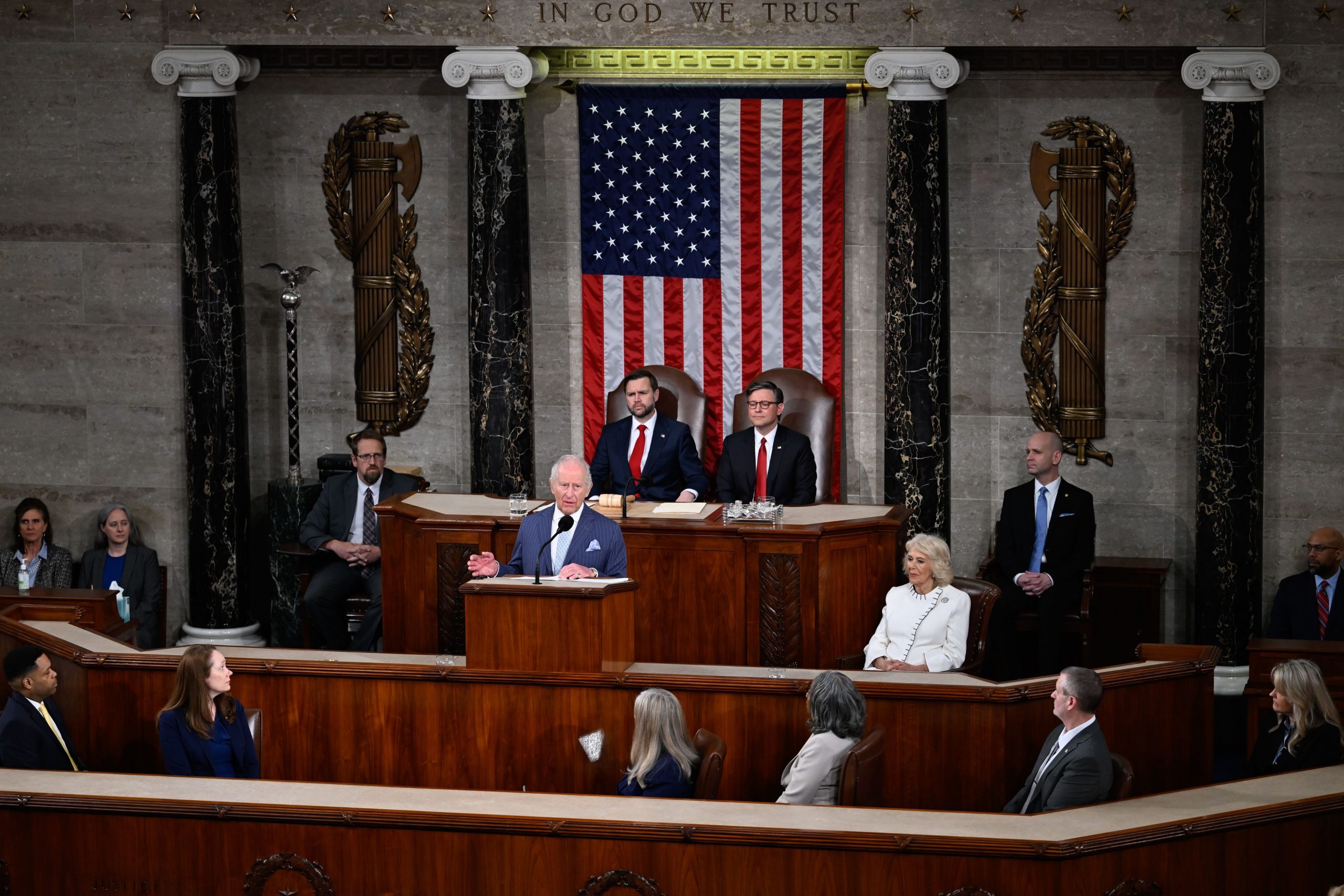
Members of the 119th Congress waited with almost fevered anticipation. So did the president’s cabinet, the vice president, and one Supreme Court justice. The occasion was one of many events this year to celebrate the 250th anniversary of America’s independence from Britain, and this one was an address from the reigning British monarch.
From the mezzanine, a man dressed as George Washington watched as King Charles III made his way through the crowd and up to the dais. The royal’s meandering walk was punctuated by handshakes with Justice Stephen Breyer and Chairman of the Joint Chiefs of Staff Dan Caine. It was scored by a raucous standing ovation that lasted more than two minutes.
The room was packed. Congressional staffers lined the walls. In defiance of House rules, elected members took out their iPhones to snap photos. When this descendent of King George III thanked “the American people for welcoming us to the United States to mark this semiquincentennial year of the Declaration of Independence,” the room leapt to its feet in applause. The portly man dressed as George Washington struggled out of his seat.
The speech drew bipartisan acclaim. Democrats, who have warned that President Trump is behaving more like a potentate than a president in his second term, gobbled up this genuine king’s reminder that the United States was founded on “the principle that executive power is subject to checks and balances.” Republicans clapped, albeit uncomfortably, as Charles delivered a full-throated defense of NATO, a rallying cry in support of Ukraine, and a few words on the importance of preserving the environment.


Not every line earned a standing O from the Republicans in the room, but very many did.
Bloomberg/Getty Images
The royal family has long maintained a disposition of studied dullness, which made the speech delivered on Tuesday, only the second of its kind after Queen Elizabeth II’s in 1991, fairly remarkable.
The old king had jokes. “When I address my own Parliament at Westminster, we still follow an age-old tradition and take a member of parliament hostage, holding him or her at Buckingham Palace until the monarch is safely returned,” he said, to laughter in the room. “I don’t know, Mr. Speaker, if there are any volunteers for that position today.”
When Charles declared that “vibrant, diverse, and free societies” are what “gives us our collective strength,” Democrats gave another standing ovation, followed by the Republicans. When he said next that “the Christian faith is a firm anchor and daily inspiration that guides us not only personally, but together as members of our community,” the Republicans were back on their feet, with Democrats following soon after.
When the king called on us to “reflect on our shared responsibility to safeguard nature, our most precious and irreplaceable asset” during an extensive section on the environment, a tentpole issue for Charles, Democrats leapt to their feet. Many Republicans, including Environmental Protection Agency administrator Lee Zeldin, remained seated. Not everything sparked comity among political rivals and their foreign guest.
Charles is in town on some very important business. The alliance between the United States and the United Kingdom is more strained than it has been in decades, perhaps since the Brits burned down the White House, and Downing Street is hoping the king can charm Trump into cooperation. At the top of his speech, Charles alluded (maybe) to the current tempest between Washington and Westminster: “With the spirit of 1776 in our minds, we can perhaps agree that we do not always agree,” he said. “Ours is a partnership born out of dispute, but no less strong for it.”
The task at hand is daunting, even for a king. Trump has spent the last year taking a sledgehammer to the so-called Special Relationship. He has regularly insulted Prime Minister Keir Starmer and London Mayor Sadiq Khan. After Britain declined to join his war in Iran, Trump ratcheted up the attacks, oscillating between insisting the United States did not need the help of its allies and complaining that so few had come to its aid. Even before the war, Trump was on a tear against Europe and NATO, threatening to invade Greenland while levying extraordinary tariffs on the continent’s goods.

The king was glad-handed by every Democrat and Republican who could reach him.
Bloomberg/Getty Images
For the UK, the most painful broadside was Trump’s derision for British troops who served alongside Americans in war. Charles pointed out here that NATO’s common defense clause has been invoked just once in its history, in the wake of 9/11. All members of the alliance sent troops to fight in Afghanistan. England lost 457 soldiers in the war, and more than 2,000 others were wounded or injured. “We’ve never needed them,” Trump said of the Brits in January. “We have never really asked anything of them. You know, they’ll say they sent some troops to Afghanistan or this or that. And they did. They stayed a little back, little off the front lines.”
The president walked back those comments a few days later. According to The Sun, he did so after an intervention from Charles, the ceremonial commander of Britain’s armed forces, who reportedly made his concern with the remark known through backchannels. “We answered the call together,” Charles said before Congress, “as our people have done so for more than a century, shoulder to shoulder, through two World Wars, the Cold War, Afghanistan and moments that have defined our shared security.”
The speech, in all its subtle politicking, could prove to be a demonstration of just how well Charles is positioned to soften Trump’s browbeating of Britain and other allies in Europe. Trump has long been enamored by the royal family, and in the past year, even as the president assailed the US-UK alliance, he has described Charles as a “fantastic man,” a “great man,” a “brave man,” a “very, very special man,” and a “long-time friend.” When the president spoke earlier on Tuesday during a White House ceremony, he opted for superlatives over insults: “Melania and I will never forget the spectacular honor your majesties showed us during our extraordinary visit to Windsor Castle last September. Now, it is our tremendous privilege to host you,” Trump said, flanked by Charles. “He’s a very elegant man.”
Concerns about the end of the “Special Relationship,” a term coined by Winston Churchill that some Brits believe makes them sound a bit needy, are top of mind. As Charles prepared to visit the White House on Tuesday morning, The Financial Times reported on private comments in which UK ambassador Christian Turner told a group of high school children that if the US has a “special relationship” with any country, it’s “probably Israel.” But if Charles’s speech and its raucous reception by Congress were any indication, the bond has deeper roots than the current bickering between the White House and 10 Downing Street suggests.
Trump may mouth off, but he remains enamored, like so many Americans, with the ornamental qualities of the royal family. 250 years after the United States fought for independence from a mad king, we have developed a strange reverence for what the family has become: A stodgy symbol of an old empire, an aesthetic accomplishment more than a political one. It’s Buckingham Palace, rotund corgis, Princess Diana on a megayacht diving board, King Charles in an Anderson & Sheppard suit cracking jokes about holding a member of Congress hostage.
The pomp of the afternoon was all faintly ridiculous. Charles, after all, is a ceremonial figure. His actual power, insofar as it is ever mentioned by the British press, is qualified by the modifier “soft,” and this particular king has never been considered a force of nature. But before Congress, he proved he still maintains a certain pull over Americans. For Democrats, who yearn for a leader to match Trump, he was received as an off-beat truth-teller, a sovereign by divine right warning against concentrated power. For Republicans, perhaps in deference to Trump’s own infatuation with the royal family, his words were met with respectful reverence.
Trump, soon after, delivered his own verdict: “He made a great speech,” the president said ahead of the state dinner Tuesday night. “I was very jealous.”
-
The First Time America Has Seen Melania Trump Visibly Emote
-
A Complete Timeline of the Drama Surrounding Michael
-
Exclusive: Queen Elizabeth’s Never-Before-Seen Portrait, Unveiled