As President Donald Trump backs AI industry self-regulation, a growing group of November candidates are calling for tougher government guardrails, turning AI into an emerging fault line ahead of the midterms.
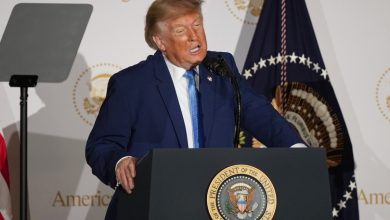
Trump hosted a group of the country’s top AI executives at the White House on Tuesday, including leaders from OpenAI, Anthropic, Meta, Google and Nvidia, as his administration pushes to accelerate American AI development while resisting regulations that could slow the industry.
Trump said Tuesday that he was seeing “tremendous self-regulation” from AI companies and described a new industry agreement as “morally binding.” He has repeatedly argued that the United States needs to move quickly on AI to maintain its technological advantage over China.
But a growing group of candidates on the November ballot are drawing a clear line with Trump, backing tougher AI guardrails instead of relying on industry self-regulation.
Fifteen candidates running in November—including two independents and 13 Democrats—have either signed the AI Pact or publicly backed stronger AI guardrails. Their proposals range from mandatory safety testing and corporate liability to protections against deepfakes, privacy violations and AI-driven discrimination.
The divide is emerging as voters say they want more oversight. A new Quinnipiac University poll found that 71 percent of registered voters are more likely to vote for a candidate who supports stricter AI guardrails, compared with 16 percent who prefer a candidate who supports expanding AI development.
AI is becoming an issue that candidates may increasingly have to take a position on—and Trump’s push for rapid development and voluntary industry standards is giving his opponents a clear point of contrast.
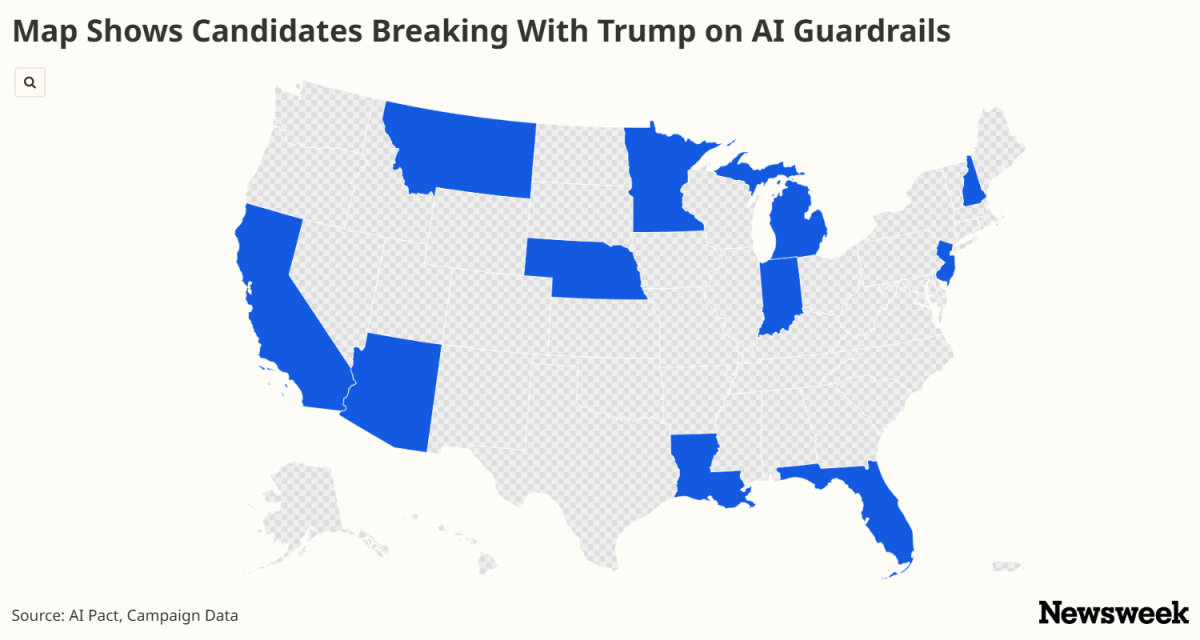
Which Candidates Are Breaking With Trump on AI?
The 15 candidates on this map are all running in November and have either signed the AI Pact or publicly backed AI guardrails.
The list includes Dan Osborn and Brian Bengs, independent Senate candidates in Nebraska and South Dakota, respectively, as well as Democratic candidates running for the Senate, governor and House.
Among them, some have offered particularly specific proposals.
- Sam Forstag, the Democratic candidate in Montana’s 1st Congressional District, calls AI “perhaps the most pressing issue” facing the country and says Congress needs “oversight and regulation” to protect privacy, children and the economy.
- Matt Little, running in Minnesota’s 2nd District, calls for government guardrails, public-interest safety oversight and legal avenues to hold AI companies accountable. His platform also addresses deepfakes, identity theft and election disinformation.
- Connie Chan, running in California’s 11th District, supports human oversight when AI is used in high-risk sectors. She also backs protections for creators, legal remedies for nonconsensual deepfakes and restrictions on political campaigns using AI to deceive voters.
- Elizabeth Lee, the Democratic candidate in Arizona’s 5th District, calls for “clear, enforceable standards” governing AI, including privacy protections, transparency, anti-discrimination safeguards and protections for workers and consumers.
- Tony D’Arrigo, running in Florida’s 13th District, says, “AI should serve people, not control them,” and calls for transparency, accountability, privacy protections and human oversight when AI is used by government.
- Cinde Warmington, the Democratic candidate for governor of New Hampshire, calls for strong AI safety regulations, consumer protections and safeguards for children.
- Cable, also known as Conrad Roberts, running in Louisiana’s 4th District, argues for regulation of AI to protect democracy and workers and prevent corporate interests from dominating AI policy.
The remaining candidates are Angie Nixon, running for the Florida Senate; Gina Hinojosa, running against Greg Abbott for Texas governor; Justin J. Pearson, running for Tennessee’s 9th congressional district; Will Lawrence, running for Michigan’s 7th congressional district Kelly Thompson, running for Indiana’s third congressional district; and Zack Mullock, running for New Jersey’s second congressional district.
The AI Pact itself calls for mandatory independent safety reviews of major AI models and legal accountability for AI companies, along with other provisions addressing workers and the AI industry’s obligations.
What Donald Trump Has Said About AI Regulation
Trump has made AI development a major economic and national-security priority while resisting broad government regulation and repeatedly dismissing warnings about the technology’s potential dangers.
In a series of Truth Social posts on September 14, he called claims that AI could “take over the World, destroying Humanity” a “HOAX” and said, “The only control or ‘guardrails’ that AI needs is a STRONG AND SMART (High IQ!) PRESIDENT.”
He later wrote, “I am the Hoax Buster,” accusing critics of AI of pushing another supposed hoax and arguing that the United States should not slow the technology while competing with China.
The president reiterated that position at the United Nations last week, comparing warnings that AI could kill people or lead to catastrophe with other issues he has described as hoaxes. Fact-checkers have noted that AI-safety concerns are not confined to one political faction or to people who oppose AI development.
At Tuesday’s White House meeting with AI executives, Trump said he was seeing tremendous self-regulation and described the companies’ voluntary agreement as “morally binding.” He also said he was considering a committee of roughly 10 people to monitor AI safety.
His broader argument is that the United States cannot afford to slow its AI industry while China races ahead. The administration has repeatedly emphasized rapid development, energy availability and American technological dominance.
That puts Trump at odds with candidates who argue that voluntary commitments by AI companies are not enough.
Voters Say They Want the Guardrails
The latest polling suggests the issue could have political resonance. Seventy-one percent of registered voters in the Quinnipiac poll said they would be more likely to vote for a candidate who supports stricter AI guardrails, compared with 16 percent who said they would be more likely to vote for a candidate who supports expanding AI development.
Seventy-nine percent said AI safety is more important than keeping the United States at the forefront of innovation, while 15 percent prioritized staying ahead in innovation. Voters also said Democrats have an advantage over Republicans on handling AI, with 42 percent choosing Democrats and 29 percent choosing Republicans.
Meanwhile, Trump’s own approval rating on AI was 25 percent, while 58 percent disapproved of his handling of the issue.
The poll surveyed 1,032 registered voters from September 24-27 and has a margin of error of plus or minus 3.8 percentage points.
For Trump, AI is a race for technological leadership. For a growing number of candidates on the November ballot, it is also becoming a question of regulation, accountability and safety—creating a new dividing line heading into the midterms.
Newsweek’s reporters and editors used Martyn, our AI assistant, to produce this story. Learn more about Martyn here. Contact Newsweek editors on this story: Edward T. Cummins