By Natalia Katona – Aug 13, 2026, 6:00 PM CDT
- Pemex’s refining recovery is losing momentum just as strong fuel margins make higher domestic runs most valuable.
- Falling utilization rates are forcing Mexico back toward fuel imports while crude exports remain well below last year’s levels.
- With more than $20 billion sunk into Dos Bocas alone and Pemex still carrying $77.5 billion of financial debt, refinery reliability is becoming a question of returns on state capital.

Mexico’s push for fuel self-sufficiency has run into a stubborn problem: Pemex has built and upgraded refining capacity faster than it has learned to operate it reliably. The state oil company is being asked to send more crude into domestic refineries and less onto the export market, a strategy that looks increasingly sensible when refined products’ cracks are strong. But the second quarter of 2026 showed the weakness of that model. Mexican refineries processed only around 1 million b/d (58% of installed capacity), while fuel imports climbed sharply again. Mexico has spent heavily to reduce its dependence on foreign gasoline and diesel, yet the effectiveness of that strategy still hinges on a refining system that repeatedly fails to sustain high runs.
Until early 2026, the numbers suggested the strategy had been working. Clean-product imports, which averaged around 750,000 b/d in 2024, fell to roughly 520,000 b/d during the first five months of 2026 as refinery throughput recovered. Runs climbed from just 785,000 b/d in late 2024 to around 1.2 million b/d between December and March 2026, helped by the ramp-up of Dos Bocas and Tula’s new coker.
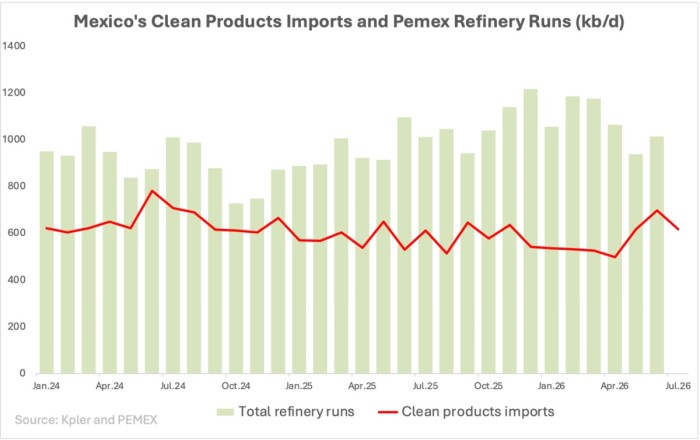
Then the recovery began to unravel. Crude processing started falling in April and was back near 1.01 million b/d by June. Product imports moved in the opposite direction, rising to around 620,000 b/d in May and 700,000 b/d in June. The reversal exposed the central weakness in Mexico’s self-sufficiency drive: the country can reduce fuel imports when Pemex’s refineries run harder, but it has yet to show that they can do so consistently. Even at the recent peak of around 1.2 million b/d, the Mexican refining system was using only about two-thirds of its roughly 1.75 million b/d of installed capacity (excluding the Deer Park refinery in Texas). By Q2 2026, utilization had fallen back to around 58%. That is a low return on a system into which Mexico has poured billions of dollars through refinery rehabilitation, new conversion units and the construction of Dos Bocas.
Moreover, Pemex’s renewed reliance on fuel imports comes at a particularly painful moment. Buying gasoline and diesel from the US Gulf Coast while crack spreads for both products are near record highs adds another layer of pressure to the company’s finances. In June, Mexico imported around 155,000 b/d of diesel and 340,000 b/d of gasoline from the United States, just as diesel and gasoline cracks averaged at $54/bbl and $44/bbl, respectively. Fast-forward to the middle of August, and US diesel cracks are already at $85/bbl, exacerbating the pain.
The problem is not that those investments have produced no results. Tula has been one of the clearest improvements, with utilization rising from around 66% in the first half of 2025 to roughly 79% a year later. The refinery processed almost 249,000 b/d on average in January-May 2026, and Pemex has attributed part of the improvement to its new delayed coker.
Pemex is also extracting a better product slate from the crude it does manage to process. Combined gasoline, diesel and jet-fuel production reached 699,000 b/d in Q2 2026, up 9% from 642,000 b/d a year earlier, while crude processing increased only about 3%, from 980,000 b/d to roughly 1 million b/d. Fuel oil output fell to 191,000 b/d from 222,000 b/d, with its yield dropping to 18.9% from 22.7%. That matters because high residual fuel oil output has long been one of the weaknesses of Pemex’s refining system. The latest numbers suggest investment in cokers and other conversion capacity is beginning to improve what comes out of each barrel. In other words, Pemex is getting better at making the right products, but what it has not solved is how to keep enough crude moving through the refineries in the first place.
Technical failures remain frequent across the Mexican system and seem to be the main weakness. Dos Bocas, ironically the newest refinery in the portfolio, has suffered repeated disruptions since early 2025 involving power and cogeneration systems, process-unit shutdowns, leaks and fires. An electrical failure in January 2026 knocked out the coker, catalytic and hydrodesulfurization units and reportedly deferred around 150,000 barrels of crude processing. Salina Cruz has also experienced repeated fires and operational problems, while Tula, Minatitlán and Salamanca have faced isolated power, equipment, weather-related or process disruptions.
Dos Bocas is the clearest illustration of the gap between capacity on paper and capacity that Pemex can actually rely on. The more than $20 billion refinery has reportedly reached its full 340,000-b/d nameplate capacity on individual days in 2026, yet it averaged only 144,000 b/d in Q2 2026, equivalent to roughly 42% utilization. The challenge is no longer to prove that the plant can hit its design rate (as it used to be in the first year of its operation), but whether it can stay anywhere close to it.
That inconsistency makes the economics of Mexico’s refining strategy much less attractive. Pemex is being encouraged to keep more crude at home because strong crack spreads can make refining more lucrative than simply exporting the barrel. But if domestic plants cannot sustain high utilization rates, Pemex sacrifices part of the crude-export opportunity without fully capturing the downstream margin. Crude exports averaged around 550,000 b/d in March through May 2026 (when the prices were peaking), down from roughly 780,000 b/d a year earlier. And still Mexico had to lift fuel imports as refinery runs weakened.
The financial issues add trouble to the matter and do not allow for prolonged inefficiency. Pemex carried $77.5 billion in financial debt at the end of June 2026, while another $14.6 billion of supplier debt incurred in 2025 has been restructured over eight years. Total debt has fallen substantially since 2020, but the improvement was not generated by operating cash flow alone: the federal government contributed around $20.6 billion of capital during 2025, alongside pre-capitalized securities (P-Caps), bond repurchases and early repayments. This way, Pemex’s financial distress may become a direct threat to Mexico’s sovereign credit profile with its rising dependence on public funds and no changes in financial management so far.
That makes refinery reliability more than a technical problem. Mexico’s strategy assumes that state-owned billions spent on rehabilitation, conversion projects and Dos Bocas will translate into structurally lower fuel imports. So far, Pemex has demonstrated that it can improve yields and occasionally push throughput much higher, but it has not demonstrated that those gains can be sustained. That is the real test for Mexico’s refining push. Pemex is becoming better at turning crude into gasoline, diesel, and jet fuel. However, until its refineries can operate reliably at much higher rates, the country risks paying twice for this strategy of self-sufficiency: once for the capacity it is building, and again for the imported fuels it still needs when that capacity fails to deliver.
By Natalia Katona for Oilprice.com
More Top Reads From Oilprice.com
- Russia Rebuilds Nuclear Workforce at Iran’s Bushehr Plant
- Egypt and Libya Near $1 Billion Oil Pipeline Deal
- The Hormuz Shock Is Far From Over
Download The Free Oilprice App Today



Natalia Katona
Natalia Katona is a freelance commodity analyst, based in the United Arab Emirates.