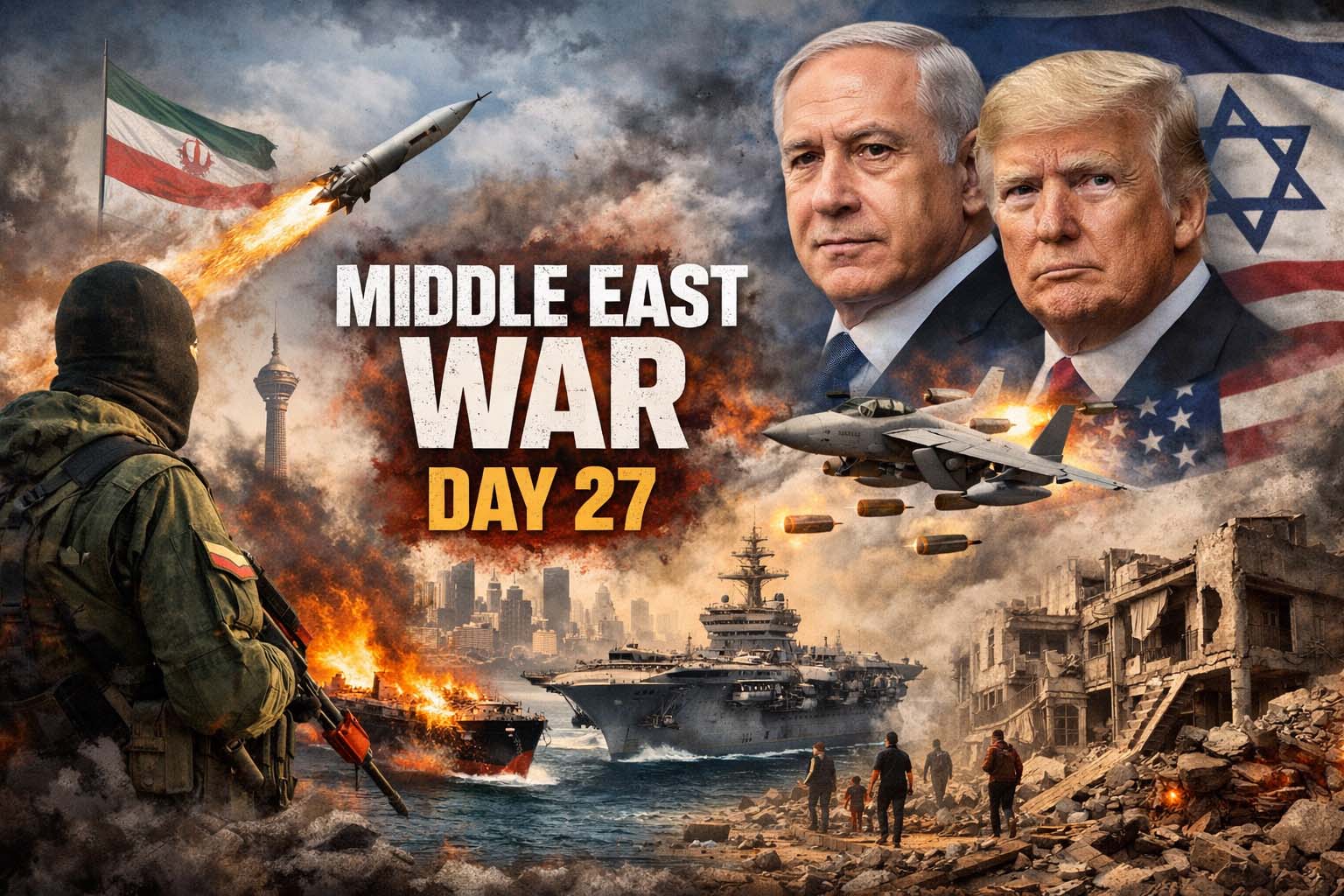
As of 26 March 2026, the current U.S.-Israeli war on Iran is on day 27, counting from 28 February 2026, the start date Reuters uses in its current reporting. So far, there is no final result: the U.S. and Israel say they have badly damaged Iran’s military and nuclear-related capabilities, but Iran is still retaliating, the humanitarian and economic fallout is growing, and no firm ceasefire has been agreed.
What day of the war is it today?
Reuters reports that the U.S. and Israel began attacking Iran on 28 February 2026. Counting from that date, 26 March 2026 is day 27 of the war. Reuters also describes the conflict as now being in its fourth week.
What is Iran’s position right now?
Iran’s public line is that it is reviewing a U.S. ceasefire proposal, but it says it has no intention of holding direct talks with Washington at this stage. Iranian Foreign Minister Abbas Araqchi said messages have moved through intermediaries, but not formal negotiations.
Iran also wants any ceasefire to go beyond Iran itself. Reuters reports that Tehran has told intermediaries that Lebanon must be included in any ceasefire deal with the U.S. and Israel, meaning Iran wants Israeli attacks on Hezbollah to stop as part of a wider regional arrangement.
On the military and strategic side, Iran has continued missile and drone retaliation and has used the Strait of Hormuz as leverage. Reuters reports that Iran told the U.N. that only “non-hostile” vessels may pass if they coordinate with Iranian authorities, while U.S. or Israeli-linked vessels do not qualify for innocent passage.
What is Israel’s position right now?
Israel’s position is still hard-line. Reuters reports that Israeli officials are skeptical Iran will accept current U.S. terms and want any deal to preserve Israel’s option to carry out pre-emptive strikes in the future.
Israel has also said it is not negotiating with Iran directly and sees the Lebanon front as separate. Reuters quotes Israel’s foreign ministry as saying, “Israel has not conducted and does not conduct negotiations with the Iranian terror regime.” Reuters also reports that Israeli strategy treats attacks on Hezbollah as likely to continue even if the air war with Iran changes.
Prime Minister Benjamin Netanyahu has defended the campaign as a strategic reset of the region. Reuters reports that he said Iran no longer has the ability to enrich uranium or produce missiles, though that claim was contested by the head of the IAEA, and Netanyahu also suggested that defeating Iran fully might require a “ground component” rather than air strikes alone.
What is the U.S. position right now?
The U.S. position mixes pressure and diplomacy. President Trump says Iran wants a deal, while the White House says talks are still under way through indirect channels and warns that Iran will be hit harder if it does not accept what Washington describes as military defeat.
Reuters reports that the U.S. ceasefire framework sent through Pakistan includes demands such as reopening the Strait of Hormuz, removing Iran’s highly enriched uranium, halting enrichment, curbing ballistic missiles, and cutting support for regional allies.
At the same time, U.S. messaging has not been completely consistent. Reuters reported on 21 March that Trump said Washington was considering “winding down” its military operation, even as more U.S. forces were moving into the region and other U.S. statements still threatened escalation.
What is the result of the war so far?
The result so far is heavy damage, but no decisive end. Reuters reports that the U.S. Central Command chief said U.S. forces had struck more than 10,000 targets in Iran and claimed that 92% of Iran’s largest naval vessels had been destroyed, with missile and drone launch rates down sharply. But Reuters also reports that Iranian drone and missile attacks on Israel, U.S. bases and Gulf states have continued, so the war is clearly not over.
Humanitarianly, the picture is severe. Reuters reports that thousands have been killed across the region, with around 3.2 million displaced inside Iran and more than 1 million displaced in Lebanon. Reuters also reported earlier this week that more than 2,000 people had been killed in Iran and 15 in Israel since the war began, though battlefield casualty figures in fast-moving conflicts can change quickly.
Economically, the war has become a global shock. Reuters reports that the fighting has all but halted shipments of roughly one-fifth of the world’s oil and LNG through the Strait of Hormuz, lifting oil prices above $100 and spreading fuel shortages and inflation fears internationally.
Will the war end soon?
A ceasefire is possible, but a stable end does not look close yet. Iran is reviewing a proposal but denying talks, Israel wants freedom to strike again if needed, and the U.S. is combining negotiation with explicit threats of harsher force. Those positions still leave major gaps on the terms of any settlement.
The most realistic short-term outlook is probably an unstable pause or limited truce attempt, not a clean final peace. That is an inference from Reuters’ current reporting: messages are moving through intermediaries, markets keep reacting to ceasefire headlines, but military operations, regional spillover and public contradictions from all sides continue.
What could happen next?
The next phase depends on four things: whether Iran softens its conditions, whether Israel accepts limits on future strikes, whether the U.S. narrows its war aims, and whether regional fronts such as Lebanon and the Strait of Hormuz are folded into any deal. Right now, the war is still active enough that the more honest conclusion is not “it has ended,” but “it may be entering a bargaining phase while fighting continues.”
FAQ
What day of the Iran-Israel-U.S. war is it on 26 March 2026?
It is day 27, counting from 28 February 2026, the date Reuters identifies as the start of the U.S.-Israeli attacks on Iran.
What is Iran’s position in the war?
Iran says it is reviewing a U.S. proposal, but it denies direct talks and wants any ceasefire to include Lebanon and allied groups such as Hezbollah.
What is Israel’s position in the war?
Israel wants to keep pressure on Iran, does not say it is negotiating directly, and wants any arrangement to preserve its right to future pre-emptive action.
What is the U.S. position in the war?
The U.S. says talks are still productive through intermediaries, but it is also threatening to hit Iran harder unless Tehran accepts current realities on the battlefield.
Has anyone won the war yet?
No final victory is in place. The U.S. and Israel say they have heavily degraded Iran’s military capacity, but Iran is still retaliating and no final ceasefire has been secured.
Will the war end soon?
It may move toward a truce, but the latest reporting does not support saying a durable end is close. The diplomacy is real, but so are the military threats and unresolved regional conditions.