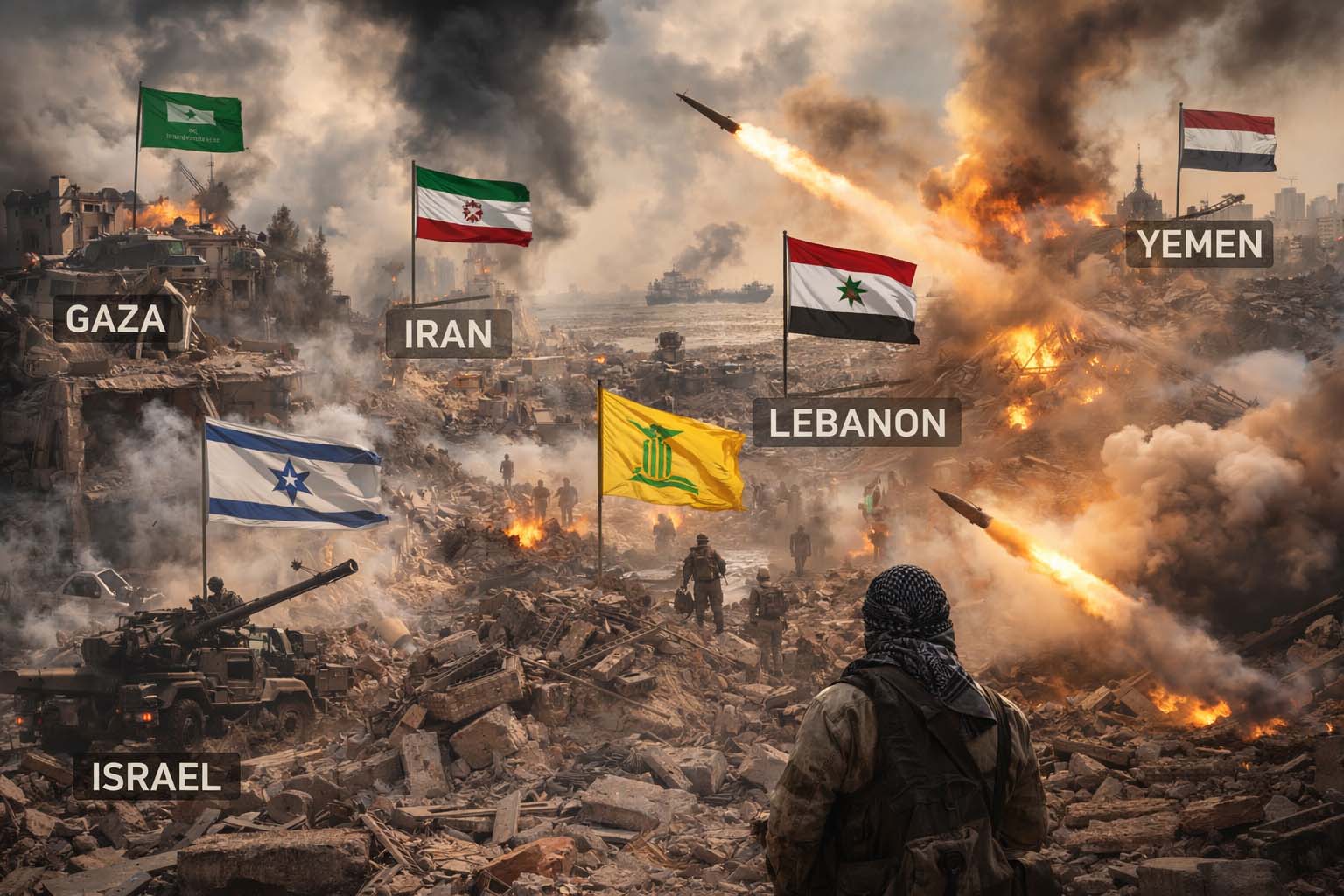
The Middle East war has moved into a broader and more dangerous regional phase. As of March 28, 2026, the conflict is no longer only about Gaza. It now includes the U.S.-Israeli war against Iran, an active Israel-Hezbollah front in Lebanon, continued instability in Gaza and the West Bank, and now a direct Houthi missile attack from Yemen on Israel. The conflict is hitting civilians, widening diplomatic divisions, and shaking global oil and shipping routes.
- Israel–Iran / broader regional war: Day 29, counting February 28, 2026 as Day 1. Reuters says that war began on February 28 and had entered its fifth week by March 28.
Lebanon front (Hezbollah–Israel in this phase): Day 27, counting March 2, 2026 as Day 1. Reuters says Hezbollah began attacking Israel on March 2 in support of Iran.
Gaza war, original war timeline: Day 904, counting October 7, 2023 as Day 1. That is the usual way the Gaza war is counted in news coverage. The AP piece I used for the article was discussing Gaza’s later ceasefire phase, not resetting the original war clock.
Gaza ceasefire / post-ceasefire phase mentioned in the article: Day 170, counting October 10, 2025 as Day 1, because AP says a ceasefire was agreed then, even though strikes continued afterward.
Where the Middle East war stands now
The current regional war phase began on February 28, 2026, when the U.S. and Israel launched strikes on Iran. Reuters reports that the war has now entered its fifth week. A second major front opened on March 2, 2026, when Hezbollah began firing on Israel in solidarity with Iran, drawing Lebanon deeper into the conflict. On March 28, 2026, the war widened again when Yemen’s Houthis confirmed their first attack on Israel in this war.
This means the conflict now has four connected theatres:
- Iran vs. Israel and the U.S.
- Lebanon vs. Israel through Hezbollah
- Gaza’s unresolved war and ceasefire disputes
- Yemen’s Houthis entering the fight
Which day of the war is it?
If counted from February 28, 2026, the broader Iran-centred regional war is about one month old and has entered its fifth week by March 28, 2026. The Lebanon front is younger, starting on March 2, 2026. Gaza, however, remains part of a much older conflict: while a ceasefire was announced on October 10, 2025, violence and Israeli strikes have continued.
Latest attacks and key developments
Iran and Israel
Reuters reports that Iran has continued launching missile waves at Israel, while the U.S. and Israel continue bombing Iran. On March 28, Reuters said Iran launched overnight missiles that killed one person and caused impacts in the Tel Aviv area from cluster munitions and debris. At the same time, Washington and Jerusalem have kept pressure on Iranian military capabilities while the U.S. says it expects operations to conclude in “weeks, not months.”
Saudi Arabia and U.S. forces
A major escalation came when 12 U.S. troops were wounded, including 2 seriously, in an Iranian strike on Prince Sultan Air Base in Saudi Arabia, according to Reuters. Reuters also said that more than 300 U.S. service members have been injured in the conflict so far, with 13 killed.
Lebanon
Lebanon is now one of the most dangerous fronts. Reuters reports that Israel announced on March 24 plans to occupy southern Lebanon up to the Litani River as a “defensive security zone,” roughly 30 km north of the border. Reuters also says Israeli operations since early March have cut off much of southern Lebanon, damaged civilian infrastructure and raised fears of a prolonged occupation.
Yemen
The Houthis have now openly joined the conflict. Reuters reported on March 28 that the Houthis launched their first attack on Israel since this Iran war began, and Israel said it intercepted the missile. Reuters had already reported on March 27 that the Houthis warned they were ready to intervene directly if escalation continued.
Gaza
Even though the wider regional war dominates headlines, Gaza remains unresolved. AP reports that the October 2025 ceasefire reduced major hostilities, but Israeli strikes have continued, and Israel still controls more than half of Gaza. AP also says that nearly 700 Palestinians have been killed since that ceasefire, according to local health officials.
The humanitarian reality in Gaza
The humanitarian situation in Gaza remains severe. OCHA reported on March 27, 2026 that 1.7 million people are sheltering in around 1,600 displacement sites, while repeated rainstorms, airstrikes, overcrowding, pests and lack of basic supplies are worsening conditions. OCHA also said that food deliveries are under pressure, only Kerem Shalom is being used for stock replenishment for the fourth consecutive week, and many families are receiving only half rations, covering around 50% of caloric needs.
This matters because Gaza is still central to the political endgame. AP reports that Hamas is considering a U.S.-backed disarmament proposal tied to reconstruction, while Israel says there will be no meaningful progress without disarmament.
What the main sides are saying
U.S. position
Reuters reports that the U.S. passed Iran a 15-point proposal via Pakistan. According to Reuters, Israeli cabinet sources said the proposal includes removal of Iran’s highly enriched uranium, an end to uranium enrichment, curbs on Iran’s ballistic missile programme and an end to Iranian support for allies such as Hezbollah. The White House has also threatened much harder strikes if Tehran rejects the proposal.
Iran’s position
Reuters says Iran’s response to the U.S. proposal has not been positive. Tehran is demanding a permanent end to the war, compensation for destruction, and insists that the Lebanon front must be included in any ceasefire arrangement. Reuters also reports that Iran claims sovereignty over the Strait of Hormuz as a “natural, legal right.”
Israel’s position
Reuters reports that Israel wants any deal to preserve its option for pre-emptive strikes and says it still has many more targets left in Iran. In Lebanon, Israel has openly described its intended belt in the south as a security zone against Hezbollah.
Hamas’ position
AP reports that Hamas is reviewing a disarmament plan but wants guarantees that Israeli aggression will stop and that there will be security assurances before it gives up weapons. That means Gaza reconstruction is being linked directly to Hamas’ future military role.
Hezbollah’s position
Reuters reports Hezbollah entered the war on March 2 in solidarity with Iran. The group opposes Israel’s declared buffer zone in southern Lebanon, and the current campaign has already killed large numbers of Hezbollah fighters while causing a far wider death toll in Lebanon overall.
Gulf and regional mediators
Reuters reports that Pakistan, Saudi Arabia, Turkey and Egypt are trying to build a diplomatic track and may host or facilitate talks. At the same time, Reuters also reports that Gulf states want any settlement not just to stop the war, but to permanently degrade Iran’s missile and drone capabilities.
Why there is still no clear conclusion
Right now, there is no settled conclusion to the war. The main reason is that the demands are still far apart. The U.S. position is close to strategic rollback of Iran’s nuclear and missile programmes. Iran wants the war ended permanently, compensation, protection of its regional position and linkage to Lebanon. Israel wants the freedom to keep striking if it sees new threats. Hamas’ future in Gaza is unresolved. Hezbollah is still active. The Houthis have just entered the fight.
That means the diplomatic gap remains wide even though mediation is active. Reuters says Pakistan is hosting talks with Saudi Arabia, Turkey and Egypt starting March 29, but Tehran still denies direct talks with Washington.
What may happen next
The most likely near-term scenarios are these:
1. More regional spillover
The Houthi entry increases the risk of attacks affecting Red Sea shipping and broadening the war’s map even further. Reuters explicitly warns that Houthi involvement could open a new front and threaten the Bab al-Mandab Strait.
2. Continued pressure on Lebanon
Israel’s declared aim to create a zone up to the Litani River suggests Lebanon may remain one of the main military theatres in the days ahead.
3. More economic damage
Reuters reports the war has caused the biggest disruption ever to energy supplies, with Brent crude topping $112 and stock markets falling on fears the conflict will drag on.
4. Slow diplomacy, not immediate peace
There is movement through intermediaries, but the positions are still maximalist. That makes a quick comprehensive peace deal unlikely, even if partial de-escalation steps become possible. This is an inference based on the stated demands and mediation track.
Conclusion
The Middle East war situation is now broader, riskier and more interconnected than it was even a week ago. As of March 28, 2026, the conflict includes direct Iran-Israel-U.S. warfare, a hardening Lebanon front, a still-unresolved Gaza crisis, and a new Houthi front from Yemen. Diplomacy is alive, but the military and political positions of the main sides are still too far apart for a clean conclusion. For now, the clearest conclusion is this: the region is not at the end of the war yet, and the immediate risk still points toward further escalation before any stable settlement is reached.
FAQ
What day of the Middle East war is it now?
As of March 28, 2026, the broader Iran-centred regional war is about one month old and has entered its fifth week, according to Reuters.
What was the latest major attack?
One of the newest escalations was the Houthi missile attack on Israel on March 28, the first from Yemen in this war, according to Reuters.
Is Gaza still part of the conflict?
Yes. AP reports that although a ceasefire was announced in October 2025, Israeli strikes have continued and Israel still controls more than half of Gaza.
What is Israel’s current position?
Reuters says Israel wants to keep the option of pre-emptive strikes and says it still has many more targets left in Iran. In Lebanon, it has announced plans for a southern security zone up to the Litani River.
What is Iran demanding?
Reuters reports Iran is demanding a permanent end to the war, compensation, and inclusion of the Lebanon front in any ceasefire arrangement.
Is there any real chance of peace soon?
There are active mediation efforts through Pakistan, Saudi Arabia, Turkey and Egypt, but Reuters reports Tehran still denies direct talks with Washington, so a full settlement does not look close yet.
Why does this war matter globally?
Reuters reports the war is disrupting energy supplies, threatening key sea routes like the Strait of Hormuz and Bab al-Mandab, and pushing up oil prices and inflation fears.