National Backwards Day (also called National Backward Day) is observed every year on 31 January—a playful excuse to do a few things “the wrong way round” on purpose.
But here’s the part that makes it more than a silly trend: doing something backwards for a few minutes is a pattern-break. It interrupts autopilot and gives your brain a tiny jolt of novelty—often enough to create a fresh perspective, a new idea, or a calmer mood.
What is National Backwards Day?
It’s a lighthearted day that encourages you to reverse something—your route, your order, your routine, or even your handwriting—just for fun.
Where did it come from? The “origin story” is fuzzy. Some holiday calendars attribute it to two women in 1961, but there’s limited documentation and different sites tell it differently—so it’s best treated as a modern fun observance rather than a formally documented holiday.
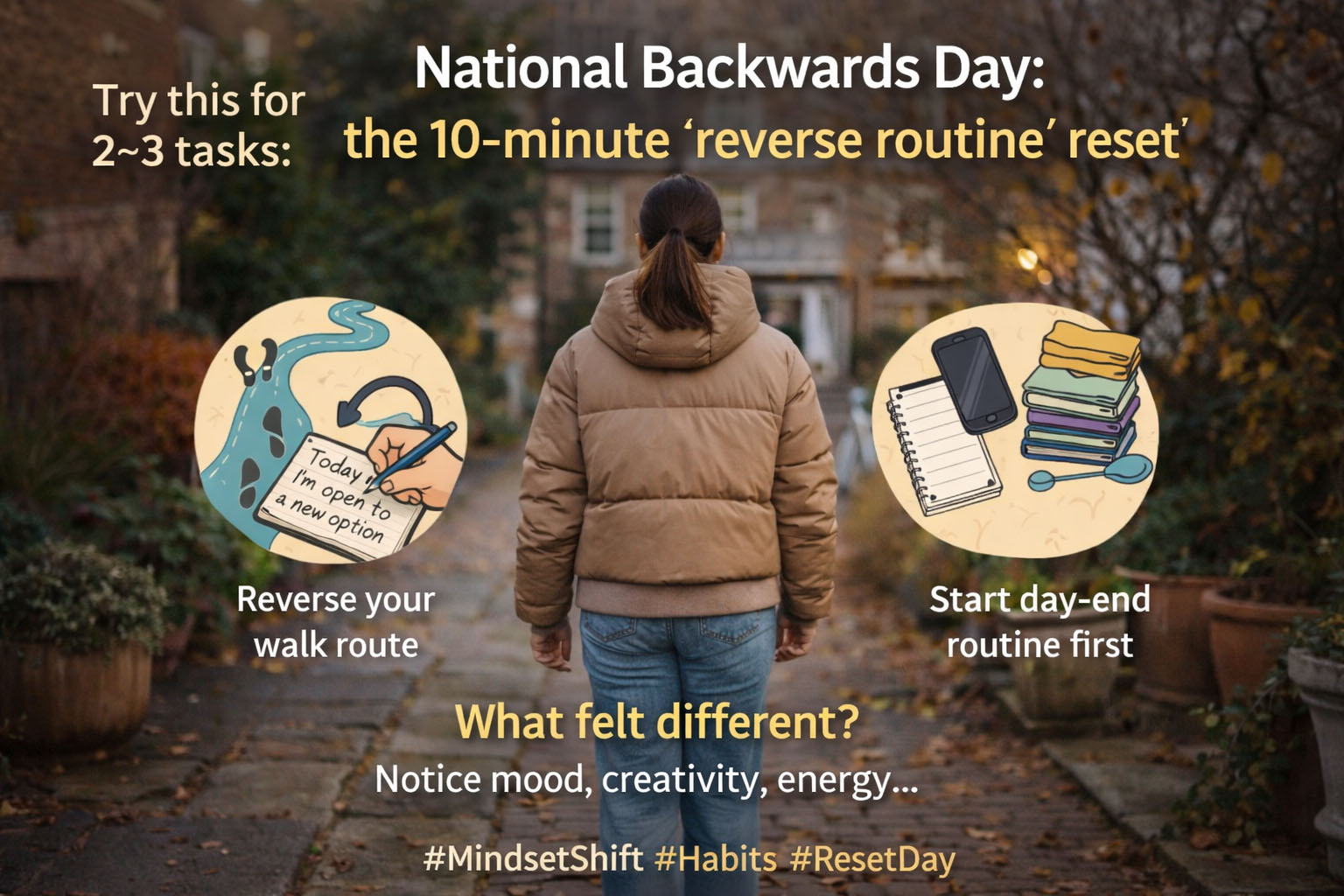
The 10-minute reverse routine reset (safe + easy)
Pick 2–3 of these. Keep it playful and don’t do anything risky (no driving “backwards,” no stairs backwards, no cooking backwards).
Minute 0–3: Reverse your route (micro-adventure)
- Take a short walk and turn left where you’d normally turn right, or walk your usual loop in reverse.
- If you’re indoors, walk through your home in the opposite direction than usual.
Why this helps: novelty is strongly linked to attention and learning signals in the brain.
Minute 3–4: Write with your non-dominant hand (60 seconds)
Write one sentence, slowly:
- “Today I’m open to a new option.”
- Or: “One thing I’m overthinking is ____.”
It feels awkward—that’s the point. You’re forcing your brain to notice what it usually does automatically.
Minute 4–10: Start your day-end routine first (reverse order)
Do your “night routine” now, but mini:
- Put your phone face down.
- Tidy one surface for 60 seconds.
- Prep one small thing for later (water bottle, outfit, notes).
- Sit and breathe slowly for 60–90 seconds.
This flips the script: instead of ending the day exhausted and “catching up,” you create a sense of closure early.
Why it works
1) You break autopilot
Most days run on repeated micro-habits. When you disrupt the sequence—even slightly—you can spot triggers and patterns more clearly.
2) Novelty makes your brain pay attention
Novel experiences can trigger dopamine-related mechanisms tied to learning and memory persistence—one reason “small newness” can feel energising.
3) You practise cognitive flexibility
A major part of feeling stuck is mental rigidity. Cognitive flexibility is essentially your ability to reconfigure and switch mental gears.
This routine is a tiny workout for that skill.
Optional mini ritual: Release → Reset → Intention (2 minutes)
Grab notes app or paper and answer these 3 prompts:
- Release: “What do I want to stop repeating (thought, habit, reaction)?”
- Reset: “What’s one small action that makes tomorrow easier?”
- Intention: “How do I want to feel by the end of today—and what supports that?”
Try it today
Do the reverse routine for 10 minutes, then comment (or journal):
What felt different—your mood, your thoughts, your creativity, your energy?
Do something backwards for 10 minutes today—your brain will notice new options. Try it and tell me what changed 👇
#MindsetShift #Habits #ResetDay #Manifestation
FAQ (for SEO)
When is National Backwards Day?
It’s observed on 31 January each year.
Is this actually good for mindset—or just a joke?
It’s both. The “backwards” theme is fun, but the benefit comes from interrupting routine and creating novelty—two things that can support flexible thinking.
What’s the safest backwards thing to do?
Reverse a walking route, reverse the order of a small routine, or do 60 seconds of non-dominant handwriting.
Safety note: If you’re dealing with anxiety, depression, or intrusive thoughts that feel overwhelming, use this as a light exercise—not a fix—and consider speaking with a GP or a qualified mental health professional.