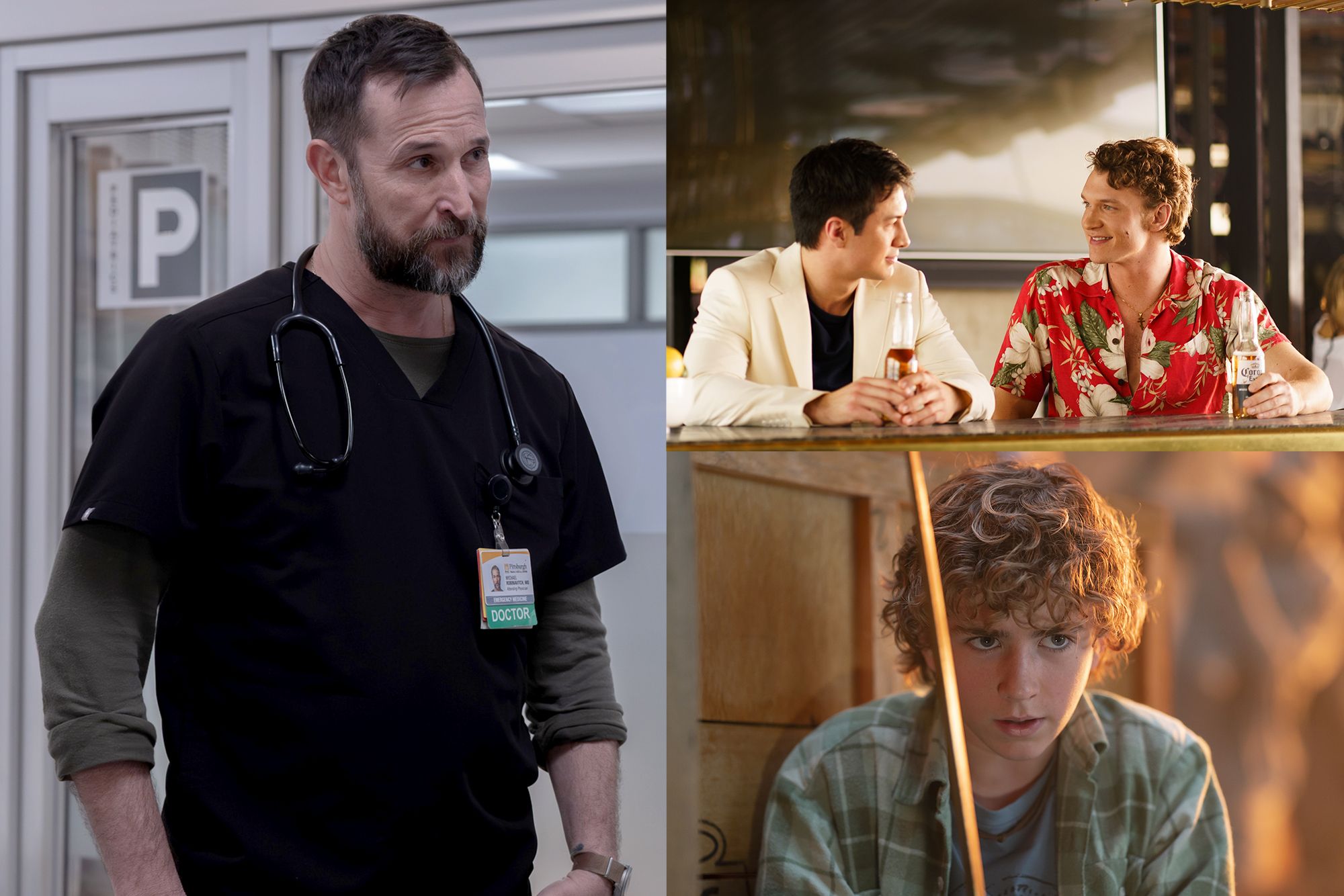
On the second season finale of The Pitt, Dr. Robby (Noah Wyle) painfully articulates the darkness that has been weighing on him for 15 episodes—driving him, at points, to suicidal ideation. “The most important things I’ve ever done in my life have been in this hospital. Nothing will ever matter more than what I’ve done in this hospital. But it is killing me,” he says in confidence to Dr. Abbot (Shawn Hatosy). “You know how they say a part of you dies when you lose someone you love? I’m not convinced that a part of you doesn’t die every time you see a fellow human pass, and I’ve seen so many people die that I feel like it’s leeching something from my soul.”
The speech—a mix of raw emotion and restraint superbly delivered by Wyle—effectively explains why Dr. Robby has been a bit off his game the whole season. But there’s a good chance his explanation fell on deaf ears. A surprising number of people who used to love HBO Max’s Emmy-winning series now swear it’s “awful”—and, what’s more, that Wyle, its creator and star, is the one to blame.
In isolation, a fanbase turning on something they once loved wouldn’t be particularly notable; ultimately, that’s their prerogative. But The Pitt’s woes are part of a larger wave sweeping fandoms across many mediums and genres, in which relationships that used to be pleasantly parasocial have become borderline disturbing. This is a problem that music fans are well acquainted with; there’s a specific term for diehard fans, ”Stans,” that comes from an Eminem hit about a guy whose obsessive love for Slim Shady drives him to a murder-suicide. Certain stans have earned a reputation for cyber aggression—see: the Swifties and the Barbz.
But now this unbridled intensity is bleeding into other areas of culture, with alarming results. What’s more, the proliferation of gossip handles like Deux Moi and fan accounts like ClubChalamet mean that doubling down on a parasocial fixation can be a legitimate career path, and a profitable one at that. It doesn’t help that the line between reality and fiction on the internet is becoming increasingly blurred: Is this video I’m watching real or AI? Is ChatGPT my friend? It’s easy to feel like nothing online is real—or, conversely, that it’s all too real.
In the recent past, the teams behind television shows across genres—from the reality competition show The Traitors to the YA romcom The Summer I Turned Pretty—have had to issue statements pleading with fans to stop cyberbullying and harassing contestants and actors. “The show isn’t real but the people playing the characters are,” posted the official The Summer I Turned Pretty TikTok account in a caption accompanying a video graphic that read: “The Summer We Started Acting Normal Online.” Yes, it’s fun to choose sides in a fictional romantic triangle—I’m still #TeamJacob, by the way. But when the real actors involved start to feel uncomfortable, or worse, unsafe, it’s time, respectfully, to take a chill pill.
Then there’s the boy who can’t go to prom. Last week, 17-year-old Percy Jackson star Walker Scobell said on his Instagram story that he has to sit out this rite of passage because his fans have threatened to kill every girl he might want to bring as a date. “Please stop sending death threats to EVERY teenage girl who could remotely be associated with me based on their proximity to where I live,” he wrote in a now expired Instagram Story. “It’s not fair to them or to their families. Maybe also just stop sending death threats in general. That’s just not cool. Kinda weird I have to say this.”
The actor is right: It is kinda weird that he has to say this. Though teenage fans especially have a long and documented history of being intense—think Beatlemania and One Directioners—cyberstalking all the female residents of a given town is a bridge too far. Sure, maybe these fans’ frontal lobes aren’t fully developed yet. But I’d argue one doesn’t need a fully developed frontal lobe to know that sending death threats to anyone within proximity of your favorite actor is a bad thing to do.
And it’s not just teen fans who are acting out. The stars who are arguably experiencing the weirdest fan behavior right now can be found on another HBO Max property, and a decidedly adult one at that: the steamy, gay romance Heated Rivalry. After that series made Hudson Williams and Connor Storrie into overnight sensations, things started getting…well, really odd. Fans began obsessing over every detail of the star’s lives: their looks, their location, their digital footprint, and, most notably, their sexuality. WIRED covered their increasingly problematic fan base in a story called “The Heated Rivalry Fandom Is Tearing Itself Apart,” detailing the growing toxicity of a group that’s been hurling racist insults at Williams—who is Asian—and accusing their costar Francois Arnaud of grooming for allegedly dating Storrie, who is 14 years his junior. (Both, though, are consenting adults.)
Things got so intense that Williams and Arnaud eventually posted a joint statement online addressing the toxicity of the fandom. “Don’t call yourself a fan if you share racist/ homophobic/ biphobic/ misogynistic/ ageist/ ableist/ parasocial/ bigoted comments of any kind,” read the statement. “None of us need your hateful ‘love.’ We all respect and support and love each other and are on the same side. If you can’t accept that then gtfoh.”
Perhaps some fans have been emboldened by the fact that rallying around a chosen celebrity or show can lead to material change in some specific cases. See, for instance, the Free Britney movement, which pledged allegiance to the struggling pop star Britney Spears, leading to the end of the pop star’s 13-year-long, hyper-controlling conservatorship.
But while the Free Britney movement wanted the best for its idol, it hasn’t necessarily been smooth sailing for Spears since the court constraints were lifted. She has released only one song since the conservatorship was dissolved, and has said she’s leaving the music industry entirely; in 2023, authorities conducted a wellness check on the singer after she posted a video on social media in which she danced with knives (she says they weren’t real). In 2025, her ex husband Kevin Federline expressed concern over her well-being while promoting his memoir. On March 4, Spears was charged with a DUI; weeks later, she voluntarily checked herself into rehab. Free Britney may have meant well, but attempting to meddle in the personal affairs of our favorite celebrities—as many of these fandoms either consciously or unconsciously aspire to do—might not ultimately be to anyone’s benefit.
And, sometimes, the fans are plain wrong. Weeks ago, the internet exploded in rage after Chappell Roan allegedly slighted Jude Law’s 11-year-old daughter. The girl’s stepfather, former soccer player Jorginho, accused Roan of calling security on the girl for deigning to look at the pop star at a hotel in Brazil. Fans of Roan dragged the “Pink Pony Club” singer for allegedly “hating children;” even the mayor of Rio de Janeiro weighed in, saying that Roan wasn’t welcome to perform in his city. Then we learned that the entire incident was a misunderstanding: The bodyguard later admitted that he acted of his own volition and was not working for Roan.
Jorginho released another statement attempting to set the record straight, but the damage was done: The pernicious rumor that Roan hates her fans had already taken hold. “I do not hate people who are fans of my music,” Roan said in an Instagram video she posted after the incident went viral. “I do not hate children. Like, that is crazy.”
She’s right. Celebrities and actors are not avatars or LLMs: They’re people, and should be treated as such. There have always been—and, unfortunately, probably always will be—individual fans who take things too far, and some with serious mental illness who need medical treatment and attention. The untimely deaths of John Lennon and Selena are a testament to this fact, as is the Florida woman who allegedly recently opened fire at Rihanna’s Los Angeles mansion.
But that’s not what we’re talking about here. Fandom, in too many recent cases, seems to have shifted from a way to connect with other likeminded people to something sinister, if not dangerous. And so, a simple request: Can everyone simply chill out, so we can start having fun again?
With love, a non-toxic fan.
-
A Brief History of RFK Jr.’s Fascination With the Animal Kingdom