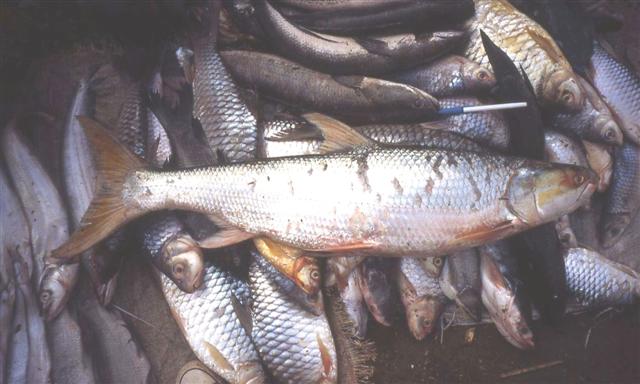
A large fish once feared extinct in Cambodia has been recorded in the country’s waters for the fourth time since 2020, renewing hope for the species.
The Mekong giant salmon carp (Aaptosyax grypus), a critically endangered large-sized freshwater fish, was formally described from the Mekong River in 1991. Over the next 14 years, there had been only 20 formal records of the species; none since 2005.
However, Bunyeth Chan, a researcher at Svay Rieng University in Cambodia, and his colleagues confirmed three observations in a 2024 study. The three carps had been caught by fishers from different parts of the lower Mekong River Basin between 2020 and 2023. “Those recent observations indicate that the species persists, and that one or more populations of A. grypus inhabit the Cambodian Mekong and its tributaries,” the researchers wrote.
The same team confirmed a fourth record of the species, captured by a fisher on Nov. 27, 2025, according to a note recently published in the journal Oryx.
“The rediscovery of the giant salmon carp is a reason for hope, not just for this species but for the entire Mekong ecosystem,” Chan said in a statement to Nevada Today in 2024. “The Mekong ecosystem is the most productive river on Earth, producing over two million tons of fish per year worth over $10 billion.”
The Mekong giant salmon carp, endemic to the middle and lower reaches of the Mekong River basin, can grow up to 130 centimeters (more than 4 feet) in length and weigh up to 30 kilograms (66 pounds). The most recent specimen was a 6.2-kg (13.67-lbs) individual.
The IUCN Red List currently flags the species as “possibly extinct” in Cambodia, but the new evidence suggests a small population persists in the Lower Mekong Basin, the authors wrote. They added that the species likely undertakes transboundary movements, migrating between Cambodia, Thailand and Lao PDR.
The recent records are the result of a research initiative named the Wonders of the Mekong Project, which has established financial incentives to encourage fishers to report captures of threatened large-sized fish and release them back into the wild.
However, all four recently documented carps were recovered dead from market vendors. This has limited the ecological data researchers could gather like critical habitats and threats, the authors wrote.
Following the recent records, the Cambodian Fisheries Administration listed A. grypus as a threatened species, making its capture and sale illegal.
To ensure long-term survival of the salmon carp, researchers recommended using non-invasive detection methods, such as environmental DNA, to locate remaining populations. They also emphasized that given the carp migrates between countries, it would benefit from regional cooperation on monitoring, threat reduction and protection of key river reaches and migration corridors. Lastly, they urged the species be included under the Convention on Migratory Species.
Banner image: Giant Salmon Carps in Laotian market. Image by Peter Cunningham via Wikimedia Commons (CC BY 3.0).