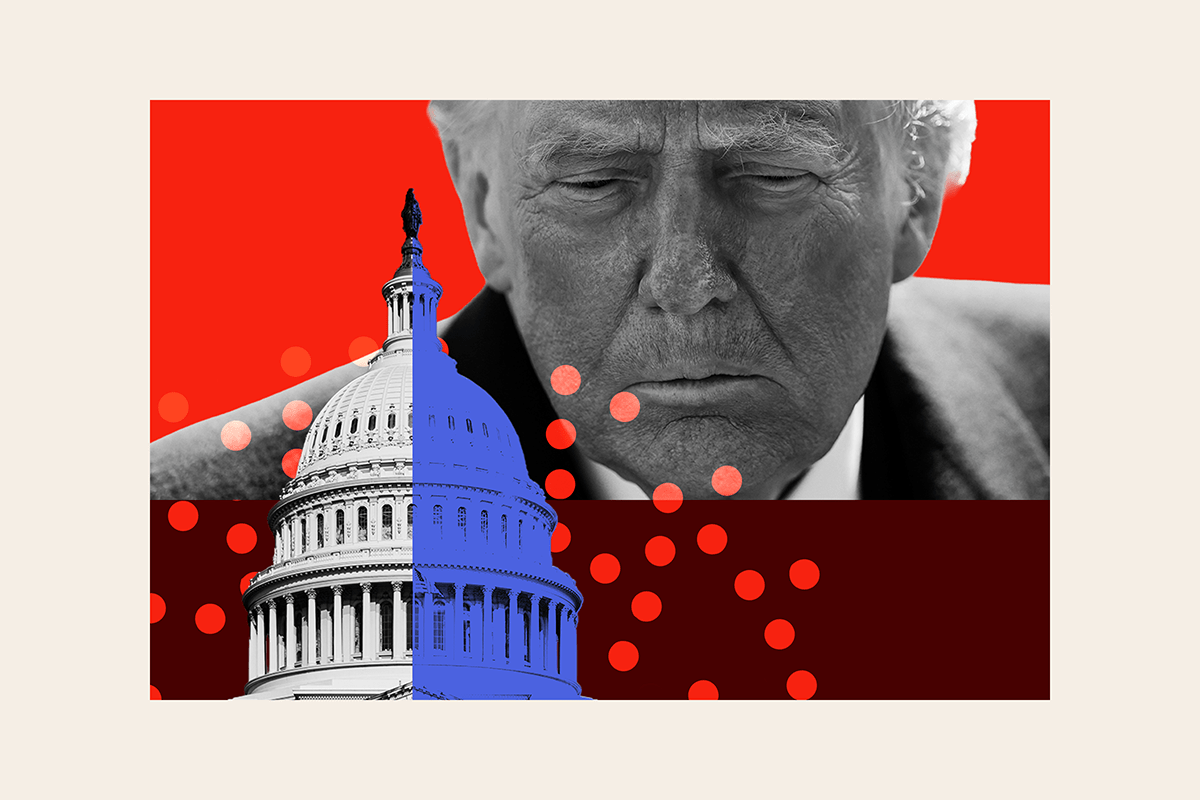
In American politics, there is a rule as old as the republic itself: The incumbent president’s party will likely lose ground in the midterms. Even popular presidents have not avoided it. It happened under Barack Obama. It happened under Bill Clinton. It happened under Ronald Reagan.
After regaining the White House in 2024, President Donald Trump declared victory. His approval numbers climbed. Republicans controlled Congress. The opposition was fractured and adrift. For a season, Trump looked invincible. But the midterms are still seven months away, and in that time, everything has shifted.
The gains have evaporated. Republicans are now bracing for what comes next—a reckoning that suggests the old rule will hold once more.
The Polling Picture
Trump’s approval rating sits at 41.3 percent, with 56.3 percent disapproval, according to RealClearPolitics averages. More troubling for Republicans, polling now suggests they could lose not just the House but the Senate as well—a scenario that seemed implausible just months ago. About 39 House seats are deemed competitive. As of today, Democrats need a net gain of only three to regain control of the House. On the Senate side, states once written off as safely Republican—like Texas, Iowa and Ohio—are now in play.
Prediction markets reflect the shift. Kalshi, one of the largest prediction markets, prices a Democratic flip of the House at 84 percent. For the Senate, Republicans lead at 51 percent to retain the upper chamber, though Democrats have recently yet briefly surpassed the 50 percent threshold.
“I’ve never seen the fundamentals of an election cycle as bad for an incumbent party as I am right now,” said Mike Madrid, a Republican strategist with 35 years in the business.
The core problem is the economy. Trump promised 2026 would be a bumper year for growth. Instead, the year has kicked off with job losses, rising gasoline prices and deepening uncertainty. The unemployment rate has climbed to 4.7 percent from 4.4 percent over the past 12 months. Prices at the pump have jumped 19 percent to a national average of $3.45, according to AAA.
“The public’s anxiety about the economy, specifically their own financial situation, has led to a downward trend in polls for the president,” Matt Klink, veteran Republican strategist, told Newsweek.
The political damage is severe. Trump’s approval rating on inflation has reached an all-time low of -34 points, down from +6 at the beginning of his second term. More Americans now blame Republicans than Democrats for rising inflation—a dramatic reversal from 2024.
The Base Cracks
The fracturing extends beyond economics. The files related to sex offender Jeffrey Epstein became a flashpoint within the Republican base. Trump had campaigned on releasing them to expose Democratic corruption. But when he took office, he resisted. It took a bipartisan congressional push—a discharge petition, a 427-1 House vote and Senate unanimity—to force his hand. In November 2025, Trump signed the Epstein Files Transparency Act. The releases began in December, heavily redacted. When investigators reviewed the January files, they found the Department of Justice had selectively withheld materials related to accusations against the president.
Immigration, once Trump’s signature issue, is slipping. After dominating the political agenda for years, it fell behind civil rights and civil liberties concerns in late January, according to YouGov and The Economist tracking—to its weakest standing since Trump took office. The shift coincided with the killings of Renee Good and Alex Pretti, two Minneapolis residents fatally shot by federal immigration agents during enforcement operations.
Then came the Iran war, a foreign policy adventure that contradicts the “America First” theology animating Trump’s rise. Marjorie Taylor Greene has left Congress. Thomas Massey has become openly confrontational with the White House. Rand Paul speaks publicly against the war. Thom Tillis acknowledges the political liability of gas prices. Eight Republican senators held firm on the government shutdown over Department of Homeland Security funding. The list of Republicans willing to break with Trump—once a handful—has stretched into double digits.
For a decade, Republicans treated Trump as an asset to be protected at any cost. That calculation has shifted.
In competitive races across the country, Democrats have been overperforming. In special elections throughout 2025, Democratic candidates won by larger margins than former Vice President Kamala Harris did in 2024. In Virginia, James Walkinshaw won by about 50 points. In Rhode Island, Stefano Famiglietti won by 67 points. In Oklahoma, Amanda Clinton won by 69 points, compared to Harris’ 19-point victory. The pattern repeated across Pennsylvania, Kentucky, Arizona, Tennessee and elsewhere. Overall, Democrats won or overperformed in 41 out of 42 key elections in 2025, according to the Democratic National Committee.
This Is Trump’s Loss, Not a Democratic Win
The political reversal is not primarily a story of Democratic strength. It is Republican collapse under Trump’s watch. Democrats remain deeply unpopular—their net favorability stands at -20 points, according to polls. Generic ballot leads mean little when neither party inspires confidence.
What is happening instead is simpler: Voters are punishing Trump. They are rejecting his economic record, his immigration enforcement tactics and his foreign entanglements. They are walking away because he promised one thing and delivered another.
Even Republican strategists acknowledge the limits of recovery. Alex Patton, GOP strategist, was blunt: “Realistic path? Never say never, but at this point highly unlikely.” To turn things around, he said, Republicans would need nearly everything to change.

“Conservatives would need to recapture enthusiasm. Independents would need for trust to be reestablished. Inflation would need to decrease, wars and invasions would need to end, the Epstein files would need to be released, gas prices would need to decrease. I’m not sure there’s enough runway to correct these trends,” Patton said.
Klink also told Newsweek that the problem runs deep. “President Trump and the GOP’s problems are more significant than messaging,” he said.
“The GOP faces the momentum that all midterm politicians face—particularly in second presidential terms. Couple that with incredibly tight minorities in both the House and Senate, and you have the makings of a dissatisfied electorate.”
Historically, the party controlling the White House loses an average of 22 House seats in the midterms. But Senate retention, once considered secure for Republicans, has become uncertain. “Voters’ concerns about affordability, along with rising gas prices, higher healthcare costs, and uncertainty surrounding the Iran War, have made a Democratic Senate takeover more likely,” Klink said.
But the numbers tell the story voters already sense. Peter Loge, director of George Washington University’s Project on Ethics in Political Communication, explains how Americans use elections.
“Elections are ways to fire the people in charge if voters don’t like what’s going on. Economic news has been bad all year and is getting worse. That’s bad news for Republicans because Republicans are in charge.”
What would reverse the trajectory? Nearly everything, according to Klink. The Iran war would need to end swiftly and favorably. Fuel prices would need to plunge to prewar levels. The economy would need to bounce back strongly, and affordability concerns would need to be addressed.
“There’s still time for Donald Trump and the Republicans, but with seven months until Election Day, the sands are running out,” Klink said.