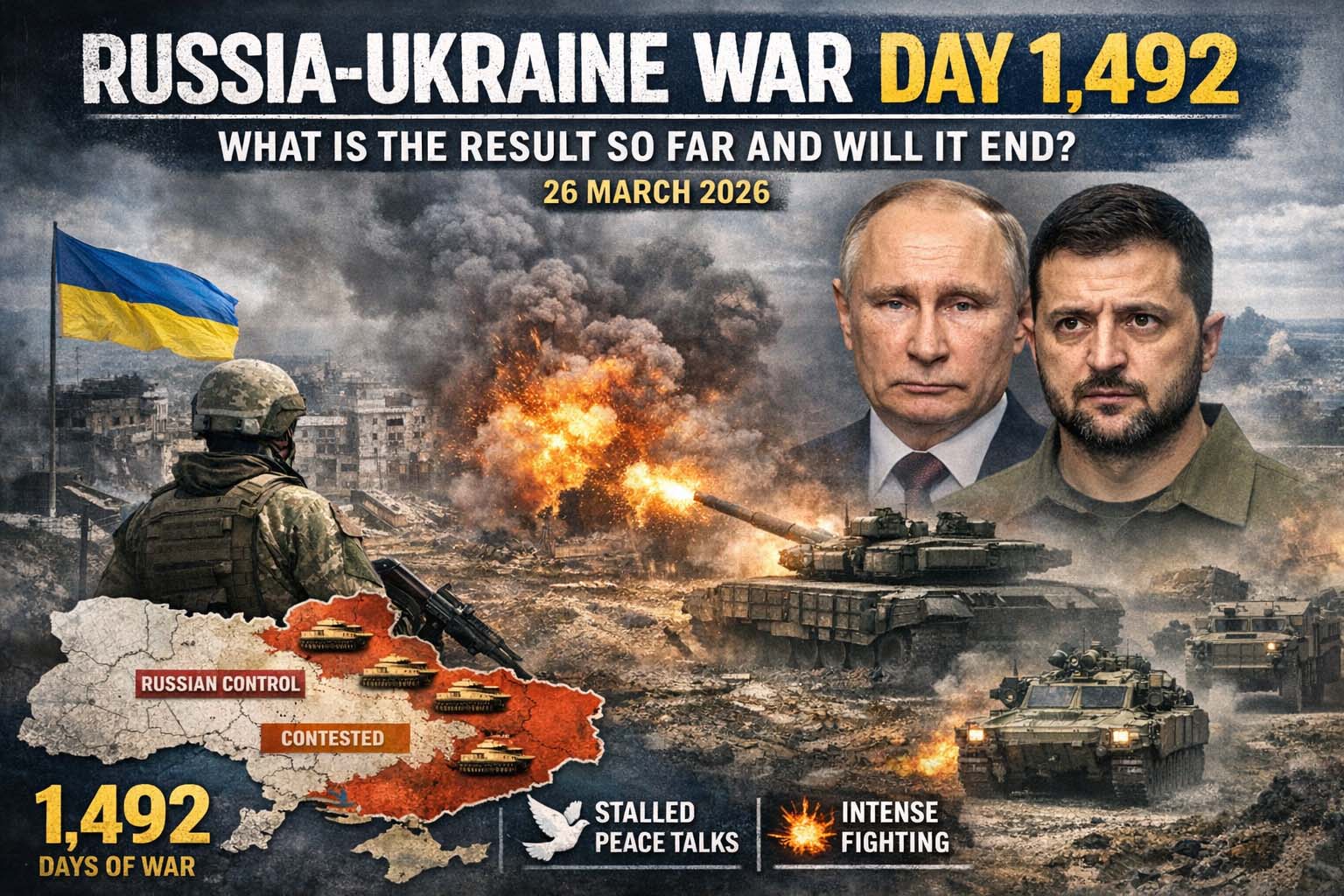
As of 26 March 2026, it is day 1,492 of Russia’s full-scale war against Ukraine, counting from 24 February 2022. So far, there is no decisive final result: Russia still controls about 20% of Ukrainian territory, but it has not achieved a complete victory, while Ukraine continues to resist, strike Russian logistics and energy infrastructure, and prevent a major battlefield breakthrough.
What day of the war is it today?
If you count from 24 February 2022, when Russia launched its full-scale invasion, then 26 March 2026 is day 1,492 of the war. Reuters and other current reporting continue to describe it as a war now in its fourth year, with fighting still active across multiple sectors of the front.
What is the result of the war so far?
The clearest honest answer is this: the war remains unresolved. Russia still occupies roughly one-fifth of Ukraine, including Crimea and parts of Donbas seized before and after 2022, but its gains since 2023 have been limited relative to the scale of the war. Ukraine has not liberated all occupied territory, yet it has also prevented Russia from achieving its larger political and military objectives.
Humanly, the cost has been devastating. The UN says that since the full-scale invasion began, over 15,000 civilians have been killed and over 41,000 injured, while civilian harm remained high into early 2026. In February 2026 alone, long-range missiles and drones caused a large share of casualties, and frontline drone attacks remained a major killer.
Politically, the result is also unfinished. The EU has extended sanctions against Russia into 31 July 2026, and NATO says allies provided more than EUR 50 billion in security assistance in 2024 and had committed an additional EUR 35 billion in 2025. That means international backing for Ukraine has not disappeared, even though strain and disagreement remain.
Who is gaining right now?
At the moment, Russia is trying to regain momentum with a new spring offensive, especially against Ukraine’s heavily defended eastern “Fortress Belt” in Donetsk. Reuters reports more than 600 assaults over four days last week, while AP says the new Russian push has intensified bombardment and drone attacks.
But the battlefield picture is not one of a dramatic Russian breakthrough. Reuters reports that recent analysts expect only tactical gains, not a major collapse of Ukrainian lines, and one cited expert said Russia may continue advancing only by a few hundred square kilometres per month without changing the overall dynamics of the war. Ukraine has also made modest gains in the southeast and kept hitting Russian energy and military targets deep behind the lines.
Why has the war not ended yet?
The war has not ended because the core issues are still fundamentally unresolved: territory, security guarantees, and the future status of eastern Ukraine. Reuters reports that Russia wants control over the entire Donbas, while Kyiv says that is unacceptable and insists that any peace deal must come with credible guarantees that fighting will not simply restart later.
Peace diplomacy is also weak right now. Reuters reported on 19 March that talks were on a “situational pause”, and on 25 March Zelenskyy said U.S. security guarantees were being linked to Kyiv giving up all of Donbas. At the same time, wider conflict in the Middle East has diverted attention, weapons supply, and diplomatic energy away from Ukraine.
Will the war end soon?
Based on the current reporting, a durable end does not look close. A ceasefire or limited deal is still possible in theory, but the gap between what Russia wants and what Ukraine can accept remains very wide. Reuters says the territorial question is still the biggest obstacle, and current talks have either stalled or slowed.
The more realistic near-term outlook is continued attritional war: Russian pressure in the east and southeast, Ukrainian long-range strikes and defensive adaptation, and diplomacy that produces headlines faster than results. That is an inference from the latest Reuters, AP, and ISW-linked reporting showing a fresh offensive, stalled talks, and expectations of only limited tactical change rather than a decisive ending.
What happens next?
The next phase will likely be shaped by three things: whether Russia can convert its spring offensive into deeper territorial gains, whether Ukraine can sustain air defence and troop recruitment, and whether Western support stays strong enough to prevent pressure for a peace deal on Moscow’s terms. The war is still moving, but not yet toward a clean conclusion.
FAQ
What day of the Russia-Ukraine war is it on 26 March 2026?
It is day 1,492 of Russia’s full-scale invasion of Ukraine, counting from 24 February 2022.
Has Russia won the war?
No. Russia still controls about 20% of Ukraine, but it has not achieved a decisive victory over the country as a whole, and Ukraine continues to resist and strike back.
Is Ukraine losing the war?
Not in the sense of a total collapse. Ukraine remains under severe pressure, but current reporting points to a hard war of attrition rather than a final Russian breakthrough.
Why has the war lasted so long?
Because neither side has accepted the other’s terms on territory, sovereignty, and post-war security guarantees, while outside military and financial support keeps the conflict going.
Will the war end in 2026?
It could, but current evidence does not suggest a quick or stable settlement is close. Talks have slowed, and the battlefield is intensifying again.
Is Europe still involved?
Yes. The EU has renewed sanctions, and NATO says allied security assistance for Ukraine has continued at a very large scale.