For the first time in the kingdom’s history, Saudi Arabia is faced with hostile actors striking from every direction, threatening Crown Prince Mohammed bin Salman‘s signature development plan as Iran raises wartime pressure on the United States’ regional partners.
Since the onset of the U.S.-Israeli war against Iran, the Islamic Republic has fired missiles and drones toward the Arabian Peninsula, home to six Gulf Cooperation Council (GCC) states hosting U.S. military bases, including Saudi Arabia. Iran’s targeting of infrastructure and vessels in the Persian Gulf has also severely disrupted vital operations along Saudi Arabia’s east coast Persian Gulf ports in a bid to throttle global oil and gas trade.
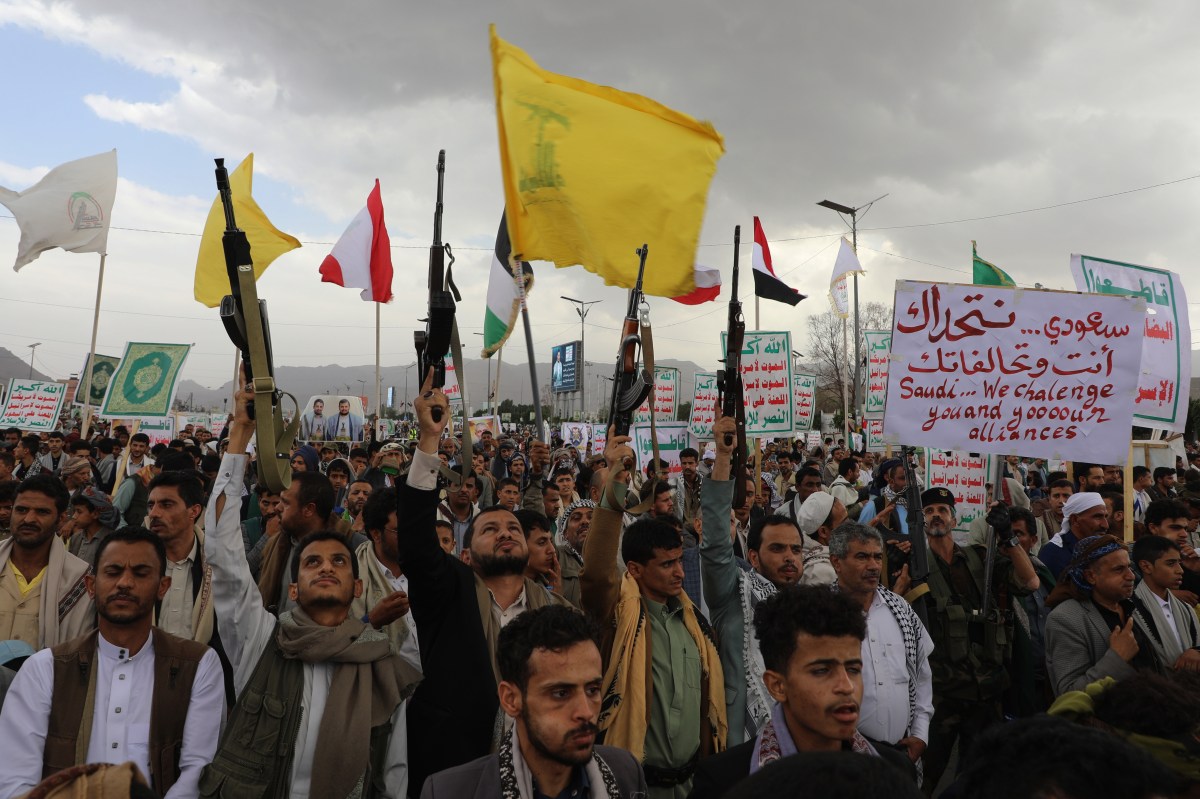
As Saudi Arabia scrambled to shift the flow of energy westward toward its Red Sea coast, Yemen‘s Iran-aligned Ansar Allah, also known as the Houthi movement, began last week a campaign of strikes targeting Saudi shipping across that lifeline to the Suez Canal.
Ansar Allah holds territory directly along Saudi Arabia’s southern border and has conducted cross-border missile strikes against the kingdom as well, accusing Riyadh of striking Sanaa International Airport earlier this month and blockading Yemen since the Saudi-led war launched against the group in 2015.
Another Iran-led Axis of Resistance group has joined the fray from the north. The Islamic Resistance in Iraq, a collective of powerful militias, has engaged in its own campaign of barrages, drawing rare retaliation in joint U.S.-Saudi airstrikes carried out Wednesday.
The following day, Saudi Arabia took further action by announcing a 14-nation maritime security coalition tasked with defending freedom of navigation through vital waterways.
The situation marks a severe test not only for Saudi Arabia’s security but also Crown Prince Mohammed’s vaunted Vision 2030 initiative that promises to transform the Kingdom into a modern globalized economy no longer dependent on oil money.
“The Kingdom’s Vision 2030 is not merely an economic plan, but a comprehensive national project to build a diversified and sustainable economy and strengthen the Kingdom’s position as a global hub for investment, energy, logistics, tourism, and innovation,” Abdullah bin Farah al-Shaya, a retired brigadier general who previously served as Saudi military attaché in Washington, D.C., told Newsweek.
“From this perspective, the Kingdom views security and development as two complementary paths,” al-Shaya said. “There can be no sustainable development without security, and no lasting security without development that provides stability, opportunities, and prosperity.”
What Saudi Arabia Can Do
The predicament is rooted in factors that predate the U.S.-Israeli war against Iran and even the Israel-Hamas war in Gaza that precipitated the great Middle East crisis consuming the region since October 2023. But the more recent penetration of these threats now bears consequences not only for the Arab world’s most influential nation but also the international community as a whole.
“The security challenges facing Saudi Arabia today are linked to the instability that has plagued some countries in the region over the past decades, resulting in security vacuums exploited by armed groups, along with regional interventions that have exacerbated and prolonged crises,” al-Shaya said.
“The effects of these challenges have transcended the borders of the countries involved, becoming a source of concern for regional and international security,” he added, noting that “a turbulent regional environment impacts the investment climate, supply chains, energy security and international trade.”
As for Riyadh’s options, the strikes in Iraq demonstrated that the Kingdom was willing to take the fight across the border. The maritime coalition proved Saudi Arabia’s known strategy of working through multilateral partnerships rather than single-handed intervention.
“For decades, the Kingdom has adopted a balanced approach that combines wisdom and resolve,” al-Shaya said. “Its hand will remain extended to all that achieves peace and stability, and it will continue to work with its regional and international partners to enhance security and development.”
“However, at the same time,” he added, “it will not hesitate to take all legitimate measures to ensure the protection of its national security, sovereignty, and vital interests, stemming from its responsibility towards its people and its contribution to the security of the region and the stability of the world.”
Newsweek has reached out to the Saudi Embassy to the U.S. for comment.

Learning ‘the Hard Way’
Both strategies were also employed in Saudi Arabia’s campaign against Ansar Allah in Yemen, where the intervention initially led by Crown Prince Mohammed—then serving as defense minister—supported the country’s internationally recognized government that had been ousted by the powerful rebel force.
But even with the backing of nine Arab nations, the campaign failed to achieve a resounding victory, leaving Ansar Allah in control of much of the country’s north and up to 80 percent of its population by the time a United Nations-brokered ceasefire was reached in April 2022.
“The conflict was more complex than conventional wars, as the coalition faced an armed group that relied on guerrilla warfare, exploited difficult geographical terrain and the political and tribal divisions within Yemen, and possessed missile capabilities, drones, and advanced weaponry, which made achieving a swift military victory extremely difficult,” al-Shaya said.
The “most important lesson” derived from that experience, he argued, is that “confronting unconventional threats does not depend solely on military force, but rather on the integration of military, security, intelligence, diplomatic, economic, and media tools, in addition to cutting off the sources of funding and arming for armed groups and strengthening national state institutions, because the absence of the state creates the environment in which armed organizations thrive.”
Dana Stroul, former U.S. deputy assistant secretary of defense for the Middle East now serving as director of research at the Washington Institute for Near East Affairs, came to a similar conclusion regarding how the war in Yemen demonstrated the limits of military means to achieving strategic goals, not just for Saudi Arabia, but also for the U.S. and Israel.
“Saudi Arabia learned the hard way—after years of war—that military force alone was not sufficient to address the Houthi threat from Yemen,” Stroul told Newsweek. “It is not only a question of Saudi military capabilities but also the nature of the Houthi threat, its support from Iran, and its entrenchment in Yemen.”
“Even successive U.S. and Israeli campaigns did not dislodge the Houthis,” Stroul said. “A return to Saudi-Houthi war will be devastating for the Kingdom, and its government’s focus on economic growth which already experiences setbacks due to the post-October 7 instability across the region.”
The same lesson applies today, she argued, as “military force alone, in Iran or in Yemen, is not going to deliver decisive outcomes without incentive structures and political processes.”
“That is why Saudi Arabia, looking at the resiliency of the Iranian regime, prefers de-escalation at this time and is communicating that to the Trump Administration,” she said.

Keeping the Kingdom Together
Saudi Arabia has also displayed impressive resiliency in the face of a multi-faceted threat environment. Riyadh opposed the conflict from the beginning, having sent diplomats to appeal to Washington against confrontation, and is now dealing with the direct consequences of the war.
These ramifications have also induced strain in unity among GCC members now under security and economic pressure as a result of the conflict. Saudi Arabia’s relationship with the UAE has faced particular scrutiny given the latter’s growing alignment with Israel and its involvement in a number of foreign conflicts.
Tensions came to a head earlier this year when Riyadh supported a Yemeni government offensive to reverse an abrupt land grab by a southern separatist movement aided by Abu Dhabi. The two sides have since attested to their lasting partnership, though differences persist.
The UAE notably did not announce its support for the new Saudi-led maritime coalition. The current signatories reportedly include Bahrain, Bangladesh, the Comoros, Djibouti, Egypt, Jordan, Kuwait, Pakistan, Qatar, Turkey, Somalia, Sudan and the Yemeni government.
The initiative will likely be welcomed by the White House, which has called on regional countries to step up in their own defense. Even the recent fallout of Trump’s decision to demand Saudi Arabia normalize ties with Israel in order to realize a long-sought nuclear agreement has yet to decisively shake the kingdom’s resolve, though it eyes alternative arrangements with China and Russia.
Ali Shihabi, a Saudi political expert who formerly led the Arabia Foundation think tank and served on the advisory board of the NEOM megacity project, argued that the Kingdom’s balancing act—along with its strategic partnership with the U.S.—would provide a path out of the current crisis.
“The strategy is a combination of force and diplomacy,” Shihabi told Newsweek. “Not to escalate to a level where things go out of control but to inflict a cost on those attacking so they recalibrate their actions. That and also working with the U.S., which despite all the noise has remained pretty reliable in its support.”
After all, he pointed out, this is not the first time Saudi Arabia has found itself facing down foes on multiple fronts. He argued that “Saudi has always been surrounded by threats,” recalling the Cold War-era conflict with Egypt under then-President Gamal Abdel Nasser.
“Yet it has managed these risks and will continue to do so.”
Contact Newsweek editors on this story: Gray R. Thomas