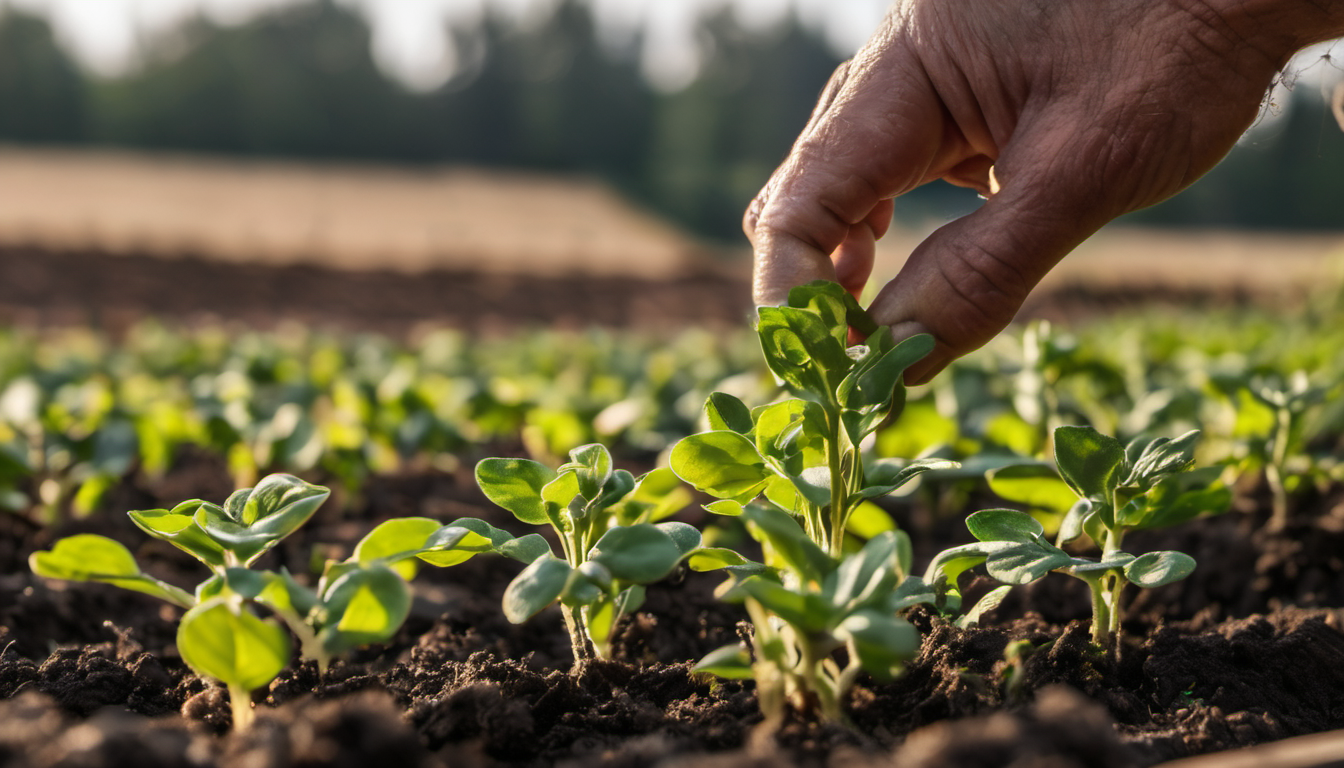
Featured image: A close-up photograph of a hand with aged skin, touching a young plant growing in soil. AI-generated image; not a photograph of the reported event.
Scotland’s farming future is being redefined by climate change, technological advances, and a growing need for resilient, sustainable food systems. The country’s unique geographical position — nestled at 57 degrees north latitude — has long influenced what crops can grow and how farming operations are structured. However, as global temperatures rise and weather patterns become increasingly erratic, traditional assumptions about agricultural viability are being challenged. This shift is prompting a comprehensive reevaluation of what crops might thrive in Scotland, how they might be cultivated, and how farming practices can evolve to meet both environmental and economic demands. Source: bbc.co.uk.
Tea in Scotland: A Small but Possible Future Crop
Susie Walker-Munro is one of a handful of tea growers in Scotland. She has cultivated tea on her family farm in Angus, a region known for its rich, acidic soils. These soils, which are naturally low in nutrients and high in organic matter, are believed by tea experts to create ideal conditions for producing a smooth, full-bodied artisan brew. The process of tea cultivation on her farm is highly traditional — only the top two leaves of each tea bush are picked, a practice that ensures a premium, high-quality product.
Her most expensive tea, Kinnettles Gold, is priced at approximately £40 per packet, making it significantly more expensive than mass-produced supermarket brands. This price point reflects not only the labor-intensive harvesting process but also the small-scale, artisan nature of her operation. While Susie acknowledges that her yields will never match those of tropical tea-producing nations like India or Sri Lanka — where year-round production is possible — she believes that climate change may offer a silver lining.
She notes that Scotland’s climate, particularly its increasing rainfall in certain seasons, could enhance tea production. ‘Our yields are never, never going to be high,’ she says. ‘Maybe with climate change they might come up a bit, it depends if we get enough rain. Scotland could be absolutely ideal.’ This sentiment reflects a broader trend: even in regions traditionally considered unsuitable for certain crops, changing climatic conditions may open new possibilities.
Despite this potential, Susie remains cautious. She does not see tea as a viable large-scale crop for Scotland. The infrastructure, market demand, and logistical challenges of scaling such a product remain significant. Still, her work represents a symbolic shift — one where small-scale, climate-responsive agriculture is being reimagined as part of a broader diversification strategy.
Climate Change and the Future of Scottish Farming
Scotland is expected to face a significant transformation in its climate by the end of the century. Climate modelling shows that Scotland can expect hotter, dryer summers and milder, wetter winters by the end of this century. These changes will directly affect crop performance, soil health, and water availability — all of which are foundational to agriculture.
For instance, prolonged droughts during summer months could reduce yields of moisture-sensitive crops like wheat or potatoes. Conversely, increased rainfall in winter may lead to waterlogged fields, increasing the risk of root rot and disease. These shifts mean that farmers must now plan not just for seasonal cycles, but for long-term variability.
Experts emphasize that traditional crop breeding — which has historically focused on optimizing performance in specific climatic zones — is no longer sufficient. As climate patterns become more unpredictable, crops must be bred not just for one environment, but for resilience across a range of conditions. This requires a fundamental shift in agricultural science and policy.
Testing Plants for Future Climates
The James Hutton Institute in Dundee has taken a leading role in this transformation. The institute operates a state-of-the-art advanced plant growth centre — effectively a climate simulator — that allows researchers to replicate future environmental conditions. This facility controls variables such as light intensity, temperature, humidity, and nutrient availability, enabling scientists to observe how plants respond to stress.
For the past three months, researchers have been conducting detailed experiments on fava beans, a leguminous crop known for its nitrogen-fixing properties and adaptability. Daily photographic monitoring allows scientists to track growth patterns and identify early signs of stress. This data is then used to assess which genetic traits are most valuable for future crop development.
Dr Robert Hancock says they need to switch from breeding crops for specific environments, such as hot or dry climates, towards ones which are more generally resilient. ‘We need to start breeding those crops now and start understanding what Scottish farming’s going to look like,’ he says. ‘Farmers need time to plan, we need to get those crops out to the farmers and registered.’
He stresses that while climate simulators are powerful tools, they are not a substitute for real-world field experience. ‘Ultimately it’s about what those guys do in the fields that matters, not what we do inside a climate simulator.’ This underscores the importance of bridging laboratory research with practical, on-the-ground farming operations.
Technology and Precision Farming
Modern agricultural machinery is already deeply integrated with digital technology. GPS-guided tractors and autonomous harvesters use real-time data to navigate fields with millimetre precision, reducing overlap, minimizing fuel use, and improving efficiency. These systems are already being adopted by many Scottish farms, particularly in larger operations where scale and consistency are critical.
Looking ahead, the next frontier in farming technology is automation — specifically, autonomous harvesting. While still in early development, the idea of machines that can operate independently to harvest crops without human supervision is gaining traction. This would allow farms to maintain productivity even as labor becomes more scarce or expensive.
David Murdoch, chair of the Scottish Association of Young Farmers and a dairy farmer based in Beith, North Ayrshire, believes that technology will play an increasingly central role. ‘There’s no point in doing it if you don’t know your cattle,’ he says, highlighting the enduring value of traditional skills. ‘But embracing the technology is what keeps us competitive.’
He points to the trend of larger herd sizes and more advanced machinery as key drivers of modern farming. These changes allow farms to produce more food with fewer people — a model that aligns with broader economic and demographic shifts in rural Scotland.
Expanding Crop Options with Glass Houses
One of the most promising innovations in Scottish agriculture is the use of glass houses — controlled-environment facilities that allow for year-round cultivation of crops not traditionally suited to Scotland’s climate. These structures are already being explored in the Netherlands, where greenhouses are used to grow a wide range of Mediterranean vegetables.
Pete Ritchie from Nourish Scotland says that glass houses could allow Scotland to produce more Mediterranean vegetables like tomatoes, cucumbers, aubergines, and even melons. He believes that such facilities could reduce reliance on imported produce and lower the carbon footprint of food supply chains. ‘We’re going to be able to produce those plants with a lower carbon footprint and provide secure all-round jobs for people on brownfield sites in the cities and also on the islands and remote parts of Scotland,’ he says.
With Scotland’s abundant wind energy — particularly in coastal and island regions — heating these facilities could become both affordable and low-carbon. This would not only improve food security but also support rural economic development, especially in areas where traditional agriculture has declined.
Renewable Energy and the Economics of Farming
Scotland’s vast wind energy potential — one of the world’s most reliable sources of renewable power — could fundamentally reshape the economics of food production. As wind farms generate more electricity, the cost of running irrigation systems, refrigeration units, and food processing facilities could drop significantly.
This shift would allow Scottish farms to capture more value from their land — not just by selling raw produce, but by processing and distributing food locally. For example, a farm could grow, process, and sell organic vegetables in a local market, reducing reliance on imported goods and cutting down on transport-related emissions.
Prof Wayne Powell, principal of the Scottish Rural College (SRUC), predicts that Scotland could become Europe’s ‘bread basket’ — a title currently held by Ukraine due to its fertile land and large-scale crop exports. He believes that climate change is redrawing the farming map of Europe, and that Scotland has the potential to become one of the most climate-resilient food-producing regions in the continent.
He adds that access to cheap, renewable energy could transform the entire agricultural value chain. ‘The possibility of access to cheap renewable energy could also transform the economics of Scottish farming from irrigation, refrigeration, food processing, so that we can capture more value from our land and food,’ he says.
What’s Driving This Change?
Several interconnected forces are pushing Scottish agriculture into new directions. First, climate change is altering growing seasons and crop viability. Second, there is increasing pressure to keep food affordable for consumers while maintaining farm profitability. Third, there is a growing need to protect and enhance natural ecosystems, reduce carbon emissions, and transition to renewable energy sources. Finally, public health trends — such as rising demand for nutrient-dense foods — are influencing what crops are prioritized.
For instance, obesity drugs are now being prescribed more widely, and patients are increasingly seeking high-protein, nutrient-rich foods. This has led to a growing interest in legumes such as soya, flax, and fava beans — crops that are not only nutritious but also environmentally beneficial due to their ability to enrich soil through nitrogen fixation.
As conditions for growing these crops become more favourable and local demand increases, their presence on Scottish farms is expected to grow.
Challenges and Limitations
Despite the promising developments, significant challenges remain. Adapting to climate change requires time, financial investment, and access to training and technical support. Not all farmers — especially smallholders or those in remote areas — have the resources to adopt new technologies or participate in climate-resilient crop trials.
Moreover, diversification does not guarantee success. Market demand, supply chain logistics, and consumer preferences still play a decisive role. A new crop may be scientifically resilient, but it may fail to gain public acceptance or find a viable market.
Experts caution that climate resilience does not mean all crops will succeed — only that some will adapt better than others. The future of Scottish farming will depend on a combination of scientific innovation, policy support, and community engagement.
What to Watch Next
Key developments to follow include:
- Expansion of climate-controlled farming facilities in rural Scotland
- Results from long-term plant trials at the James Hutton Institute
- Policy decisions on funding for sustainable agriculture
- Adoption rates of AI and automation in Scottish farms
- Public reception and market uptake of new crops like fava beans and Mediterranean vegetables
These will shape whether Scotland’s farms evolve into more resilient, diversified, and climate-adaptive systems.
Why This Matters
Scotland’s agricultural future is not just about growing more food — it’s about growing it in ways that are sustainable, resilient, and locally valuable. As climate change accelerates, farms must adapt. This shift will affect rural communities, food security, and environmental health.
Success won’t come from one crop or one technology — it will come from a combination of innovation, resilience, and long-term planning. Scotland’s farmers are already used to change. The fields of the 21st century may look unrecognizable to those who worked them in the 20th.
But with careful planning, investment, and support, Scotland could become a model for climate-resilient food production in Europe — one that balances environmental stewardship, economic viability, and community well-being.
Source: BBC News — More tea? How Scotland’s crops of the future could be set to change