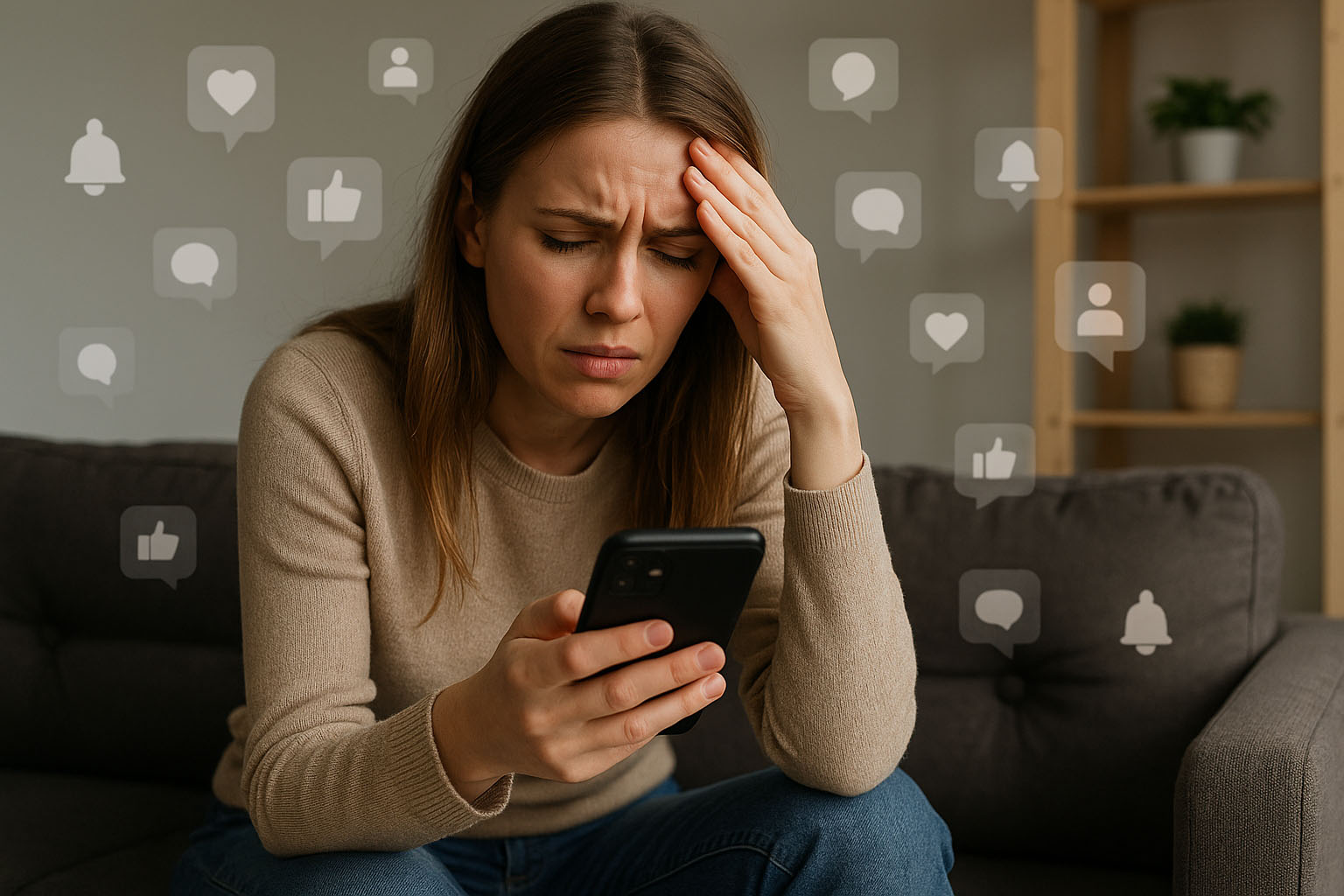
You pick up your phone “just to check one thing”.
Twenty minutes later you’re still scrolling, your tea is cold and you feel… worse.
If this sounds familiar, you’re not alone. Research consistently links heavy social media use with poorer sleep, higher stress and more mental health problems, especially when we scroll late at night. The Sun+4ResearchGate+4Longevity Protocols+4
The good news? Even a short social media detox – as little as one or two weeks – can reduce stress, improve sleep and boost life satisfaction. Calm+4PMC+4BioMed Central+4
This article will help you:
- Spot 7 warning signs of digital overload
- Follow a simple 7-day mini detox plan
- Rebuild a healthier relationship with your phone
Why social media feels so exhausting
Social platforms are built to keep you scrolling: endless feeds, notifications, likes and “recommended” content. This constant stimulation can:
- Trigger comparison and FOMO, making you feel “behind” in life HelpGuide.org+1
- Disrupt sleep when you scroll in bed
- Fill your brain with more information than it can process, leading to mental fatigue and “brain rot” – emotional numbness, cognitive overload and reduced attention span PMC+1
Teens themselves now name social media as one of the top reasons they worry about mental health. Pew Research Center+2YoungMinds+2
If your phone makes you feel stressed instead of connected, it’s time to check for these signs.
7 signs you need a social media detox
1. Your mood drops after scrolling
You open an app feeling OK and close it feeling:
- Irritated
- Anxious
- Angry at strangers
- Sad or “not good enough”
This happens when your brain constantly compares your real life with everyone else’s highlight reels, or when your feed is full of negativity and scary news. Over time, this can feed anxiety and low mood. HelpGuide.org+1
Ask yourself: “Do I feel better or worse after 15 minutes on this app?”
2. You scroll instead of sleeping
You tell yourself “just 5 minutes in bed”… then it’s suddenly midnight.
Night-time screen use is strongly linked to shorter sleep, worse sleep quality and higher insomnia risk, even when the content is “just” social media. The Sun+4Taylor & Francis Online+4ResearchGate+4
Signs this is you:
- You’re tired most mornings
- You need caffeine to function
- You fall into “doomscrolling” late at night
3. You reach for your phone automatically
You’re in a queue, watching TV, sitting on the bus — and your hand grabs your phone without you even deciding.
This automatic checking is a classic symptom of habit loops and potential behavioural addiction. Your brain starts expecting little hits of stimulation and dopamine from notifications and novelty.
Try this test: Put your phone in another room for one hour. Notice how often your brain “reaches” for it.
4. You feel constant FOMO and comparison
Signs of comparison overload:
- Feeling jealous of other people’s holidays, bodies, relationships or careers
- Feeling like your life is boring or “behind”
- Judging your worth by likes and views
Studies show that repeated appearance comparison on social media is linked with lower self-esteem and more depressive symptoms. Frontiers+1
If your self-worth rises and falls with your feed, a detox can help reset that.
5. Your attention span is shrinking
You start a YouTube video and can’t get through it. You skim three posts and already want something “new”. Long articles feel impossible.
This can be a sign of cognitive overload – your brain is used to high-speed, low-depth content and struggles to focus on anything longer or quieter. PMC+1
If you find yourself switching between apps every few minutes, your attention is probably overloaded.
6. Real-life relationships are suffering
Maybe you:
- Half-listen to loved ones while scrolling
- Feel irritated when someone “interrupts” your phone time
- Share everything online but rarely have deep offline conversations
Oxytocin (the bonding hormone) rises in real, face-to-face connection – not in likes and comments. If your phone is always between you and the people you care about, it’s time for a reset. Nuffield Health+2Cardinal Clinic+2
7. You’ve tried to cut down… and couldn’t
You tell yourself:
- “I’ll only use Instagram after 6 pm.”
- “I’ll check TikTok for 10 minutes, then stop.”
But you keep breaking your own rules.
Losing control over use — continuing even when it harms sleep, mood or work — is a key sign that you might need more than just “willpower”. A structured detox gives your brain space to reset.
The benefits of a short social media detox
You don’t have to delete everything forever. Studies show that even a 1–2 week break from social media can:
- Reduce symptoms of stress, anxiety and low mood
- Improve sleep quality and life satisfaction
- Decrease feelings of addiction and “needing” the apps all the time Calm+5PMC+5BioMed Central+5
Many people also notice:
- More free time
- Better focus at work or study
- More presence with family and friends
Let’s start gently with a 7-day mini detox.
7-Day Social Media Detox Plan
This plan is realistic: you don’t have to disappear from the internet completely. The goal is to break automatic habits and rebuild intentional use.
Before Day 1: Set yourself up for success
- Pick your start date – ideally a quieter week.
- Tell people you see often: “I’m doing a 7-day social media detox, so I might be slower replying.”
- Decide your rules, for example:
- “No social media after 8 pm.”
- “Max 30 minutes total per day.”
- “No phone in the bedroom.”
Use your own boundaries, but write them down.
Day 1 – Audit & delete temptations
Goal: Become aware of how much you’re using.
- Check your phone’s Screen Time / Digital Wellbeing stats and write down:
- Total daily screen time
- Top 3 apps & minutes
- Delete or offload the worst offenders from your home screen (or log out).
- Turn off non-essential notifications (likes, comments, “someone went live”).
Replacement habit:
Every time you reach for your phone out of habit, take 3 deep breaths first. Then ask: “Do I really want to open this?”
Day 2 – First “no scroll” zones
Goal: Create protected moments in your day.
Pick two zones where scrolling is not allowed:
- At meals
- On the toilet
- In bed
- First 30–60 minutes after waking
Start with an easy one (for example: no phone at meals).
Replacement ideas:
- Keep a small book or magazine in the kitchen.
- Talk to whoever is with you.
- Eat in silence and just taste your food (sounds simple, feels radical).
Day 3 – Curate your feed
Goal: Make what you do see less toxic.
- Open each main app once.
- Unfollow / mute:
- Accounts that trigger comparison or FOMO
- People you no longer know or care about
- Constant bad news or drama pages
- Follow 5 accounts that genuinely uplift or educate you (mental health, art, slow living, science explainers, etc.).
This way, when you do come back fully, your feed is less poisonous.
Day 4 – Evening cut-off
Goal: Protect your sleep and nervous system.
Set an evening cut-off time (for example 8 pm):
- After that time, no social media, no doomscrolling, no “just checking something”.
- Charge your phone outside the bedroom if possible, or across the room.
Use this time for:
- Reading a physical book
- Gentle stretching or yoga
- Journaling how you feel without your phone
Expect a bit of withdrawal: restlessness, boredom, “itchy fingers”. It passes.
Day 5 – Replace scrolling with something nourishing
Goal: Fill the gap with activities that actually recharge you.
Make a short list of scroll alternatives you can do in 10–20 minutes:
- Walk around the block
- Make a cup of tea and sit without screens
- Draw, colour, knit, cook
- Listen to music or a podcast (without looking at your phone)
- Message or call one friend instead of scrolling hundreds of strangers
Today, whenever you get the urge to scroll, choose one from your list.
Day 6 – Go one full day without social media
Goal: Proof that you can unplug.
Challenge: 24 hours with zero social media.
- Delete or hide the apps for the day.
- Ask a friend/partner to hold you accountable if needed.
Pay attention to:
- How many times you instinctively reach for your phone
- What emotions come up (boredom, anxiety, relief, calm)
- What you end up doing instead
Write a few lines in a notebook before bed:
“Today without social media I noticed…”
Day 7 – Design your long-term rules
Now that your brain has had a small reset, decide how you want your digital life to look after the detox.
Pick 3–5 long-term rules, such as:
- “No phones in bed.”
- “Max 1 hour total social media per day.”
- “One screen-free evening per week.”
- “Unfollow any account that makes me feel bad more than twice.”
Write them somewhere visible and review in one month.
Remember: the goal isn’t to be perfect. It’s to be conscious.
When a detox isn’t enough
If you:
- Feel intense anxiety or panic when away from your phone
- Use social media to escape serious distress all the time
- Notice your work, study or relationships collapsing because of screen use
…it may be helpful to speak with a mental health professional or GP. They can help you explore whether you’re dealing with addictive patterns, anxiety or depression that need more support. HelpGuide.org+2Frontiers+2
A detox is an excellent first step, but it’s not a substitute for professional care when things feel out of control.
Final thoughts: Detox as an act of self-respect
A social media detox isn’t about hating your phone or disappearing forever. It’s about:
- Respecting your time
- Protecting your mood and sleep
- Choosing real life over endless noise
If you recognised yourself in those 7 signs, try the 7-day mini detox. Screenshot the plan, share it with a friend, and start small.
Your brain – and your future self – will thank you.