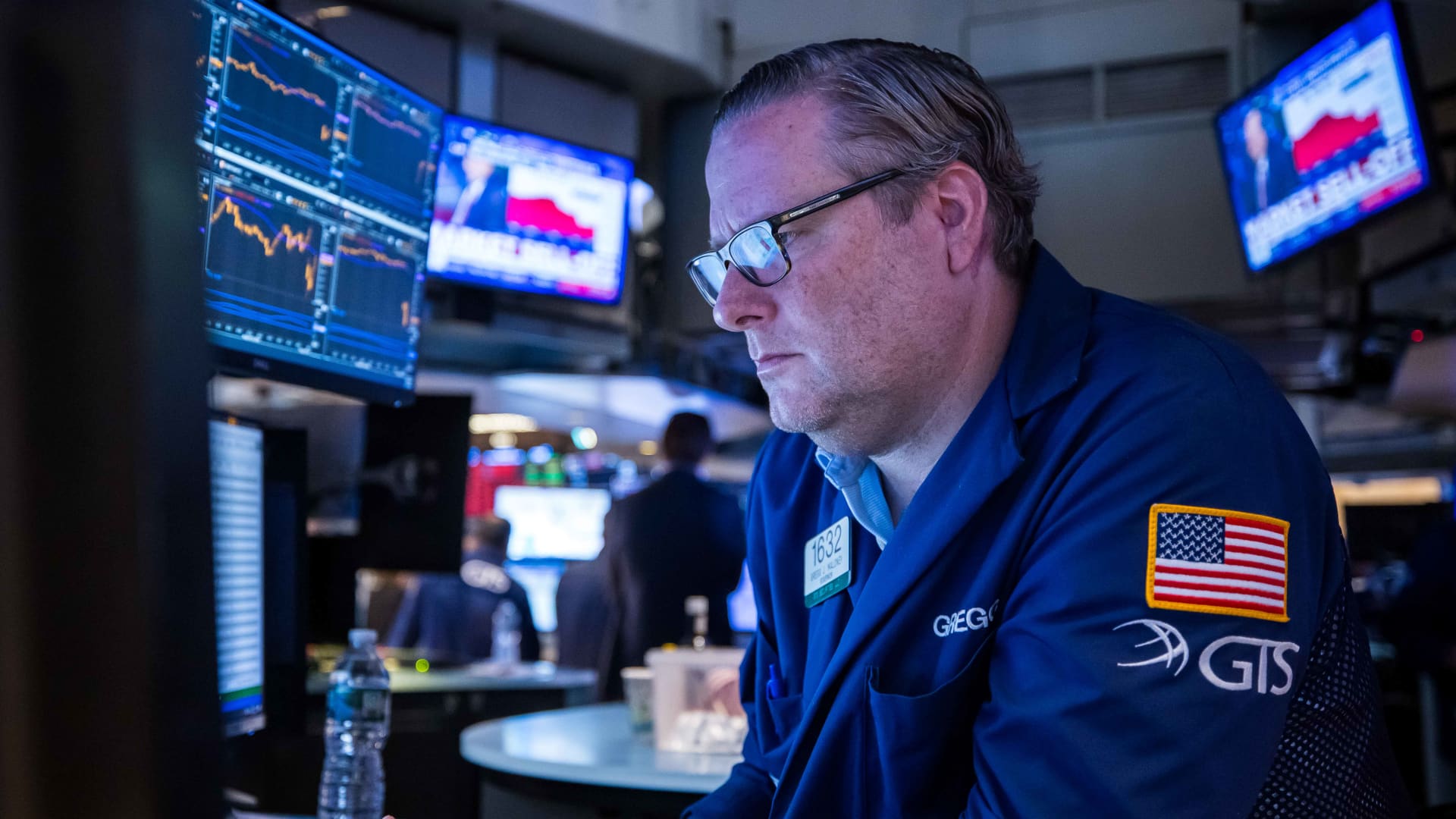
Stocks close in the red
Traders work on the floor at the New York Stock Exchange (NYSE) in New York City, U.S., Feb. 23, 2026.
Brendan Mcdermid | Reuters
The three leading U.S. indexes finished Monday’s session in negative territory.
The Dow Jones Industrial Average slid 821.91 points, or 1.66%, to close at 48,804.06. The S&P 500 dropped 1.04% to 6,837.75, while the Nasdaq Composite declined 1.13% to 22,627.27.
— Sean Conlon
Nvidia ahead of earnings has largest notional short interest position in S&P 500, researcher says
Nvidia heads into Wednesday’s fiscal fourth quarter earnings “in a multi-month [trading] range, while carrying the largest short [interest] notional exposure in the S&P 500” at $50 billion, according to S3 Partners, which monitors short interest positions and their effect on trading.
Short sellers hold a notional short position equal to 265 million shares, S3 said in a report out Monday. Nvidia has roughly 24.5 billion shares outstanding, giving it a market value of more than $4.6 trillion, the most of any company in the U.S., according to FactSet data.
“NVDA has the highest short exposure in the entire SPX in terms of dollars at risk,” S3 said, noting that the top 10 short positions in the S&P 500 total a notional $240 billion, or close to a quarter of the $1.1 trillion that’s short in the entire index.
For Nvidia, however, “short interest has risen in both shares and [percentage of] float, while price has remained range-bound, suggesting potential skepticism rather than stress,” S3 said. Jensen Huang’s AI chipmaker is not a “short squeeze candidate,” with short positions equal to just 1% of the Nvidia float, “and ample liquidity,” but the options market is still pricing in a one-day move higher or lower of 4% in the wake of Nvidia’s earnings due post-market Wednesday.


Nvidia is up 1% in a month and 2% year to date in 2026.
— Scott Schnipper
Trump’s new global tariffs ‘unlikely to have a meaningful impact on economic activity,’ Edward Jones’ Angelo Kourkafas says
Trucks carrying shipping containers wait in line at the port of Oakland following the Supreme Court’s ruling that Trump had exceeded his authority when he imposed tariffs, in Oakland, California, U.S., Feb. 23, 2026.
Carlos Barria | Reuters
President Donald Trump increasing global tariffs to 15% from 10% shouldn’t pose much of a threat to the economy, according to Angelo Kourkafas of Edward Jones.
“In our view, the newly announced 15% tariff rate is unlikely to have a meaningful impact on economic activity, and we expect tariff rates to remain elevated compared to history, even after the Section 122 tariffs expire as the administration pursues other avenues to implement tariffs,” the senior global investment strategist said.
“We advise investors not to overreact to headlines, and we reiterate our constructive outlook for global equity markets, supported by strong corporate profit growth and healthy economic activity,” he continued.
— Sean Conlon
Small-cap stocks feel brunt of market downturn
Small-cap stocks saw outsized losses amid Monday’s selloff.
The small cap-focused Russell 2000 slid nearly 2%. By comparison, the broad S&P 500 fell 1%.
Monday’s slide dragged the Russell 2000 slightly below its flatline for the month.
Russell 2000 vs. S&P 500, 1-day
— Alex Harring
Stocks making midday moves: KKR, CrowdStrike, International Paper
‘Halftime Report’ traders disagree on whether to buy Microsoft’s dip
Microsoft Corp. signage in New York on Oct. 25, 2024.
Jeenah Moon | Bloomberg | Getty Images
Microsoft’s shares are attractive after the technology stock’s recent drop, according to Jim Lebenthal, chief market strategist at Cerity Partners.
Lebenthal pointed out that the stock trades at a low-20s multiple following its nearly 20% slide this year. However, Lebenthal said he wasn’t sure if the stock could fall further.
“Now, the price has gotten to a point where I am willing to pull the trigger again,” Lebenthal said on CNBC’s “Halftime Report” on Monday. “What I’m seeing here is a great company on sale at a great price.”
Lebenthal acknowledged concerns about the company’s spending on artificial intelligence infrastructure. But he said Microsoft has strong profit in its Azure business and is in a net cash position.
On the other hand, Joseph Terranova, senior managing director at Virtus Investment Partners, said investors should stay on the sidelines.
“I think you have to wait on Microsoft,” Terranova said. “It’s part of the entire software universe that’s under pressure right now.”
— Alex Harring
Defensives lead the market
Defensive parts of the S&P 500 outperformed Monday, even with the overall index selling off.
Consumer staples were the leading sector in the S&P 500, rallying 1.3% in early afternoon trading. Indeed, five of the 11 sectors in the broad market index were in positive territory. The other sectors in addition to staples were health care, energy, utilities and real estate.
Financials were the biggest laggard in the S&P 500, down nearly 3%. Consumer discretionary and information technology, two sectors that typically outperform in a more risk-on environment, dropped 2.5% and 0.7%, respectively.
In total, there were 336 decliners in the index.
— Sarah Min
Democrats unveil legislation to force tariff refunds
A group of Senate Democrats released legislation on Monday that would mandate refunds of tariffs paid under President Donald Trump‘s higher duties that the Supreme Court struck down on Friday.
The legislation, led by Sen. Ron Wyden of Oregon, Jeanne Shaheen of New Hampshire and Ed Markey of Massachusetts, follows the Supreme Court’s momentous 6-3 decision on Friday ruling against a majority of Trump’s tariffs.
“Trump’s illegal tax scheme has already done lasting damage to American families, small businesses and manufacturers who have been hammered by wave after wave of new Trump tariffs,” Wyden, the top Democrat on the Senate Finance Committee, said in a statement. Read more.
— Justin Papp
Cybersecurity stocks get hit again
Jonathan Raa | Nurphoto | Getty Images
Following a Friday sell-off, major cybersecurity names were lower on Monday as investor fears over AI disrupting the sector continued to weigh on the stocks.
The Global X Cybersecurity ETF fell more than 4% in midday trading Monday, after tumbling nearly 5% Friday, hitting its lowest level since November 2023. Zscaler hit a new 52-week low as it declined more than 9%, while Sailpoint declined nearly 7%. CrowdStrike sank more than 9%, with its two-day decline totaling more than 16%.
Despite the panic from investors, Bank of America analyst Madeline Brooks in a Monday note stated she disagrees with the narrative AI will upend cybersecurity companies’ business models.
“We think that AI could improve efficiency in specific workflows, particularly code scanning, but does not now have the visibility, control, or reliability to replace end-to-end security platforms,” Brooks wrote.
BUG year-to-date chart.
— Davis Giangiulio & Gina Francolla
Software ETF hits new 52-week low
The software sell-off gained steam yet again on Monday, with the iShares Expanded Tech-Software Sector ETF hitting a new 52-week low.
As of morning trading on Monday, the ETF was sitting at 76.61, down more than 5% and lower than its post-Liberation Day level of 76.68 in April 2025. Software companies like Salesforce, Adobe and DocuSign also all hit new 52-week-lows, with shares of those names down between 4% and nearly 9%.
IGV year-to-date chart.
— Davis Giangiulio, Gina Francolla
Countries that want to ‘play games’ following Supreme Court tariff decision would face higher levies, Trump says
US President Donald Trump during a news conference in the James S. Brady Press Briefing Room of the White House in Washington, DC, US, on Friday, Feb. 20, 2026.
Annabelle Gordon | Bloomberg | Getty Images
President Donald Trump on Monday said that higher tariffs would be in store for countries that intend to “play games” in the wake of the Supreme Court striking down his sweeping tariff policy.
“Any Country that wants to ‘play games’ with the ridiculous supreme court decision, especially those that have ‘Ripped Off’ the U.S.A. for years, and even decades, will be met with a much higher Tariff, and worse, than that which they just recently agreed to,” the president wrote in a post on Truth Social. “BUYER BEWARE!!!”
— Sean Conlon
Stocks fall to start the week
Stocks kicked off Monday’s session with losses.
The Dow Jones Industrial Average dropped 94 points, or 0.2%. The S&P 500 and Nasdaq Composite traded just below the flatline as well.
— Sean Conlon
Arcellx, Novo Nordisk, Domino’s Pizza among the stocks making premarket moves
Check out the companies making headlines before the bell:
- Arcellx — The biotech stock surged 78% after Gilead Sciences said Monday it agreed to acquire Arcellx for $7.8 billion, offering $115 per share in cash at closing and one contingent value right of $5 per share. Arcellx focuses on immunotherapies for patients with cancer and others with incurable diseases. The deal is expected to close in the second quarter.
- Novo Nordisk, Eli Lilly — Novo Nordisk sank 14% after its weight-loss drug CagriSema failed to match Eli Lilly’s in a recent trial. Eli Lilly shares rose nearly 3%.
- Domino’s Pizza — The pizza chain gained 4% after U.S. sales for the fourth quarter grew 3.7%, topping a FactSet consensus estimate of 3.1%. Overall revenue for Q4 also beat expectations, coming in at $1.54 billion versus the $1.52 billion estimate.
Read the full list.
— Liz Napolitano
Novo Nordisk tumbles on weight-loss drug trial, Eli Lilly rises
U.S-listed Shares of Novo Nordisk sank 14% in premarket trading after the pharma company’s next-generation weight-loss drug, CagriSema, didn’t meet its key goal of demonstrating non-inferiority to Eli Lilly‘s rival drug tirzepatide.
Tirzepatide is the active ingredient in Eli LIly’s blockbusters Mounjaro and Zepbound.
Patients saw a weight loss of 23% after taking a 2.4 mg dose of CagriSema for 84 weeks. In comparison, patients achieved a weight loss of 25.5% with a 15 mg dose of tirzepatide, Novo Nordisk said.
Eli Lilly’s stock moved 3% higher before the bell.
— Michelle Fox, Elsa Ohlen
After dissenting on pause in rate cuts, Waller noncommittal about policy future
Federal Reserve Governor Christopher Waller speaks during The Clearing House Annual Conference in New York City, U.S. November 12, 2024.
Brendan McDermid | Reuters
Federal Reserve Governor Christopher Waller on Monday was noncommittal on where he would like to see interest rates go next, saying he will be weighing better-than-expected labor market data against inflation indicators that he expects to ease through the year.
After dissenting against the Fed’s latest decision in January to pause its rate-cutting cycle, Waller said the jobs data is painting a mixed picture. While he noted that nonfarm payrolls for the month were higher than forecast, he said the report may be “more noise than signal” based on other indicators showing tepid or flat job gains.
Consequently, Waller said in a speech that he will continue to watch incoming data before the Fed meets again in March to render its next rate call. He said it’s possible the January jobs report may just be a blip as part of a trend that saw few if any jobs created in 2025, or a signal that a rebound is coming.
“There are enough asterisks around the January data that I will need to see the February report due March 6 before forming any judgment on whether there has been a rebound in the labor market,” he said. “As we get more data, I will be able to decipher which of these cases we are in and can then be more deliberate in my decision on the appropriate setting of policy.”
One issue he said likely won’t have much impact is Friday’s Supreme Court decision to void President Donald Trump’s “emergency” tariffs. Waller has long said he thinks any inflationary impact from the tariffs will be short-lived and thus not a factor on his policy view.
Waller spoke in Washington, D.C. at the National Association for Business Economics.
— Jeff Cox
Europe calls for ‘full clarity’ from the U.S. after Trump’s latest tariff move
European Commission President Ursula von der Leyen attends a press conference on the day of the European Union leaders’ summit in Brussels, Belgium Oct. 23, 2025.
Yves Herman | Reuters
Trade deals made between the U.S. and Europe could be at risk following President Donald Trump’s move over the weekend to increase the global tariff rate to 15%.
In a statement published Saturday, European officials sought further clarity from Washington and stressed that trade commitments made between the European Union and the U.S. should be respected.
“The European Commission requests full clarity on the steps the United States intends to take following the recent Supreme Court ruling on the International Emergency Economic Powers Act (IEEPA),” the Commission said in the statement. “The current situation is not conducive to delivering ‘fair, balanced, and mutually beneficial’ transatlantic trade and investment, as agreed to by both sides and spelled out in the EU-U.S. Joint Statement of August 2025.”
— Sean Conlon, Holly Ellyatt
CNBC Pro: Is the ‘Magnificent Seven’ trade over?
Jakub Porzycki | Nurphoto | Getty Images
The “Magnificent Seven” that propelled the broader market to record heights in recent years has been flipped on its head this year.
All but two stocks in the group are in the red to start 2026, with Microsoft down nearly 18% and Tesla and Amazon each shedding more than 8%. Google-parent Alphabet, crowned one of the leading artificial intelligence winners of 2025, is roughly flat while chipmaking darling Nvidia is up just 1% this year. The Roundhill Magnificent Seven ETF (MAGS) is down nearly 6% year to date.
The declines come amid a flurry of concerns about these companies’ soaring capital expenditures on artificial intelligence — and their ability to meet increasingly high earnings growth expectations. Rapidly improving AI models and ramping industry competition are also adding volatility.
CNBC Pro subscribers can read the full story here.
— Pia Singh
Trump to hike global tariffs to 15% from 10%
U.S. President Donald Trump speaks during a press briefing at the White House on February 20, 2026 in Washington, DC.
China News Service | Getty Images
President Donald Trump on Saturday said he would increase global tariffs to 15% from 10%, one day after the Supreme Court struck down a broad swath of the president’s trade agenda.
In a Truth Social post, Trump said the new tariffs will be “effective immediately.” He also warned that additional levies would follow.
“I, as President of the United States of America, will be, effective immediately, raising the 10% Worldwide Tariff on Countries, many of which have been “ripping” the U.S. off for decades, without retribution (until I came along!), to the fully allowed, and legally tested, 15% level,” he wrote.
“During the next short number of months, the Trump Administration will determine and issue the new and legally permissible Tariffs,” he added.
— Sarah Min
Stock futures open little changed
U.S. stock futures opened little changed on Sunday night.
Dow Jones Industrial Average futures fell by 19 points, or 0.04%. S&P 500 futures and Nasdaq 100 futures dipped 0.07% and 0.14%, respectively.
— Sarah Min